I was about a month old when Kelly Hrudey started playing as a rookie for the WHL's Medecine Hat Tigers, a season in which he'd appear in 57 games for the team that went 15-50-7, which explains why his goals-against average was 6.17; he brought it down to 4.17 the following season, posting a winning record (25-23-4) and convincing the New York Islanders to select him in the second round (38th overall) at the 1980 draft.
The following season, he was named to the WHL's Second All-Star Team after bring his GAA down to 3.97 and keeping an .895 save percentage, on his way to the professional ranks; he spent four seasons with the Central Hockey League's Indianapolis Checkers where he would hone his game to besome an eventual NHL starter in lieu of Isles star Billy Smith, winning the league's Best Goalie ("Terry Sawchuk") trophy twice, earning First Team All-Star status twice, winning the playoff MVP for the 1981-82 season and regular-season MVP the next year.
He split the 1983-84 season between the CHL and NHL and got to the Big Show full time in 1984-85, playing 41 games to Smith's 37 and Roland Melanson's 8, on an Isles team that iced no fewer than three 100-point players: Mike Bossy (58 goals, 117 points), Brent Sutter (42 goals, 102 points) and John Tonelli (42 goals, 100 points).
He would appear in more and more games each year, cementing his position as the #1 goalie up until and including the 1988-89 season, where he was a trade deadline after appearing in 50 games to the Isles, and sent to the Los Angeles Kings where he would appear in another 19 and be a fixture for eight years, culminating in a 1993 Stanley Cup Final appearance.
He would finish his career by spending two seasons with the San Jose Sharks alongside two other veterans - Ed Belfour and Mike Vernon - before retiring to Calgary and joining the Hockey Night In Canada/Sportsnet analysis teams for Calgary Flames games but also the national telecasts.
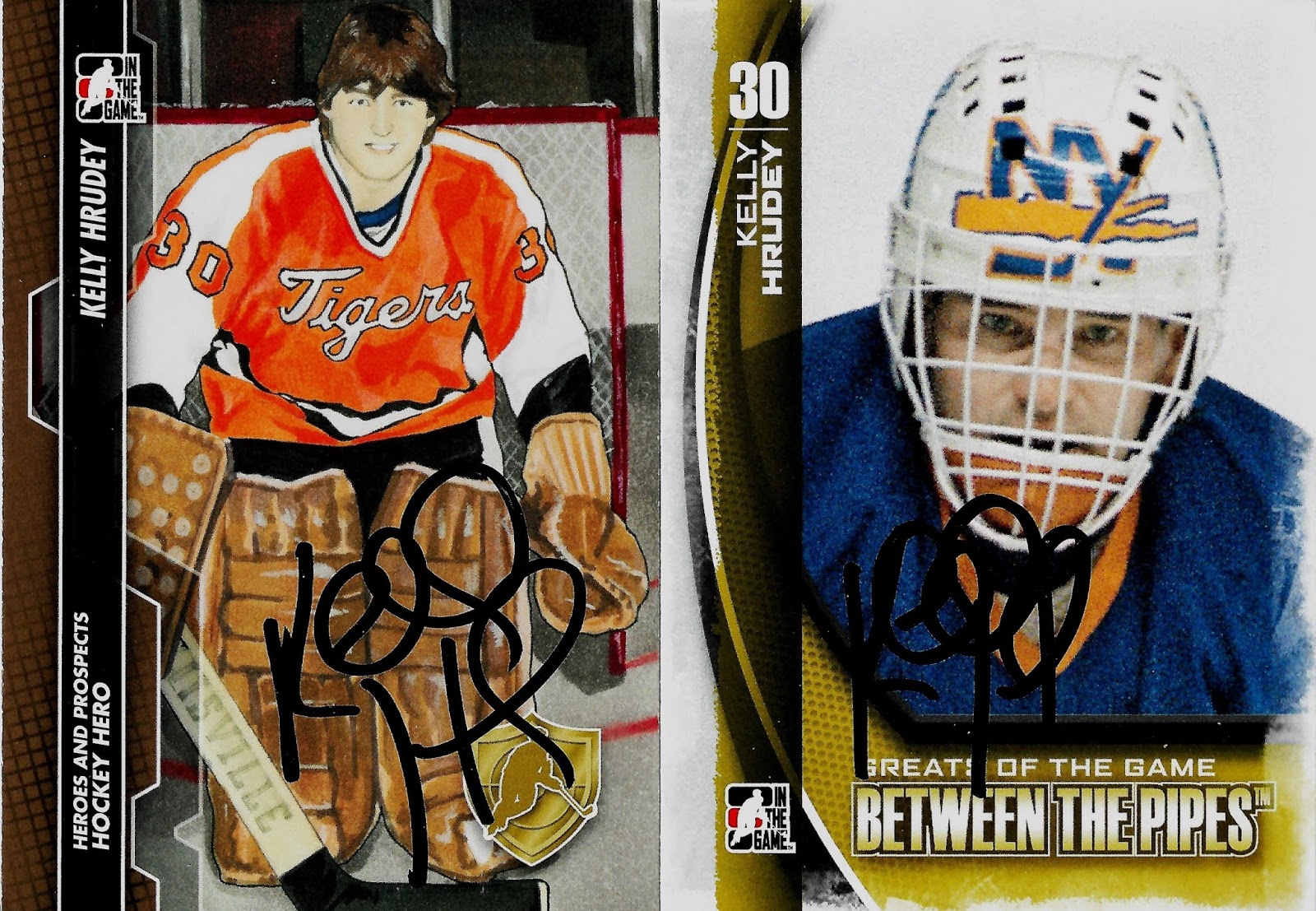
But today I want to focus on the earlier part of his career. This is an artist's rendering of what he looked like wearing the Tigers' Philadelphia Flyers-inspired uniform, on card #138 from In The Game's 2013-14 Heroes And Prospects set and Hockey Hero sub-set:
And this is him wearing his classic Jofa helmet-and-grid with the Islanders' blue (then-away) uniform, on card #123 from ITG's 2013-14 Between The Pipes set and Greats Of The Game sub-set:
That was his look when he set a record that would last 33 years, that of making 73 saves in a single playoff game - the seven-period "1987 Easter Epic", which stood until hours ago when Joonas Korpisalo of the Columbus Blue Jackets stopped 85 Tampa Bay Lightning shots in a bitter eight-period Game 1 loss.
And Hrudey took it well, as you can see here:
He seems humble, genuine and nice, which is the same feeling I had when I received those cards from him in the mail a few years back. I had written him a fan letter and joined those cards care of HNIC and they came back in roughly eight months. He signed them in black sharpie.
He's also been an advocate for mental health for a few years now, and even more so during the pandemic.
Showing posts with label Hockey Hero. Show all posts
Tuesday, August 11, 2020
Sunday, March 1, 2015
Henri Richard Autographed Card
Guess whose birthday it almost is today? Henri Richard, the ''Pocket Rocket'' Hall Of Famer was born on February 29th, 1936, so while he's lived for 79 years so far, his actual birth date fell on a Leap Year and has only come 19 times.
But the Pocket Rocket was always one for abnormal numbers: his 11 Stanley Cups in 20 years playing for the Montréal Canadiens is an average not likely to be repeated any time soon; he broke into the NHL at age 19 in 1955-56, playing on a line with his older brother and legendary Hall Of Famer in his own right Maurice 'Rocket' Richard (the first man to score 50 goals in a season and 500 in an NHL career) and Dickie Moore, another HOFer himself. All three have their jersey numbers retired by the Habs, as well.
The year of his fifth birthday, he won his first Cup; four years later, on his sixth birthday, he won his fifth. His brother wore jersey #9, Henri played in nine All-Star Games.
He managed to captain the Habs for four seasons, following reigns by other HOFers such as Émile 'Butch' Bouchard, the Rocket, Doug Harvey and Jean Béliveau. And while he was often compared to his sibling, his actual playing style was less of the rugged, tough, I'll-show-you variety and more along the lines of Dave Keon and Stan Mikita, or David Desharnais and Johnny Gaudreau nowadays: small, speedy, shifty and slick. Another difference between the brothers is that Maurice was a goal scorer while Henri was a better passer, twice leading the league in assists. And as bizarre as that sounds, Henri reached the 1000-point mark while Maurice did not (his regular season totals end at 965, while he posted another 126 in 133 playoff games).
I have met Henri Richard many times in my life. I was often in environments which facilitated meeting former players, particularly those like him who do so much for the community and associate themselves with events for youth teams. My mom also reminded me of a funny/sad moment when I saw her last Christmas, about when my grandfather died in 1989 when I was a pre-teen; he'd been a journalist and newspaper editor in the 1950s, 60s and 70s, and Mr. Richard came to the funeral - as many other former Habs did. And as he left us after wishing his condolences, apparently I turned to my mom wondering if I should have asked for his autograph, and she told me I'd have plenty of other opportunities later where the circumstances would lend themselves more to it.
And I did. She says she still has a box with things I had signed from my childhood, stored somewhere in her house, I'll have to look for that some day, but for now, here's a 2011-12 Heroes And Prospects card (#3 of the Hockey Hero sub-set) from In The Game, signed in thin blue sharpie at a team event two summers ago:
His uniform number (16) is tagged at the end, and his youthful head shot is a nice change from the previous cards of him I'd featured, more from the twilight of his terrific career.
But the Pocket Rocket was always one for abnormal numbers: his 11 Stanley Cups in 20 years playing for the Montréal Canadiens is an average not likely to be repeated any time soon; he broke into the NHL at age 19 in 1955-56, playing on a line with his older brother and legendary Hall Of Famer in his own right Maurice 'Rocket' Richard (the first man to score 50 goals in a season and 500 in an NHL career) and Dickie Moore, another HOFer himself. All three have their jersey numbers retired by the Habs, as well.
The year of his fifth birthday, he won his first Cup; four years later, on his sixth birthday, he won his fifth. His brother wore jersey #9, Henri played in nine All-Star Games.
He managed to captain the Habs for four seasons, following reigns by other HOFers such as Émile 'Butch' Bouchard, the Rocket, Doug Harvey and Jean Béliveau. And while he was often compared to his sibling, his actual playing style was less of the rugged, tough, I'll-show-you variety and more along the lines of Dave Keon and Stan Mikita, or David Desharnais and Johnny Gaudreau nowadays: small, speedy, shifty and slick. Another difference between the brothers is that Maurice was a goal scorer while Henri was a better passer, twice leading the league in assists. And as bizarre as that sounds, Henri reached the 1000-point mark while Maurice did not (his regular season totals end at 965, while he posted another 126 in 133 playoff games).
I have met Henri Richard many times in my life. I was often in environments which facilitated meeting former players, particularly those like him who do so much for the community and associate themselves with events for youth teams. My mom also reminded me of a funny/sad moment when I saw her last Christmas, about when my grandfather died in 1989 when I was a pre-teen; he'd been a journalist and newspaper editor in the 1950s, 60s and 70s, and Mr. Richard came to the funeral - as many other former Habs did. And as he left us after wishing his condolences, apparently I turned to my mom wondering if I should have asked for his autograph, and she told me I'd have plenty of other opportunities later where the circumstances would lend themselves more to it.
And I did. She says she still has a box with things I had signed from my childhood, stored somewhere in her house, I'll have to look for that some day, but for now, here's a 2011-12 Heroes And Prospects card (#3 of the Hockey Hero sub-set) from In The Game, signed in thin blue sharpie at a team event two summers ago:
His uniform number (16) is tagged at the end, and his youthful head shot is a nice change from the previous cards of him I'd featured, more from the twilight of his terrific career.
Subscribe to:
Posts (Atom)


