Monday, September 14, 2020

2020-21 Upper Deck Hockey MVP Blaster Box Break

(team and product links go to sponsored Amazon products, player links go to related pages on my blog, news links go to source pages)


It's my birthday, and I'm lucky enough that next season's first set of hockey cards are already out despite the fact that the current season is still underway, so Covid-19 may be ruining the economy, but there is no stopping Upper Deck from shoving their 2020-21 MVP collection down our throats - and suckers like me falling for it.

Right off the bat, there seems to be too many colours - and way too many cold colours, too much blue on the packaging, and I'm not only referring to Auston Matthews of the Toronto Maple Leafs donning the box for some odd reason... didn't they technically miss the playoffs this year, and di he not fail to win hardware again? 

For the record, there were 105 cards in this box: 21 packs (20+1) of 5 cards each. The base cards look like this:

As usual for this set, the back shows the bare minimum: five years' worth of basic statistics (games played, goals, assists, points, +/-, penalty minutes and powerplay goals), plus career totals, birthday, birth place, height, weight and shot side. Oh, and how to pronounce their names, or a decent approximation to someone who isn't paying attention.

Some of the cards have the company information on the front of the card - that's because, as is customary with MVP, there are "pretend-inserts" of "puzzle back" cards, where a combination of 9 cards will make up a larger version of a regular-issue base cards, and these cards of Anze Kopitar, Max Pacioretty and Jacob Markstrom fall into that category:

As usual, there are the Silver Script inserts, represented here by Miro Heiskanen, Anthony Beauvillier and Mitch Marner:

I also pulled one Gold Script card, of Columbus Blue Jackets captain Nick Foligno:

There were a couple of Gold Script "Anniversary" cards of Sidney Crosby and Brent Burns, though:

One insert set that seemed new to me was the "Teal" (or "Green") variant, like this one of Artemi Panarin:

Even better were the four "Teal"/"Green" rookies, though, Kiefer Bellows, Nikolai Knyzhov, Keegan Kolesar and Jonas Johansson:

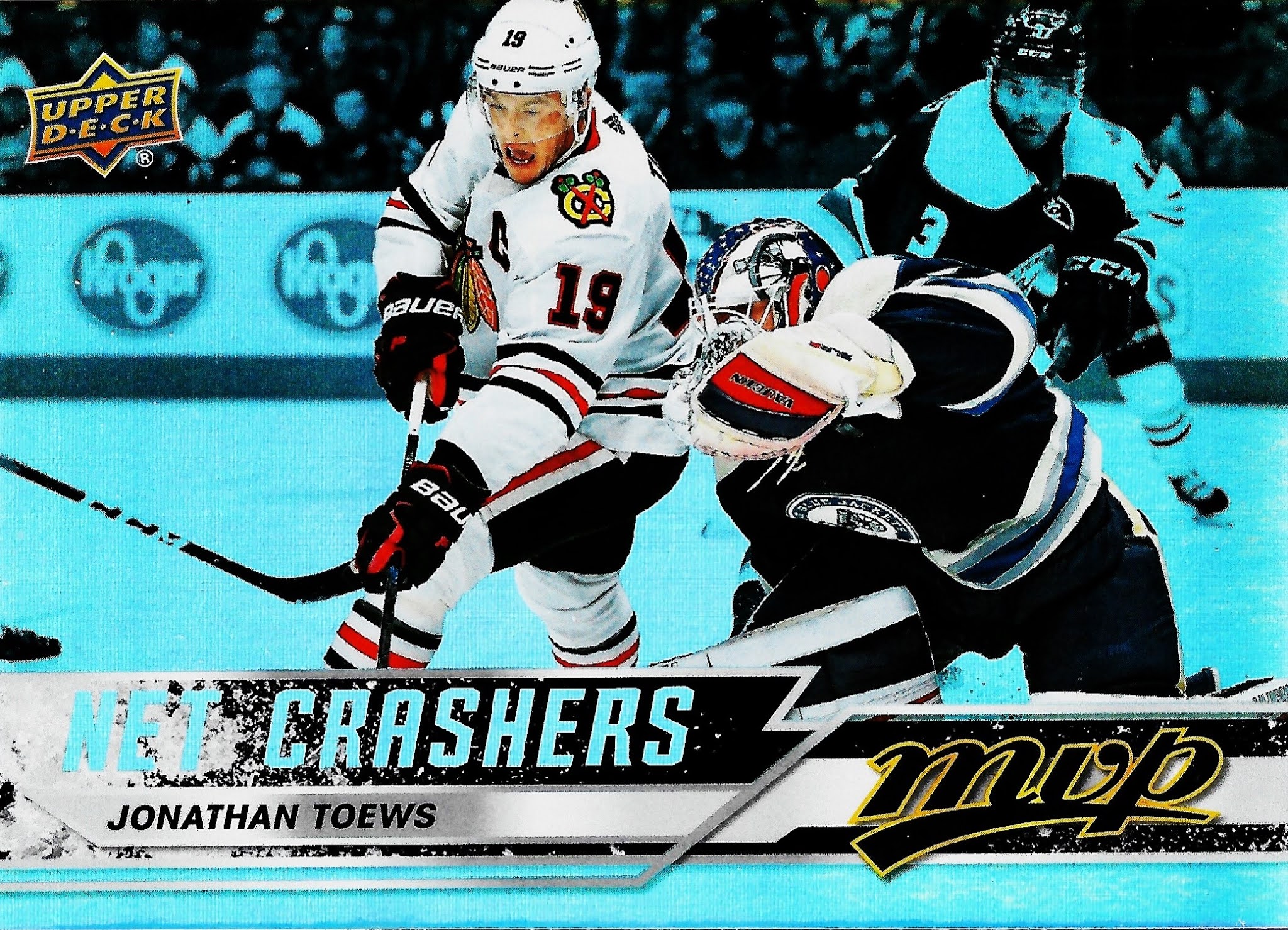
There were also your typical sub-sets, like this Net Crashers foil card of Jonathan Toews:

And another Crosby card, Mirror Mirror:

As usual, I like that it's an early set, even though it's less and less affordable as the years pass - I don't know that a kid with pocket change or a paper route can afford the $45 for 105 cards ($35 plus taxes) it costs to get in on roughly a third of a set - but for a teen, for a curious adult or an autograph seeker like myself, they do the trick.

The collation was good this year, fewer doubles than I recall from years past although they're going to start running out of ways to insert Alex Ovechkin, Crosby, Toews and the rest of last decade's stars at some point.

I give this one a decent 7/10.

Friday, September 11, 2020

Ryan Pulock Autographed Card

Even though he is technically playing a minute less than he was in last year's playoffs - 22:17 versus 23:17 per game - Ryan Pulock is the New York Islanders' most-used skater, roughly 30 seconds more than defensive partner Adam Pelech. And while the Isles are generally seen as the lone remaining postseason team without a Norris-level defenseman - compared to the Vegas Golden Knights' Shea Theodore, the Dallas Stars' Miro Heiskanen and the Tampa Bay Lightning's Victor Hedman, not to mention Ryan McDonagh and Mikhail Sergachev - Pulock's goal and 8 assists for 9 points in 18 games is definitely elite-level, but the fact that the Islanders are 7-1 when he gets on the score sheet is even more impressive.

In Barry Trotz' system, apparently, the "little things" that quiet and subtle players achieve on the ice get rewarded often enough that they show up as "actual tangible things", and when they do, they tend to matter.

I'm really enjoying this series between a team basically using a modernized version of "The Trap" and the other perhaps the most skilled team of the salary cap era, and while I like a lot of players wearing the NY logo - Pulock, Semyon Varlamov, Jean-Gabriel Pageau, Anthony Beauvillier, Mathew Barzal, Jordan Eberle, Derick Brassard, Nick Leddy, Johnny Boychuk, Thomas Hickey and Andrew Ladd - I'm also kind of glad to see the Bolts find ways to create offense and ensure we don't fall into another Dead Puck Era.

Here's a look at Pulock wearing the Isles' current/retro blue (now-home) uniform on card #182 from the 2018-19 O-Pee-Chee set from Upper Deck:
He signed it in blue sharpie last December.

Saturday, September 5, 2020

Lane Lambert Autographed Card

Lane Lambert was the 25th player taken in the 1983 NHL draft (Detroit Red Wings, second round), the second by the Wings after a chap named Steve Yzerman, who might be in the market for a head coach soon in his current position as Detroit's GM, although you would think Jon Cooper (should he get fired after failing to win the Stanley Cup with the Tampa Bay Lightning) and Gerard Gallant might be ahead of Lambert on his list.

First, though, here are the facts: Lambert was a checking right winger in his three seasons in Motor City, sometimes also taking face-offs, but the team was loaded at centre with the likes of Yzerman, Ron Duguay, and Kelly Kisio in or about to enter their prime, Dwight Foster occasionally getting reps down the middle, as well as veterans Ivan Boldirev and Darryl Sittler who were in the twilight of their respective careers. There was only John Ogrodnick and Danny Gare ahead of him on the wing. He started off with seasons of 35 and 25 points (and well over 100 penalty minutes), but when his production dipped drastically 1985-86, he was sent to the AHL Adirondack Red Wings to find his game - which he did, with 16 goals, 25 assists and41 points in 45 games.

That was enough for the New York Rangers to add him to the trade that brought them Kisio, Jim Leavins and a fifth round pick for goalie Glen Hanlon and two third-rounders. However, after only suiting up for 18 NHL games (2 goals, 2 assists, 4 points and 33 penalty minutes) and 11 more with the AHL's New Haven Nighthawks (3 goals, 3 assist, 6 points and 19 penalty minutes), he was sent packing to the Québec Nordiques, where he would have an immediate impact.

He closed out the 1986-87 season with 10 points (5 goals and 5 assists) in 15 games after the trade deadline and added another 6 points (2 goals and 4 assists) in 13 playoff games, helping the Nordiques dispose of the Hartford Whalers in 6 games in the opening round and falling to the reigning Cup Champion Montréal Canadiens in 7 games in Round 2, with Brian Hayward tending net for the bulk of the Habs' games in the series after Patrick Roy had taken care of the Boston Bruins in the opening round (both would split the Conference Finals against the Philadelphia Flyers, each outplayed by Ron Hextall).

Lamberts's first full season in Québec would also be a success, posting a career-high 40 points (13 goals, 27 assists), but the team was in disarray, missing the playoffs despite a coaching change from André Savard (with a 10-13-1 record) to Ron Lapointe (22-30-4) and having two 100-point players in Peter Stastny (46-65-111) and Michel Goulet (48-58-106).

It was the beginning of the last downfall for the Little Team That Could (And Did, Only In Denver). In 1988-89, the team finished last overall, tied in points with the New York Islanders, who had one more win, enabling Québec to draft Mats Sundin first overall; Owen Nolan and Eric Lindros would get the same treatment in the following two seasons.

For his part, Lambert only dressed for 13 NHL games that year (2 goals 2 assists, 4 points, 23 penalty minutes), but played a starring role with the AHL's Halifax Citadelles, where his 60 points (25 goals, 35 assists in 59 games) tied veteran defenseman Claude Julien 79-game total for third-best on the team, behind Ken Quinney (90 points in 72 games) and Max Middendorf (80 in 72).

In need of a new oportunity, he joined the Canadian National Team and opted to play in European leagues, playing for Germany's Düsseldorfer EG in 1989-90 and three teams in five seasons in the Swiss League (HC Ajoie, HC La Chaux-de-Fonds and SC Langnau), averaging more than two points per game.

He finally came back to North America to play for the IHL's Cleveland Lumberjacks and Houston Aeros for three years apiece, retiring after the 2000-01 season.

He started coaching in 2002-03, first as an assistant in the WHL for two seasons with the Moose Jaw Warriors, then two as head coach for the Prince George Cougars, one season as assistant with the AHL's Bridgeport Sound Tigers in 2005-06, followed by a steady climb through the Nashville Predators' organization, with one year as assistant coach followed by four as head coach with the AHL's Milwaukee Admirals, to being promoted as Barry Trotz' assistant in the NHL for three years, until the Preds didn't renew Trotz' contract.

He then followed Trotz to the Washington Capitals, culminating with the 2018 Cup victory, after which the duo along with goaltending guru Mitch Korn (who'd also been with Trotz since their Nashville days) went to the New York Islanders.

Which brings us to tonight's Round 2, game 7 win over the Flyers and the team's first Conference Final since 1993. Eventually, Lambert will get his shot at being the bench boss in the NHL, possibly even making a return to the Caps now that former fellow assistant Todd Reirden has now been fired after two early exits since Trotz' departure. I must say I would also probably put him ahead of current Predators head coach John Hynes in my list of best bets, but he just got the job, so chances are he'll get another season to cost his GM David Poile his job like he did his former boss in New Jersey.

Yes, Trotz is the best coach in the game, but some of the credit also goes to his assistants, and as Associate Coach, Lambert is first in that line. Well, second, after miracle worker Korn, who is to this generation of goalie experts what François Allaire was to those from 1986 to 2005 - head and shoulders above the rest.

Here is Lambert as I remember him most fondly, wearing the Nordiques' clasic blue (away) uniform, on card #224 from O-Pee-Chee's 1988-89 O-Pee-Chee set:
He signed it in blue sharpie earlier this season. This allows him to join Robbie Ftorek as #7 in my Nordiques Numbers Project.

My Nordiques Numbers Project: An Introduction

You're probably used to it by now, what with my Habs Numbers Project, my Oilers Numbers Project, my Sens Numbers Project, and my Canucks Numbers Project, but I decided long ago that I would also have one for my favourite team growing up, the Québec Nordiques.

As a reminder, the goal is to have an autographed card of a player representing each jersey number worn/used by the franchise. If I can't find an autographed card, autographed pictures, postcards or jersey cards can count.
Originally founded as a WHA team in in 1972, they joined the NHL with the New England/Hartford Whalers, the Oilers and the Winnipeg Jets when the WHA folded with the agreement that four teams would merge with the NHL, pending a transfer fee and the loss of their superstars whose rights belonged to existing NHL teams.

Because the franchised relocated to Denver to become the Colorado Avalanche in 1995, it's a tad harder to complete this set than my previous ones, because it gives me a limited number of years to access and fewer players having the chance to wear certain jersey numbers.

I'm starting this project with the mindset of limiting myself to the 1972-1995 time period, ignoring the Avs part of the team's history - and also skipping over former teams based in the same city, such as the Stanley Cup-winning Québec Bulldogs.

Here's the list of those I have featured here thus far:

1. Ron Tugnutt and Richard Sévigny: check!
2. Sylvain Lefebvre: check!
4. Paul Baxter: check!
5. Réjean Houle and Brent Severyn: check!
6: Craig Wolanin: check!
7: Robbie Ftorek and Lane Lambert: check!
9: Réal Cloutier: check!
10. Guy Lafleur: check!
12. Chris Simon: check!
16. Michel Goulet once: (and twice) check!
18: Marian Stastny and Mike Hough: check!
19. Michel Dion (also wore 30): check!
21: Randy Moller: check!
22. Ron Sutter: check!
28: Tony Hrkac (also wore #40): check!
30. Michel Dion (also wore 19): check!
31. Stéphane Fiset: check!
32. Dale Hunter: check!
33. Mario Gosselin: check!
36: Adam Deadmarsh: check!
40: Tony Hrkac (also wore #28): check!
41: Doug Smail: check!
44: Mario Marois: check!
48. Scott Young: check!
49: Kip Miller: check!
51: Andrei Kovalenko: check!
55: René Corbet: check!
59: Dave Karpa: check!

That's 27 numbers. Some will be harder than others to acquire (Peter Stastny's 26 and Joe Sakic's/Owen Nolan's 88), but I'm actually fairly confident with this one. This and the Habs one, fittingly, should near completion before I get bored with having these projects!

Friday, September 4, 2020

Brayden McNabb Autographed Card

Despite the shot discrepancy, the two most obvious stars of Game 7 between the Vegas Golden Knights and Vancouver Canucks tonight were goalies Robin Lehner (second) and Thatcher Demko (first), who appears like the "real deal", the true next elite goaltender. But if I had to pick a third star, it wouldn't necessarily be Shea Theodore despite the game-winning goal and his title of "only man who can beat Demko"; no, I would probably go with Brayden McNabb instead, for his defensive play and display of courage by stopping two shots with his face and another one with his leg. He's a reason why the Canucks' shot count was so low.

When the Buffalo Sabres selected him in the 2009 draft (third round, 66th overall), he had just completed an impressive season with the Kootenay Ice that saw him provide upwards of half a point per game from the blue line but also accumulate 140 penalty minutes as a bruising presence in his own zone. He was expected to be an eventual solid second-pair defenseman who can replace on the top-two once in a while, and that's what they sold the Los Angeles Kings on in a 2014 deadline trade.

After all, he had been named the Ice's captain for his final year in the WHL and twice made the AHL All-Star Team while with the Sabres' farm team Rochester Americans. At the time of the trade, McNabb had 7 goals, 22 assists, 29 points and 45 penalty minutes with a +9 rating in just 38 AHL games, but he had suffered his first concussion while with Buffalo.

He spent three full seasons with the Kings, but health was a bit of an issue in 2016-17, as he only suited up in 49 games, although it was enough of a look for the Golden Knights, who selected him in that summer's expansion draft. He's been a steady presence ever since, perhaps a little less offensively-inclined than the Sabres had first hoped he would become, but an essential player nonetheless.

And he's still just 29 years old right now, so he does have the room to grow into two or three 25-to-30-point seasons, particularly if the team wants to continue playing a strong offensive game with three scoring lines.

Here he is wearing Kootenay's black (away) uniform, on card #122 from In The Game's 2009-10 Heroes And Prospects set:
He signed it in black sharpie during his time in the AHL (2011-2014). My hope is to get him to sign his Vegas Inaugural Set card for me in the future.