This will likely be the preface to all of this year's Season Preview posts: 2020 is a different beast and requires adaptability; in my case, it means the joint posts with my "main/personal" blog will not be in the "player here/analysis there" format but rather the entire scope of the analysis will take place here and the player will have some sort of direct connection to what's written. Caveats: at this point, despite the season being set to start in Mid-January, several impact players haven't found a team yet and quite a few teams are currently above the salary cap, which means there is much maneuvering left to do.
The New Jersey Devils (team links may bring forth referral money for me) started off with 6 losses, then in December proceeded to lose 10 of 12, leading to the justified and overdue firing of head coach John Hynes, who inexplicably found employment with the Nashville Predators afterwards. Rookie coach Alain Nasreddine was able to garner points in 26 out of the team's final 38 games, but that wasn't enough for GM Tom Fitzgerald, who instead went with Old Boys' Club lifetime member Lindy Ruff to lead the team in a shortened season with little to no real training camp and no pre-season games, which is a huge mistake in my book (and yet another example of a French Canadian getting the shaft uselessly). Playing it "safe" may cost him in the end.
What makes their odds look good:
Oh, boy. There are players who are doing an ok job in a first-line role when they could perhaps be better used on a second line instead (Nico Hischier at this point in his career and Kyle Palmieri), terrific prospects up-front in Nolan Foote (20 years old, 6'4" and 200 pounds, three years from an NHL job and five from his prime), Alexander Holtz (18, 6'1", pro-level shot, needs two or three years in Europe and to add weight), Dawson Mercer (19, dominating in Juniors, three or four years away) and Jack Hughes (19, never should have made the team last year). On defense, Ty Smith (20, best defenseman in the WHL, two years from NHL job, five from his prime) is a great cornerstone to build upon, and P.K. Subban, Damon Severson and Will Butcher can each play much better than they did last year. Mackenzie Blackwood has looked like the real deal, mostly, compared to Cory Schneider.
Question marks:
Well, technically, everything written above was true. But Subban and Butcher could also continue stagnating; Subban in particular seems at a loss when not playing for high stakes (then again, when the guy who acquires you pretty much loses his job over it, the best player on the team wants to leave, and the fanbase is hoping to tank for a high draft pick, it's probably hard to find motivation). Is Pavel Zacha's niche as a third-line center? There are active first-rounders who have thrived after finding a home in the middle of the lineup after aiming for more prime minutes, such as Lars Eller with the Washington Capitals, so it's not unheard of, but it's a far cry from calling him the steal of his draft year, as former GM Ray Shero did. Points given for enthusiasm, (more) points taken for failing to manage expectations.
Outlook:
I thought the team was trending up, I really did. Adding Ryan Murray and Dmitri Kulikov on defense solidifies the back end, Andreas Johnsson didn't cost anything and is a solid second-liner, and adding Corey Crawford to platoon with Blackwood looked like a great idea... until he retired earlier this morning, less than 24 hours after taking a leave of absence for personal reasons. He had yet to play a single minute, and it's still the team's biggest loss since Ilya Kovalchuk. I'll give him a proper send-off later this year.
Prediction:
Eighth in the East.
The Devils have three Stanley Cups (1994-95, 1999-2000, and 2002-03), which they won on the strength of playing the trap and a trio of unique defensemen: the speedy Scott Niedermayer, the punishing Scott Stevens, and the bruising Ken Daneyko. Stevens won the Conn Smythe Trophy in the 2000 Final, and opposing goalie Jean-Sébastien Giguère from the Mighty Ducks of Anaheim won it in 2003.
1995 was a different, special beast. It was a lockout-shortened season, for one, and the first since 1980 where a Canadian team didn't make it to a Conference Final: the most efficient playoff performer of all-time, Patrick Roy, missed the postseason cut for the only time of his career; the first seed in the East, the Québec Nordiques, were ousted in the first round by the defending champion New York Rangers, opting to play rookie Jocelyn Thibault in a high-pressure situation he perhaps wasn't ready for; the Philadelphia Flyers plowed through Dominik Hasek and his Buffalo Sabres before sweeping the Rangers, while the West saw multiple sweeps leading to the Cup Final, but the fast-skating Detroit Red Wings of Sergei Fedorov, Paul Coffey, Vyacheslav Kozlov and Nicklas Lidstrom were unable to get through the wall of D at the Devils' blue line, and a certain Claude Lemieux, who they would get to know much better in the next five years as a member of the Colorado Avalanche, led all playoff skaters with 13 goals, including a couple in the Final, one of them a game-winner.
This is what he looked like wearing the Devils' red (away) uniform:
That's card #258 from Upper Deck's 1995-96 Series 1 set and Mike Milbury's Scouting Report sub-set, because you really want "Mad" Mike Milbury's take on players... here's what he had to say about Lemieux:
I've been prone to hyperbole myself and, sure, a case can be made for Hall Of Fame consideration when it comes to Lemieux, but to deem him to have Hart Trophy potential in prime Jaromir Jagr, Mario Lemieux, Eric Lindros, Dominik Hasek, and Fedorov era, and even compared to his own Avs teammates the following year in Roy, Joe Sakic, and Peter Forsberg is, well, madness.
Showing posts with label New Jersey Devils. Show all posts
Saturday, January 9, 2021
Sunday, October 11, 2020
Taylor Hall Jersey Card
The most coveted forward in this off-season's free agency, Taylor Hall, will go through the process again next year, as he's agreed to a one-year deal worth $8M with the Buffalo Sabres.
You may recall him saying he was looking to win and that a large paycheque was not the top thing on his shopping list, that he was looking for stability...
While this move makes his previous comments seem a tad hypocritical, bear in mind that most contending teams are tight against the cap this year with a flat cap looming over GMs' heads for the next couple of seasons - and few of them were looking to make trades to make room to add salary, save perhaps for the Toronto Maple Leafs, who already have arguably three better forwards on their roster and instead need to find a way to keep pucks out of their own net at this point.
So instead, Hall is betting on himself, hoping he gets to line up with Jack Eichel, that neither of them gets injured, and that they can pad each other's statistics enough for Hall to force himself to an even greater payday next summer. If all the stars align, the Sabres can win it all in 2020-21, but that's going to take a near-miracle. Hall's semi-realistic hope is to crack the 100-point mark with Eichel to parlay his way onto a stacked team like the Tampa Bay Lightning, Washington Capitals, Boston Bruins, Vegas Golden Knights, St. Louis Blues, Winnipeg Jets, Colorado Avalanche or Vancouver Canucks.
I, for one, expect the market to remain essentially the same next time around, however, with GMs going for safe, reasonable bets.
Here is Hall wearing the New Jersey Devils' red (home) uniform, on card #24 from Upper Deck's 2017-18 Premier set, which I got in a trade last summer for a card of his wearing the Edmonton Oilers' blue uniform: It features a matching game-used piece of "memorabilia" (as per the back, the front specifies it's a jersey). The actual card has the foil at the bottom in pure silver, the scan rendered it beige.
You may recall him saying he was looking to win and that a large paycheque was not the top thing on his shopping list, that he was looking for stability...
While this move makes his previous comments seem a tad hypocritical, bear in mind that most contending teams are tight against the cap this year with a flat cap looming over GMs' heads for the next couple of seasons - and few of them were looking to make trades to make room to add salary, save perhaps for the Toronto Maple Leafs, who already have arguably three better forwards on their roster and instead need to find a way to keep pucks out of their own net at this point.
So instead, Hall is betting on himself, hoping he gets to line up with Jack Eichel, that neither of them gets injured, and that they can pad each other's statistics enough for Hall to force himself to an even greater payday next summer. If all the stars align, the Sabres can win it all in 2020-21, but that's going to take a near-miracle. Hall's semi-realistic hope is to crack the 100-point mark with Eichel to parlay his way onto a stacked team like the Tampa Bay Lightning, Washington Capitals, Boston Bruins, Vegas Golden Knights, St. Louis Blues, Winnipeg Jets, Colorado Avalanche or Vancouver Canucks.
I, for one, expect the market to remain essentially the same next time around, however, with GMs going for safe, reasonable bets.
Here is Hall wearing the New Jersey Devils' red (home) uniform, on card #24 from Upper Deck's 2017-18 Premier set, which I got in a trade last summer for a card of his wearing the Edmonton Oilers' blue uniform: It features a matching game-used piece of "memorabilia" (as per the back, the front specifies it's a jersey). The actual card has the foil at the bottom in pure silver, the scan rendered it beige.
Wednesday, September 18, 2019
Mike McKenna Autographed Card
(As per years past, this is a twin-post with my "regular" blog, where I predicted the New Jersey Devils would finish tied for fourth/fifth in the Metropolitan Division in 2019-20).
Granted, I do not have many Devils-themed collectibles, and I didn't want to feature a retired player who just spent a single season with them (well... a retired star player, anyway), but I did manage to find one player worth talking about, the journeyman of journeymen goaltenders, Mike McKenna.
You might recall McKenna if the 15 NHL organizations he passed through was the one you cheered for, of if you followed the ECHL after the season-long 2004-05 lockout, or if you read his wife's tweets explaining the hardships that come with being traded and/or claimed on waivers many times per season, or his bittersweet - mostly sweet - retirement announcement this summer.
He's played in Springfield (IL), Las Vegas, Norfolk, (Vegas again), Milwaukee, Omaha, Portland (ME), (Norfolk again), Tampa Bay, Lowell, Albany, New Jersey, Binghamton, Peoria, Springfield (MA), Columbus, (Portland again), Arizona (Portland again), (Springfield MA again), Syracuse, Texas (Austin), Dallas, Belleville, Ottawa, sat on the bench in Vancouver, was assigned to but didn't play in Utica, played in Philadelphia, and Lehigh Valley.
That last stretch was pretty insane: three different organizations in four days, six teams in the same week, when the Ottawa Senators re-assigned him to the Belleville Baby Sens, traded him to the Vancouver Canucks, who assigned him after two games backing up Jacob Markstrom to the Utica Comets, only to have the Philadelphia Flyers snatch him on waivers, have him play a game, then send him down to the Lehigh Valley Phantoms.
It was during his time in Ottawa that he signed card #51 from Panini's 2010-11 All Goalies set in blue sharpie, tagging his jersey number with the Devils (40) at the end:
That was one of his finest masks; in Philly, not taking any chances, he ust had an all-black one. In case.
I respect McKenna a lot. I believe had I continued playing after getting traded from Laval to Halifax in Juniors, I would have had the same kind of trajectory, probably without the ECHL and AHL All-Star titles he has, though.
Granted, I do not have many Devils-themed collectibles, and I didn't want to feature a retired player who just spent a single season with them (well... a retired star player, anyway), but I did manage to find one player worth talking about, the journeyman of journeymen goaltenders, Mike McKenna.
You might recall McKenna if the 15 NHL organizations he passed through was the one you cheered for, of if you followed the ECHL after the season-long 2004-05 lockout, or if you read his wife's tweets explaining the hardships that come with being traded and/or claimed on waivers many times per season, or his bittersweet - mostly sweet - retirement announcement this summer.
He's played in Springfield (IL), Las Vegas, Norfolk, (Vegas again), Milwaukee, Omaha, Portland (ME), (Norfolk again), Tampa Bay, Lowell, Albany, New Jersey, Binghamton, Peoria, Springfield (MA), Columbus, (Portland again), Arizona (Portland again), (Springfield MA again), Syracuse, Texas (Austin), Dallas, Belleville, Ottawa, sat on the bench in Vancouver, was assigned to but didn't play in Utica, played in Philadelphia, and Lehigh Valley.
That last stretch was pretty insane: three different organizations in four days, six teams in the same week, when the Ottawa Senators re-assigned him to the Belleville Baby Sens, traded him to the Vancouver Canucks, who assigned him after two games backing up Jacob Markstrom to the Utica Comets, only to have the Philadelphia Flyers snatch him on waivers, have him play a game, then send him down to the Lehigh Valley Phantoms.
It was during his time in Ottawa that he signed card #51 from Panini's 2010-11 All Goalies set in blue sharpie, tagging his jersey number with the Devils (40) at the end:
That was one of his finest masks; in Philly, not taking any chances, he ust had an all-black one. In case.
I respect McKenna a lot. I believe had I continued playing after getting traded from Laval to Halifax in Juniors, I would have had the same kind of trajectory, probably without the ECHL and AHL All-Star titles he has, though.
Wednesday, May 15, 2019
Sean Burke Autographed Card
I think I'll be saying this until I retire, but the Edmonton Oilers missed the boat when they chose Ken Holland as their next GM last week, choosing another proven salary cap era mismanager instead of new blood like Sean Burke.
Learning the ropes as an exec with the Phoenix Coyotes, Arizona Coyotes and Montréal Canadiens, Burke also plied his trade as GM of Team Canada at several World Championships and the 2018 Olympics - the one where he scoured the globe trying to put together the best possible team of non-NHLers to try to stop the KHL-playing Russians from winning gold.
The five-time IIHF medalist as a player managed to build a roster that won bronze (better than Finland, Sweden, the United States, Slovakia and the Czech Republic), so one can objectively say he did a fairly decent job.
Former goalies are showing they have an eye for talent and management, as the likes of Burke, Ron Hextall (rebuilding the Philadelphia Flyers post-Paul Holmgren), Holland (three Stanley Cups in the pre-cap era) and, to a lesser extent, Patrick Roy (Memorial Cup) and Garth Snow (rebuilding the New York Islanders post-Mike Milbury) have all shown to be able to build decent rosters pretty much from scratch.
I know if I owned a team in, say, Seattle, I'd take a serious look at him to build my team.
As many of you know, Burke was impactful to me as a young goalie in the late 1980s. His exploits with the Canadian National Team and the New Jersey Devils set an example that many Canadian goalies wanted to follow. Sure, Roy was the reason I donned the pads in the first place, but the fact that even in Montréal he was seen as an unattainable God-like figure meant a guy like Burke - who participated in CHL/Team Canada clinics and moved around a lot by changing teams often - was more present, in a way.
And he showed that one didn't have to be a record-setting Conn Smythe winner to be an All-Star and a Hart and Vezina candidate. These days, my favourite goalies are Jaroslav Halak, Ben Bishop, Corey Crawford and Marc-André Fleury, but in the 1980s and 1990s, it was Roy, Burke and, a peg below, Stéphane Fiset. No one else came close.
Here is the 6'4" Burke in the uniform that, to me, best represents the first third of his nearly 20-year career, the Devils' red-and-green classic, on card #66 from Upper Deck's 1990-91 Series 1 set:
He signed it in blue sharpie in one of his few trips to Montréal in the past couple of years.
Learning the ropes as an exec with the Phoenix Coyotes, Arizona Coyotes and Montréal Canadiens, Burke also plied his trade as GM of Team Canada at several World Championships and the 2018 Olympics - the one where he scoured the globe trying to put together the best possible team of non-NHLers to try to stop the KHL-playing Russians from winning gold.
The five-time IIHF medalist as a player managed to build a roster that won bronze (better than Finland, Sweden, the United States, Slovakia and the Czech Republic), so one can objectively say he did a fairly decent job.
Former goalies are showing they have an eye for talent and management, as the likes of Burke, Ron Hextall (rebuilding the Philadelphia Flyers post-Paul Holmgren), Holland (three Stanley Cups in the pre-cap era) and, to a lesser extent, Patrick Roy (Memorial Cup) and Garth Snow (rebuilding the New York Islanders post-Mike Milbury) have all shown to be able to build decent rosters pretty much from scratch.
I know if I owned a team in, say, Seattle, I'd take a serious look at him to build my team.
As many of you know, Burke was impactful to me as a young goalie in the late 1980s. His exploits with the Canadian National Team and the New Jersey Devils set an example that many Canadian goalies wanted to follow. Sure, Roy was the reason I donned the pads in the first place, but the fact that even in Montréal he was seen as an unattainable God-like figure meant a guy like Burke - who participated in CHL/Team Canada clinics and moved around a lot by changing teams often - was more present, in a way.
And he showed that one didn't have to be a record-setting Conn Smythe winner to be an All-Star and a Hart and Vezina candidate. These days, my favourite goalies are Jaroslav Halak, Ben Bishop, Corey Crawford and Marc-André Fleury, but in the 1980s and 1990s, it was Roy, Burke and, a peg below, Stéphane Fiset. No one else came close.
Here is the 6'4" Burke in the uniform that, to me, best represents the first third of his nearly 20-year career, the Devils' red-and-green classic, on card #66 from Upper Deck's 1990-91 Series 1 set:
He signed it in blue sharpie in one of his few trips to Montréal in the past couple of years.
Friday, September 1, 2017
Patrik Elias Autographed Card
Greetings!
What I'll be trying to do this September is feature one player per NHL team on this blog while conducting a preview for that team on my "General/Opinion/Personal" blog, culminating in my predictions for final ranking, Stanley Cup winner and finalist, and all major individual trophy winners.
I thought I'd start out with the New Jersey Devils today (preview here), with a nod to Patrik Elias, who was forced to retire due to knee problems at age 41 earlier this spring; the team has announced they will retire his #26 in February.
He finishes his career with 408 goals, 617 assists and 1025 points in 1240 regular-season games on a tremendously defensive-minded Devils team who played the trap better than anyone else before or since. He captained the team for one year and won two Stanley Cups in 19 seasons with the organization. His playoff numbers aren't too shabby either, with 45 goals, 80 assists and 125 points in 162 games - including 20 points in 23 games and 23 in 25 in consecutive postseasons in 1999-2000 and 2000-01.
He was at close to a point-per-game pace (or better) for 12 of 14 seasons between 1998-99 and 2013-14, with a peak of 40 goals, 56 assists and 96 points in 2000-01.
He also won bronze medals with the Czech Team at the 1994 European World Juniors, the 1998 and 2011 World Championships, and the 2006 Olympics.
I personally think he falls short of a Hall Of Fame nod, but I do agree the Devils need to retire his number, because he was the best long-tenured forward in team history. Some teams are meant to have lower standards than others for such ceremonies... and New Jersey certainly doesn't have as rich a history as, say, the Montréal Canadiens, Detroit Red Wings or Boston Bruins.
I've been sitting on this card for precisely this day:
It's #144 from Upper Deck's 2008-09 Collector's Choice set. He signed it in blue sharpie, and it shows his wearing the Devils' red (now-home) uniform.
What I'll be trying to do this September is feature one player per NHL team on this blog while conducting a preview for that team on my "General/Opinion/Personal" blog, culminating in my predictions for final ranking, Stanley Cup winner and finalist, and all major individual trophy winners.
I thought I'd start out with the New Jersey Devils today (preview here), with a nod to Patrik Elias, who was forced to retire due to knee problems at age 41 earlier this spring; the team has announced they will retire his #26 in February.
He finishes his career with 408 goals, 617 assists and 1025 points in 1240 regular-season games on a tremendously defensive-minded Devils team who played the trap better than anyone else before or since. He captained the team for one year and won two Stanley Cups in 19 seasons with the organization. His playoff numbers aren't too shabby either, with 45 goals, 80 assists and 125 points in 162 games - including 20 points in 23 games and 23 in 25 in consecutive postseasons in 1999-2000 and 2000-01.
He was at close to a point-per-game pace (or better) for 12 of 14 seasons between 1998-99 and 2013-14, with a peak of 40 goals, 56 assists and 96 points in 2000-01.
He also won bronze medals with the Czech Team at the 1994 European World Juniors, the 1998 and 2011 World Championships, and the 2006 Olympics.
I personally think he falls short of a Hall Of Fame nod, but I do agree the Devils need to retire his number, because he was the best long-tenured forward in team history. Some teams are meant to have lower standards than others for such ceremonies... and New Jersey certainly doesn't have as rich a history as, say, the Montréal Canadiens, Detroit Red Wings or Boston Bruins.
I've been sitting on this card for precisely this day:
It's #144 from Upper Deck's 2008-09 Collector's Choice set. He signed it in blue sharpie, and it shows his wearing the Devils' red (now-home) uniform.
Sunday, June 11, 2017
Craig Billington Autograph Card
After featuring Craig Billington with the Boston Bruins and Colorado Avalanche, perhaps it's time I revisited his first NHL trade, one that sent him from the New Jersey Devils to the Ottawa Senators, with card #A-CB from In The Game's 2012-13 Decades - The 1990s set:
Notice the Devil's horns helmet but black jersey, which is the original Sens away uniform.
At first, Billington was highly regarded as a potential #1 goalie, which is why the Devils drafted him in the second round (23rd overall) in 1984, but by the time he finished his career in Juniors (two more seasons in the OHL) and finished developing with the AHL's Utica Devils, making it to the NHL in 1991-92 after spending all of the previous season with the Canadian National Team, the Devils were had already drafted Martin Brodeur, so they no longer had a need for Billington or Chris Terreri - although it should be noted that the latter eventually turned into Brodeur's backup and retired to become his goaltending coach.
Yet, because every team needs to be represented at All-Star Games and the 1992-93 Devils were so awful, Billington was the representative that was sent to Montréal for the mid-season classic, where he joined the Senators' own rubber magnet, Peter Sidorkiewicz.
That first-year Sens teams were god-awful, finishing with a 10-70-4 record, and its leading scorer was a defenseman, and not a household name either: Norm Maciver, a guy who had been toiling between the AHL and NHL in the Edmonton Oilers organization the previous three years, the Hartford Whalers before that, and the New York Rangers the three seasons before that, so of course their only representative would be their goalie, although considering Sidorkiewicz finished with a 8-46-3 record, 4.43 GAA (which was extremely high even in the high-scoring 90s), and a .856 save percentage.
And so, on Draft Day 1993, just four months removed from both appearing in their lone, semi-controversial All-Star Game, both goalies were traded for one another, with former Rangers prospect Troy Mallette and the fourth-round pick that became Cosmo Dupaul also making their way to the Sens.
With all the shuffling on the Colorado Avalanche staff these past few years, Billington has graduated from player development coach to Director of Player Personnel to VP of Player Personnel to his current position as assistant-GM to Joe Sakic, as well as the general manager of their AHL affiliate San Antonio Rampage, although I hear rumblings they may move their players closer to home in Colorado in the near future.
Notice the Devil's horns helmet but black jersey, which is the original Sens away uniform.
At first, Billington was highly regarded as a potential #1 goalie, which is why the Devils drafted him in the second round (23rd overall) in 1984, but by the time he finished his career in Juniors (two more seasons in the OHL) and finished developing with the AHL's Utica Devils, making it to the NHL in 1991-92 after spending all of the previous season with the Canadian National Team, the Devils were had already drafted Martin Brodeur, so they no longer had a need for Billington or Chris Terreri - although it should be noted that the latter eventually turned into Brodeur's backup and retired to become his goaltending coach.
Yet, because every team needs to be represented at All-Star Games and the 1992-93 Devils were so awful, Billington was the representative that was sent to Montréal for the mid-season classic, where he joined the Senators' own rubber magnet, Peter Sidorkiewicz.
That first-year Sens teams were god-awful, finishing with a 10-70-4 record, and its leading scorer was a defenseman, and not a household name either: Norm Maciver, a guy who had been toiling between the AHL and NHL in the Edmonton Oilers organization the previous three years, the Hartford Whalers before that, and the New York Rangers the three seasons before that, so of course their only representative would be their goalie, although considering Sidorkiewicz finished with a 8-46-3 record, 4.43 GAA (which was extremely high even in the high-scoring 90s), and a .856 save percentage.
And so, on Draft Day 1993, just four months removed from both appearing in their lone, semi-controversial All-Star Game, both goalies were traded for one another, with former Rangers prospect Troy Mallette and the fourth-round pick that became Cosmo Dupaul also making their way to the Sens.
With all the shuffling on the Colorado Avalanche staff these past few years, Billington has graduated from player development coach to Director of Player Personnel to VP of Player Personnel to his current position as assistant-GM to Joe Sakic, as well as the general manager of their AHL affiliate San Antonio Rampage, although I hear rumblings they may move their players closer to home in Colorado in the near future.
Wednesday, May 10, 2017
Matthew Halischuk Jersey Card
After years of mostly splitting his time between the NHL and AHL organizations of the New Jersey Devils, Nashville Predators, and Winnipeg Jets, Matt Halischuk went overseas for the 2016-17 season, signing on with the German League's Iserlohn Roosters.
The right winger scored 4 goals with 6 assists (for 10 points) in 23 games, a decent point-per-game production on a team where the leading scorer, former Bridgeport Sound Tigers player Blaine Down, posted 33 points 18 goals and 15 assists) in 48 games.
It's also the team where former Preds goaltending prospect, 2008 first-rounder Chet Pickard (Calvin's brother) plies his trade, as Matias Lange's backup.
Halischuk's main issue has always been his size. Though he grew to stand at 6'0", his lanky 180-pound stature makes it easy to knock him off the puck, regardless of the league he's playing in.
Here he is wearing the Devils' red (home) uniform, on card #FT-MH from Upper Deck's 2008-09 Ice set and Fresh Threads sub-set:
It features two jersey swatches from a rookie photo shoot, one all-black and the other mainly white with a trace of red, encompassing all three of the Devils' current colours.
The right winger scored 4 goals with 6 assists (for 10 points) in 23 games, a decent point-per-game production on a team where the leading scorer, former Bridgeport Sound Tigers player Blaine Down, posted 33 points 18 goals and 15 assists) in 48 games.
It's also the team where former Preds goaltending prospect, 2008 first-rounder Chet Pickard (Calvin's brother) plies his trade, as Matias Lange's backup.
Halischuk's main issue has always been his size. Though he grew to stand at 6'0", his lanky 180-pound stature makes it easy to knock him off the puck, regardless of the league he's playing in.
Here he is wearing the Devils' red (home) uniform, on card #FT-MH from Upper Deck's 2008-09 Ice set and Fresh Threads sub-set:
It features two jersey swatches from a rookie photo shoot, one all-black and the other mainly white with a trace of red, encompassing all three of the Devils' current colours.
Saturday, January 21, 2017
Martin Brodeur Net Fusions Card
Hopefully, I'm not walking down a dangerous path by making an exception for Martin Brodeur - something I've accused the NHL of doing time and time again by awarding him four Vezina trophies when he deserved one at best - by featuring him on a card that is neither signed nor one including a swatch/patch of some kind.
Instead, the Glove-Side Net-Fusions card features a pretend glove netting filling the space between the goal posts:
That's card #12 from Pacific's 2000-01 Paramount set, showing him wearing the New Jersey Devils' red (then-away) uniform. I've seen it selling for $12-15 on Ebay, however, and it's tempting to not shit on it too much so I can pass it on to someone else.
Now you've heard me attack his Vezina Trophy record, but one thing that led to those awards as well as his three Stanley Cups was the Devils' defensive system devised by Jacques Lemaire, which was so effective that not only did it bring about the Dead Puck Era, but gave the team five Jennings trophies, which reward the goalie(s) from the team with the lowest goals-against average - which he's shared with the likes of teammate Mike Dunham but also Philadelphia Flyers goalies Roman Cechmanek and Robert Esche. Ties in this category are uncommon but do happen, as was the case with the Montréal Canadiens (Carey Price) and Chicago Blackhawks (Corey Crawford) sharing it in 2014-15.
Is Brodeur Hall Of Fame material? Of course he is.
Should he be considered on the same plane as Dominik Hasek and Patrick Roy in his era, and Terry Sawchuk, Jacques Plante, Georges Vezina, Ken Dryden or Tony Esposito in the broader spectrum of NHL history? Absolutely not. He did not dominate at any point, hidden between the defensive fortress of Scott Stevens and Ken Daneyko, although he was the best at moving the puck in his time, even forcing the NHL to change its rules bout goaltenders leaving the crease to play the puck. But as far as him being the stopping force that brought his team to the promised land, despite three Cups, he has no Conn Smythe to his name; also, the only time he faced Roy in a Final, he lost while watching Roy get the shut out, which should have been the ultimate mic drop.
And with Team Canada, he was sad to look at in the 2010 Olympics when Roberto Luongo was forced to take over.
Instead, the Glove-Side Net-Fusions card features a pretend glove netting filling the space between the goal posts:
That's card #12 from Pacific's 2000-01 Paramount set, showing him wearing the New Jersey Devils' red (then-away) uniform. I've seen it selling for $12-15 on Ebay, however, and it's tempting to not shit on it too much so I can pass it on to someone else.
Now you've heard me attack his Vezina Trophy record, but one thing that led to those awards as well as his three Stanley Cups was the Devils' defensive system devised by Jacques Lemaire, which was so effective that not only did it bring about the Dead Puck Era, but gave the team five Jennings trophies, which reward the goalie(s) from the team with the lowest goals-against average - which he's shared with the likes of teammate Mike Dunham but also Philadelphia Flyers goalies Roman Cechmanek and Robert Esche. Ties in this category are uncommon but do happen, as was the case with the Montréal Canadiens (Carey Price) and Chicago Blackhawks (Corey Crawford) sharing it in 2014-15.
Is Brodeur Hall Of Fame material? Of course he is.
Should he be considered on the same plane as Dominik Hasek and Patrick Roy in his era, and Terry Sawchuk, Jacques Plante, Georges Vezina, Ken Dryden or Tony Esposito in the broader spectrum of NHL history? Absolutely not. He did not dominate at any point, hidden between the defensive fortress of Scott Stevens and Ken Daneyko, although he was the best at moving the puck in his time, even forcing the NHL to change its rules bout goaltenders leaving the crease to play the puck. But as far as him being the stopping force that brought his team to the promised land, despite three Cups, he has no Conn Smythe to his name; also, the only time he faced Roy in a Final, he lost while watching Roy get the shut out, which should have been the ultimate mic drop.
And with Team Canada, he was sad to look at in the 2010 Olympics when Roberto Luongo was forced to take over.
Monday, August 29, 2016
Travis Zajac Jersey Card
I was never sold on Travis Zajac as a first-liner, though I must admit the "ZZ Pops" line(s) he was on with Zach Parise and an interchangeable cast of veterans in the role of the "pops" - including Jamie Langenbrunner, Brian Gionta, Ilya Kovalchuk and Dainius Zubrus - had a terrific moniker.
Still, we're talking about a two-time 20-goal scorer (with a high of 25 in in 2009-10) who only twice posted over 48 points in a full season (granted, both times he hit the 60 mark), despite playing with elite-level players on well-coached teams that had stellar defenses.
Over time, he developed into a reliable two-way center who kept improving in the face-off circle, particularly under the guidance of Adam Oates. He played for Team Canada at two World Championships, earning a silver medal while producing zero points in 2009, and not medaling whilst posting three points as an alternate captain in 2011, for a total production of 3 points in 12 games on the Men's National Team.
He is married to former College Hockey star and one-time captain of the New Hampshire Wildcats, Nicole Hekle, who also excelled at ringuette.
Here is Zajac wearing the New Jersey Devils' red (now-home) uniform, on card #GJ-TZ from Upper Deck's 2012-13 Series 1 collection and UD Game Jersey sub-set:
It features a white game-worn jersey swatch that blends well into the design of the card.
Still, we're talking about a two-time 20-goal scorer (with a high of 25 in in 2009-10) who only twice posted over 48 points in a full season (granted, both times he hit the 60 mark), despite playing with elite-level players on well-coached teams that had stellar defenses.
Over time, he developed into a reliable two-way center who kept improving in the face-off circle, particularly under the guidance of Adam Oates. He played for Team Canada at two World Championships, earning a silver medal while producing zero points in 2009, and not medaling whilst posting three points as an alternate captain in 2011, for a total production of 3 points in 12 games on the Men's National Team.
He is married to former College Hockey star and one-time captain of the New Hampshire Wildcats, Nicole Hekle, who also excelled at ringuette.
Here is Zajac wearing the New Jersey Devils' red (now-home) uniform, on card #GJ-TZ from Upper Deck's 2012-13 Series 1 collection and UD Game Jersey sub-set:
It features a white game-worn jersey swatch that blends well into the design of the card.
Saturday, May 14, 2016
Patrik Elias Jersey Card
Patrik Elias' future in the NHL has come into question for the past three summers and this year will be no different, as the New Jersey Devils announced two days ago that the 40-year-old had undergone surgery on his right knee.
Injuries have cost the Devils' all-time leading scorer no less than 96 games in the past three seasons, limiting him to 19 games in 2015-16, though he did produce 8 points. If I were the team's GM, I would bring him back for a final season if he understood he'd be playing bottom-six minutes with second-unit powerplay time, so around 12-14 minutes per game where he could still contribute offensively but where he would have a sheltered role.
The two-time Stanley Cup champion does deserve the respect of ending his career with the only NHL team he's ever known and not have to Martin Brodeur it elsewhere for a sad half-season. With over 400 career goals, 600 career assists, 1000 points and 1200 games played, he has no milestone to set his sights on and can concentrate on just being a good team player, showing leadership and helping the team's youth develop.
Here's card of his from Upper Deck's 2010-11 Series 1 set (card #GJ-EL of the UD Game Jersey sub-set):
It's a bust shot showing him wearing the team's white jersey, with a matching swatch.
Injuries have cost the Devils' all-time leading scorer no less than 96 games in the past three seasons, limiting him to 19 games in 2015-16, though he did produce 8 points. If I were the team's GM, I would bring him back for a final season if he understood he'd be playing bottom-six minutes with second-unit powerplay time, so around 12-14 minutes per game where he could still contribute offensively but where he would have a sheltered role.
The two-time Stanley Cup champion does deserve the respect of ending his career with the only NHL team he's ever known and not have to Martin Brodeur it elsewhere for a sad half-season. With over 400 career goals, 600 career assists, 1000 points and 1200 games played, he has no milestone to set his sights on and can concentrate on just being a good team player, showing leadership and helping the team's youth develop.
Here's card of his from Upper Deck's 2010-11 Series 1 set (card #GJ-EL of the UD Game Jersey sub-set):
It's a bust shot showing him wearing the team's white jersey, with a matching swatch.
Friday, February 5, 2016
Brian Gionta Jersey Card
I would be remiss if I didn't post about Brian Gionta this week. Gionta's career path is one of putting team achievements ahead of personal glory, though he does hold the New Jersey Devils' single-season goals record (48, in 2005-06). He won the Stanley Cup with them in 2002-03. He then moved on to the Montréal Canadiens, which he captained and reached the Conference Finals with in 2009-10. He was a quiet, almost boring captain who said all the right things but didn't stir the pot and wasn't as outspoken as past wearers of the "C", a top-6 right winger who didn't reach the 30-goal plateau with the Habs, mostly because he had two injury-plagued seasons in the five years he was in town, leaving him with 28- and 29-goal campaigns.
When the Habs offered him a lower-range contract with less term as he reached UFA status for the second time of his career in the summer of 2014, he signed with his hometown Buffalo Sabres, who made him their captain as well. He missed 13 games because of injuries on last year's tanking team, but they're showing clear signs of growth this year.
The Canadiens, on the other hand, are sinking, and captain Max Pacioretty looks like a player who not only has no idea as to how to deal with the situation, but has seemingly also quit. He doesn't have the belief and determination that teammates P.K. Subban and Brendan Gallagher have. He looks helpless out there.
And it was Gionta who put the final nail in the coffin on Wednesday, as the Habs blew a 2-1 lead to open the third period to lose 4-2, with the former captain scoring the empty-netter. In a town he didn't want to leave, against the team he was the leader of.
It's the first big crisis that GM Marc Bergevin and head coach Michel Therrien have faced together, in their third season at the helm of this franchise. As you can tell by the boos in the video linked above, fans are very unhappy. The newspapers are mean. The post-game analysis on both French-language specialized sports stations is vitriolic. People want heads to roll (and, as usual, I disagree with most of them as to which ones should).
They say you only realize what you had when it's gone, and it's time to give Brian Gionta props for having been the right leader for those 2009-14 Canadiens. Here he is wearing the Devils' white (now-away) uniform with an enclosed red game-worn jersey swatch, from Upper Deck's 2006-07 SP Game-Used Edition (card #AF-BG of the Authentic Fabrics sub-set):
When the Habs offered him a lower-range contract with less term as he reached UFA status for the second time of his career in the summer of 2014, he signed with his hometown Buffalo Sabres, who made him their captain as well. He missed 13 games because of injuries on last year's tanking team, but they're showing clear signs of growth this year.
The Canadiens, on the other hand, are sinking, and captain Max Pacioretty looks like a player who not only has no idea as to how to deal with the situation, but has seemingly also quit. He doesn't have the belief and determination that teammates P.K. Subban and Brendan Gallagher have. He looks helpless out there.
And it was Gionta who put the final nail in the coffin on Wednesday, as the Habs blew a 2-1 lead to open the third period to lose 4-2, with the former captain scoring the empty-netter. In a town he didn't want to leave, against the team he was the leader of.
It's the first big crisis that GM Marc Bergevin and head coach Michel Therrien have faced together, in their third season at the helm of this franchise. As you can tell by the boos in the video linked above, fans are very unhappy. The newspapers are mean. The post-game analysis on both French-language specialized sports stations is vitriolic. People want heads to roll (and, as usual, I disagree with most of them as to which ones should).
They say you only realize what you had when it's gone, and it's time to give Brian Gionta props for having been the right leader for those 2009-14 Canadiens. Here he is wearing the Devils' white (now-away) uniform with an enclosed red game-worn jersey swatch, from Upper Deck's 2006-07 SP Game-Used Edition (card #AF-BG of the Authentic Fabrics sub-set):
Tuesday, June 16, 2015
Jarrod Skalde Autographed Card
I have featured Jarrod Skalde twice before (here and here), focusing on his playing career and unique career path, spanning 19 seasons with a total of 29 teams in 8 leagues and 6 countries.
After retiring from the game, he became a head coach, first as a player/coach with the Bloomington PrairieThunder of the IHL, then winning a championship and best coach award in the ECHL with the Cincinnati Cyclones (a team he'd played for in the IHL in the 1990s) before starting as an assistant and graduating to head coach with the AHL's Norfolk Admirals. As the Admirals' parent team - the NHL's Anaheim Ducks - decided to move their team closer to home to become the AHL iteration of the San Diego Gulls (a team he's played for in the 1990s when it was in the IHL), he and the team agreed to part ways.
It's unclear whether he was tired of moving his family around (though in March, he seemed pleased to move back to an area he and his wife had loved) and/or the Ducks had found the perfect scapegoat for finishing with a 27-39-10 record with a team whose top talent was either in the NHL (John Gibson, Emerson Etem) or injured (Max Friberg, Chris Wagner, Nicolas Kerdiles) - but the fact remains that he is now currently unemployed.
I'm fairly confident he'll find work soon enough - or whenever he's ready, at least; it's what he's always done.
Here he is wearing the New Jersey Devils' white (then-home) 1980s and early-1990s uniform (with red and green as highlight colours instead of red and black), from Score's 1991-92 (Canadian) set (card #282, part of the Top Prospect sub-set), signed in-person in the 1990s in black sharpie:
After retiring from the game, he became a head coach, first as a player/coach with the Bloomington PrairieThunder of the IHL, then winning a championship and best coach award in the ECHL with the Cincinnati Cyclones (a team he'd played for in the IHL in the 1990s) before starting as an assistant and graduating to head coach with the AHL's Norfolk Admirals. As the Admirals' parent team - the NHL's Anaheim Ducks - decided to move their team closer to home to become the AHL iteration of the San Diego Gulls (a team he's played for in the 1990s when it was in the IHL), he and the team agreed to part ways.
It's unclear whether he was tired of moving his family around (though in March, he seemed pleased to move back to an area he and his wife had loved) and/or the Ducks had found the perfect scapegoat for finishing with a 27-39-10 record with a team whose top talent was either in the NHL (John Gibson, Emerson Etem) or injured (Max Friberg, Chris Wagner, Nicolas Kerdiles) - but the fact remains that he is now currently unemployed.
I'm fairly confident he'll find work soon enough - or whenever he's ready, at least; it's what he's always done.
Here he is wearing the New Jersey Devils' white (then-home) 1980s and early-1990s uniform (with red and green as highlight colours instead of red and black), from Score's 1991-92 (Canadian) set (card #282, part of the Top Prospect sub-set), signed in-person in the 1990s in black sharpie:
Monday, August 18, 2014
Jarrod Skalde Autographed Card
I wrote about Jarrod Skalde's career path just about a year ago, mentioning I had some in-person autographs of him I could feature later. The time has come, but unfortunately, so far in my unpacking, I have just found one:
It's from Upper Deck's 1991-92 Series 1 set (card #446, part of the Star Rookie sub-set), signed in thick black sharpie, which is what I carried with me to games as a teen (after a brief stint with pens). I got it in person, but since I have two or three of him and they weren't all had at the same time, it could have been from any NHL, IHL or AHL stint prior to 1996, when I took a break from all things puck-related (mostly at the NHL level, but also to a lesser extent at all levels).
He was a point-per-game player in the minors, and for a while also was in the NHL, until bouncing around from team to team every year and never being given a real chance with top-line minutes. He may have been a tad skinny at 170 pounds to start his career, and 180 at the height of it, but he had hands and some vision; paired with the right guy(s), he could have made a decent contributor.
He made some news this summer when he was named the new head coach of the Norfolk Admirals, the AHL farm team of the Anaheim Ducks, replacing Trent Yawney, who made the jump up to assistant in Anaheim.
I really like the focus he shows on the card, possibly during a pre-game warm-up; he's wearing the New Jersey Devils' white (then-home) 1980s-1990s uniform.
It's from Upper Deck's 1991-92 Series 1 set (card #446, part of the Star Rookie sub-set), signed in thick black sharpie, which is what I carried with me to games as a teen (after a brief stint with pens). I got it in person, but since I have two or three of him and they weren't all had at the same time, it could have been from any NHL, IHL or AHL stint prior to 1996, when I took a break from all things puck-related (mostly at the NHL level, but also to a lesser extent at all levels).
He was a point-per-game player in the minors, and for a while also was in the NHL, until bouncing around from team to team every year and never being given a real chance with top-line minutes. He may have been a tad skinny at 170 pounds to start his career, and 180 at the height of it, but he had hands and some vision; paired with the right guy(s), he could have made a decent contributor.
He made some news this summer when he was named the new head coach of the Norfolk Admirals, the AHL farm team of the Anaheim Ducks, replacing Trent Yawney, who made the jump up to assistant in Anaheim.
I really like the focus he shows on the card, possibly during a pre-game warm-up; he's wearing the New Jersey Devils' white (then-home) 1980s-1990s uniform.
Saturday, February 15, 2014
Adam Henrique Jersey Card
The fourth and final Upper Deck 2013-14 Series 1 card from last week's Ebay purchases is this one of Adam Henrique of the New Jersey Devils (card #GJ-AH from the UD Game Jersey sub-set):
It shows him wearing the Devils' red (home) uniform. It is my second ''special'' Henrique card after this autograph card.
He's slowed down a bit since his rookie season, where he had tallied 16 goals and 51 points in 74 games, but on the other hand, the Devils did lose some prime scorers to help him in Ilya Kovalchuk and Zach Parise. H has 27 points in 59 games this year, after a 16-point, 42-game shortened season last year.
At 24 years of age, with a cap hit of $4M per season, he's worth a shot, though, and could still develop into a more potent offensive force.
It shows him wearing the Devils' red (home) uniform. It is my second ''special'' Henrique card after this autograph card.
He's slowed down a bit since his rookie season, where he had tallied 16 goals and 51 points in 74 games, but on the other hand, the Devils did lose some prime scorers to help him in Ilya Kovalchuk and Zach Parise. H has 27 points in 59 games this year, after a 16-point, 42-game shortened season last year.
At 24 years of age, with a cap hit of $4M per season, he's worth a shot, though, and could still develop into a more potent offensive force.
Wednesday, January 29, 2014
Brian Rolston Autograph Card
Last April, one of the most complete forwards of his time - though never a star per se, despite his one All-Star Game appearance and multiple Team USA nominations - announced his retirement: Brian Rolston.
Rolston has a Stanley Cup (in 1994-95 with the New Jersey Devils) and a World Cup (1996) to go with World Junior bronze (1992), World Championship bronze (1996) and Olympic silver (2002). He was near the point-per-game plateau only once (in 2005-06 with the Minnesota Wild, where he tallied 79 points in 81 games) but reached the 30-goal plateau 4 times in six seasons between 2001-02 and 2007-08.
A fine team player, he captained the Wild four times back when they would rotate the title.
I really like this card, from In The Game's 1998-99 Be A Player set (card #230 in silver foil), signed on-card in black sharpie:
It depicts him wearing the Devils' white then-home uniform, ready to accept a pass in the offensive zone.
Rolston has a Stanley Cup (in 1994-95 with the New Jersey Devils) and a World Cup (1996) to go with World Junior bronze (1992), World Championship bronze (1996) and Olympic silver (2002). He was near the point-per-game plateau only once (in 2005-06 with the Minnesota Wild, where he tallied 79 points in 81 games) but reached the 30-goal plateau 4 times in six seasons between 2001-02 and 2007-08.
A fine team player, he captained the Wild four times back when they would rotate the title.
I really like this card, from In The Game's 1998-99 Be A Player set (card #230 in silver foil), signed on-card in black sharpie:
It depicts him wearing the Devils' white then-home uniform, ready to accept a pass in the offensive zone.
Saturday, March 23, 2013
Lyle Odelein Autograph Card
My friends and I still refer to a goal scored by a defenseman after an end-to-end rush as a... Lyle Odelein goal.
Sure, these days, it's more likely it'll happen from P.K. Subban's stick, and our parents fill us up with tales of how Bobby Orr invented those types of rushes (then our grandparents correct them and say Doug Harvey did so a decade before him), but that's also how Odelein scored his first - and what seems now like his lone - NHL goal for the Montréal Canadiens.
He wasn't awful by any stretch of the imagination, but his talents were more of the stay-at-home type, blocking shots, and he had a knack for sacrificing himself and taking on fights when he really shouldn't have had to, except the Habs then, just like now, lacked an actual enforcer (pretty much since the day the Anaheim Mighty Ducks chose Todd Ewen in the expansion draft). He finished his NHL career with 2316 penalty minutes, good for the 29th spot of all time.
Odelein was part of the Habs' record 24th Stanley Cup-winning team (1993), also the last time a Canadian team won the Cup. GM Réjean Houle traded him to the New Jersey Devils in 1996, though (for Stéphane Richer), which is why this 1997-98 Be A Player signed insert card (card #17, signed in black sharpie) by Pinnacle Brands features him wearing their red (away) uniform; he's also sporting the assistant captain's 'A', which he also wore in Montréal. He was the Columbus Blue Jackets' first captain.
Sure, these days, it's more likely it'll happen from P.K. Subban's stick, and our parents fill us up with tales of how Bobby Orr invented those types of rushes (then our grandparents correct them and say Doug Harvey did so a decade before him), but that's also how Odelein scored his first - and what seems now like his lone - NHL goal for the Montréal Canadiens.
He wasn't awful by any stretch of the imagination, but his talents were more of the stay-at-home type, blocking shots, and he had a knack for sacrificing himself and taking on fights when he really shouldn't have had to, except the Habs then, just like now, lacked an actual enforcer (pretty much since the day the Anaheim Mighty Ducks chose Todd Ewen in the expansion draft). He finished his NHL career with 2316 penalty minutes, good for the 29th spot of all time.
Odelein was part of the Habs' record 24th Stanley Cup-winning team (1993), also the last time a Canadian team won the Cup. GM Réjean Houle traded him to the New Jersey Devils in 1996, though (for Stéphane Richer), which is why this 1997-98 Be A Player signed insert card (card #17, signed in black sharpie) by Pinnacle Brands features him wearing their red (away) uniform; he's also sporting the assistant captain's 'A', which he also wore in Montréal. He was the Columbus Blue Jackets' first captain.
Saturday, October 27, 2012
Scott Gomez Jersey Card
If you read yesterday's post about Tomas Plekanec, you realized that was but one of the two swatch cards I got in that trade...
The second one is of the Montréal Canadiens' much-maligned ''fourth-line'' center Scott Gomez, from In The Game's 2002-03 Action (Ruby Jersey, #M-25), featuring a nice red piece of game-used jersey and shows him wearing the New Jersey Devils' white (then-home) uniform.
Say what you will about his cap hit and inability to score (except for empty-netters, and even then...), the guy is quick, swifty, and an adept passer. He's also a Stanley Cup champion, and has one trophy Sidney Crosby and Wayne Gretzky never got their hands on: the Calder, as rookie of the year (in 1999-2000).
He's also a good citizen, and a great tipper, as can be attested by many of my service-industry friends who've been lucky enough to serve him.
The second one is of the Montréal Canadiens' much-maligned ''fourth-line'' center Scott Gomez, from In The Game's 2002-03 Action (Ruby Jersey, #M-25), featuring a nice red piece of game-used jersey and shows him wearing the New Jersey Devils' white (then-home) uniform.
Say what you will about his cap hit and inability to score (except for empty-netters, and even then...), the guy is quick, swifty, and an adept passer. He's also a Stanley Cup champion, and has one trophy Sidney Crosby and Wayne Gretzky never got their hands on: the Calder, as rookie of the year (in 1999-2000).
He's also a good citizen, and a great tipper, as can be attested by many of my service-industry friends who've been lucky enough to serve him.
Wednesday, October 10, 2012
Bruce Driver Autograph Card
While I'm on the subject of 1995-96 Be A Player cards by Upper Deck... here's Bruce Driver, the long-time (and one-time captain) New Jersey Devils point man who won the Stanley Cup with them in 1995 but then decided to finish his career with rivals New York Rangers right after.
It's card #S147 in the collection, signed in black sharpie. He hasn't changed one bit since the picture was taken:
Then again, he stays in shape by coaching a women's high school team and plays goalie in a recreational league, so I get it. But I'm still impressed. In the same time span, I went from looking like Chris Cornell to Kevin Smith - and I was a goalie to begin with.
It's card #S147 in the collection, signed in black sharpie. He hasn't changed one bit since the picture was taken:
Then again, he stays in shape by coaching a women's high school team and plays goalie in a recreational league, so I get it. But I'm still impressed. In the same time span, I went from looking like Chris Cornell to Kevin Smith - and I was a goalie to begin with.
Tuesday, October 9, 2012
Phil Housley Autograph Card
Once again, I was inspired by a post from fellow blogger Sal Barry for this one, seeings as his Gary Suter card features the same uniform as this Phil Housley card - a lock-out tournament, NHLPA uniform, full of sponsors. It's from a set I've featured often, Upper Deck's 1995-96 Be A Player collection (this is card #S72), which had an NHLPA licence but not one from the NHL, so players were depicted either in NHLPA garb, national team uniforms, or their NHL uniforms with the logo airbrushed out. It is signed in thin black sharpie that is hard to see at first through the red and black of the uniform (and John Vanbiesbrouck's pads), but is quite clear after you've seen it once.
Housley was one of the best offensive defensemen of his era, and perhaps one of the 10 best American defensemen of all time (a case can definitely be made for his contemporaries Chris Chelios, Brian Leetch, Mathieu Schneider - although he is half-Canadian - and Gary Suter as well).
When this card was made, he was a member of the New Jersey Devils, but his cornerstone seasons were spent with the Buffalo Sabres and Winnipeg Jets; he also played with the Washington Capitals, Calgary Flames (twice), Chicago Blackhawks and Toronto Maple Leafs, which whom he played just one game, which happened to be his last. He was a member of the 1996 World Cup-winning Team USA.
He is a member of the American Hall Of Fame and ranks among the highest point-producing Americans of all time, despite being a defenseman.
Housley was one of the best offensive defensemen of his era, and perhaps one of the 10 best American defensemen of all time (a case can definitely be made for his contemporaries Chris Chelios, Brian Leetch, Mathieu Schneider - although he is half-Canadian - and Gary Suter as well).
When this card was made, he was a member of the New Jersey Devils, but his cornerstone seasons were spent with the Buffalo Sabres and Winnipeg Jets; he also played with the Washington Capitals, Calgary Flames (twice), Chicago Blackhawks and Toronto Maple Leafs, which whom he played just one game, which happened to be his last. He was a member of the 1996 World Cup-winning Team USA.
He is a member of the American Hall Of Fame and ranks among the highest point-producing Americans of all time, despite being a defenseman.
Monday, June 11, 2012
Patrik Elias Jersey Card
As I had predicted, the New Jersey Devils will lose in 6 to the Los Angeles Kings tonight. Probably.
Sure, the Kings could have won in 4 and spared us valuable time - almost a week! - but in this day and age of salary caps and parity, statistical anomalies are bound to play a huge part in how things end up being played.
For example, the Kings hadn't lost on the road yet, in 10 games. They were due, so they lost Game 5.
Also, a Stanley Cup Finals has never - so far - been won in 6 after one team took a 3-0 series lead; the favourite had won in 4, 5, and 7 countless times, and the neglected had won it 7 twice. But ''in 6'' had never happened before. It's bound to happen tonight.
One man who cannot be blamed for the Devils' losses is assistant captain Patrik Elias, whom I had featured almost a month ago.
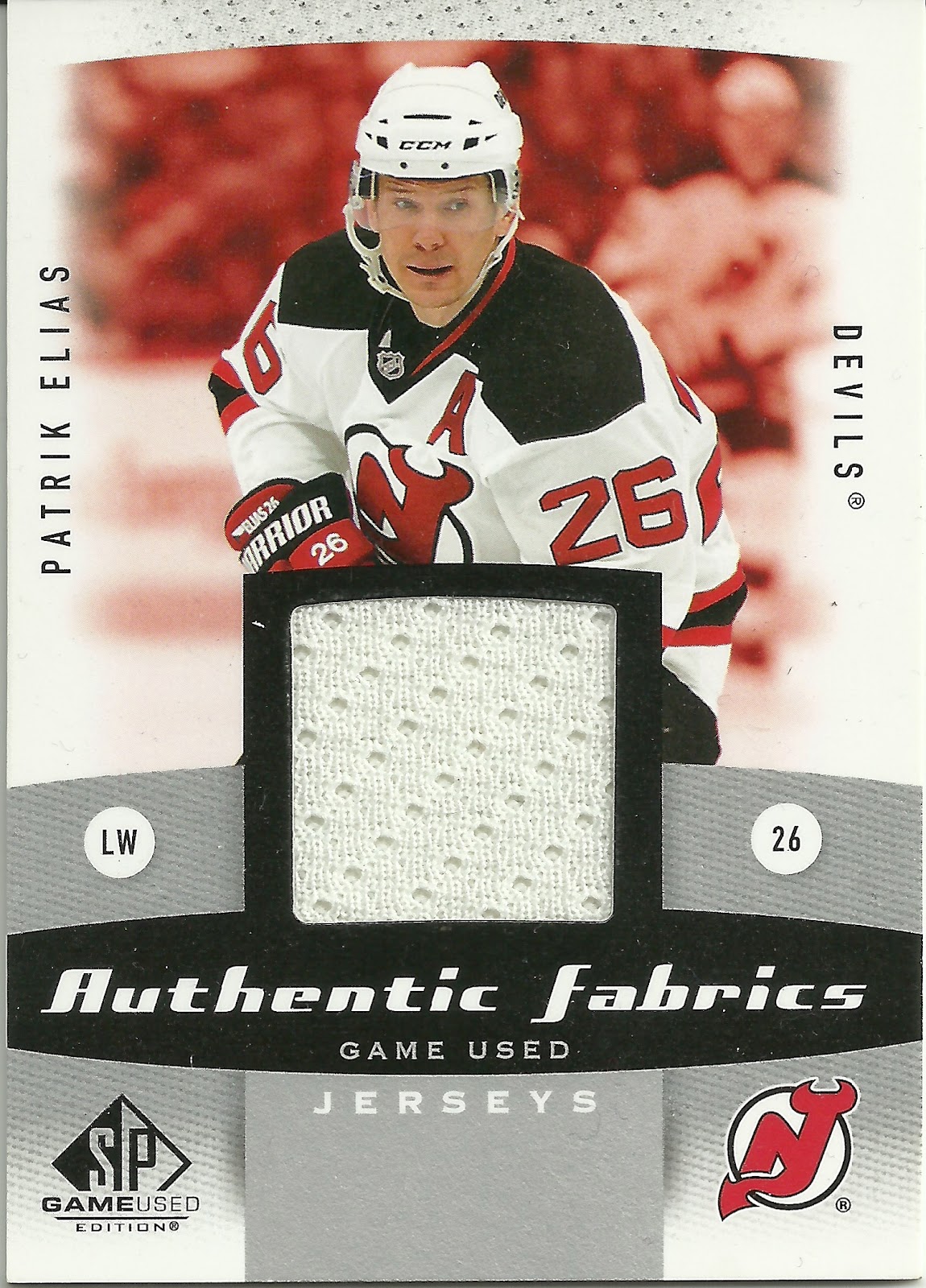
I got this card - and another one I'm saving for later - from a seller on Ebay who was letting them go at $1.99 each, shipping included. This one's from Upper Deck's 2010-11 SP Game-Used Edition (card #AF-EL) and sports a big white swatch of ''material'' (jersey? sock? the card is unclear about the origins), but it's guaranteed to have been used in a game, by a winner and tremendous athlete, and that's good enough for me.
Sure, the Kings could have won in 4 and spared us valuable time - almost a week! - but in this day and age of salary caps and parity, statistical anomalies are bound to play a huge part in how things end up being played.
For example, the Kings hadn't lost on the road yet, in 10 games. They were due, so they lost Game 5.
Also, a Stanley Cup Finals has never - so far - been won in 6 after one team took a 3-0 series lead; the favourite had won in 4, 5, and 7 countless times, and the neglected had won it 7 twice. But ''in 6'' had never happened before. It's bound to happen tonight.
One man who cannot be blamed for the Devils' losses is assistant captain Patrik Elias, whom I had featured almost a month ago.
I got this card - and another one I'm saving for later - from a seller on Ebay who was letting them go at $1.99 each, shipping included. This one's from Upper Deck's 2010-11 SP Game-Used Edition (card #AF-EL) and sports a big white swatch of ''material'' (jersey? sock? the card is unclear about the origins), but it's guaranteed to have been used in a game, by a winner and tremendous athlete, and that's good enough for me.
Subscribe to:
Posts (Atom)