(team links go to sponsored Amazon products, player links go to related pages on my blog, news links go to source pages)
I was window-licking on Ebay earlier today and saw this card, signed in blue sharpie like mine, go for anywhere from $7 to $30 to $70:
That's Olivier Michaud of the Montréal Canadiens on card #271 from In The Game's 2002-03 Be A Player First Edition set, which is not his rookie card, as he'd previously appeared in ITG's 2001-02 Be A Player Memorabilia, 2001-02 Parkhurst and 2001-02 Between The Pipes sets, as well as Topps' 2001-02 Bowman collection and no fewer than eight Upper Deck sets from the same year.
Michaud holds a special place in my heart, which is why I'm delighted to have him as #95 in my Habs Numbers Project, and not just because of his spectacular 14-save shutout performance in 18 minutes of play in his lone NHL game in 2001-02 that places him as the goalie with the best GAA in Habs history (0.00) - a pro-rated 47-save showing in a full game - but also because he led the LHJMQ Shawinigan Cataractes to first place in their division and the best defensive record in the league that season too, and I'm attached to the region because part of my family comes from there (both grandparents on my father's side). We were also both born on September 14th, albeit five years apart.
An undrafted free agent signing, he was out of the professional ranks after a sub-par showing with both the AHL's Hamilton Bulldogs (6-5-1, 3.29 GAA and .893 save percentage, compared to Jaroslav Halak's 7-6-0, 2.29 and .927) and ECHL's Long Beach Ice Dogs (6-7-1, 3.40 and .888, compared to Halak's 11-4-2, 2.05 and .932 and Greg Hewitt's 17-14-6, 2.95 and .900) in 2005-06, despite having been decent in 2003-04 (4-7-3, 2.53 and .905 with the AHL Bulldogs) and 2004-05 (18-14-6, 2.54 and .918 with the ECHL Ice Dogs), and would keep in shape in the Québec semi-pro LNAH league for the next four seasons, all while acting as goaltending coach in Midget AAA (2007-10, 2018-present) and with the LHJMQ's Drummondville Voltigeurs (2010-present). He stopped getting paid to play before the age of 26 and is now one of the longest-tenured coaches in the province.
Let's be honest - he was not going to supplant José Theodore on that Canadiens roster, particularly not smack-dab in that Hart and Vezina season, and the team wanted to groom Yann Danis on its main farm team, but a number of teams could have used him in their system, including teams whose collective GAAs were at or below the .900 line such as the Columbus Blue Jackets, Philadelphia Flyers, Carolina Hurricanes and Boston Bruins (off the top of my head).
Which is to say that I like the guy, but I wouldn't pay the exorbitant prices I saw on Ebay for this card, even if he is the second-youngest goalie to ever play in the NHL.
Showing posts with label 2002-03. Show all posts
Saturday, March 20, 2021
Thursday, February 4, 2021
Jason Spezza Autographed Card
(team links go to sponsored Amazon products, player links go to related pages on my blog, news links go to source pages)
Two weeks after being put on waivers by the Toronto Maple Leafs - with his agent using the "don't claim him or he'll retire" shtick - Jason Spezza scored a hat trick against the Vancouver Canucks.
Things seem to be going Toronto's way this season, as the team leads the NHL a month into an abridged 56-game season, and their decisions in handling Spezza's situation and cap hit is just one example of how fortunate they've been; any team could have claimed him off waivers, even the Ottawa Senators, whom he has captained in the past with the "C" currently vacant; at 37 years of age, ending his career with the team that drafted him would almost be as romantic as his current situation of suiting up for his hometown club. Except the Leafs truly believe they are Stanley Cup contenders - and as a fan, so does he. It's a mass delusion that's been ongoing since 1967.
The Sens went back to their original uniforms this season, and this is what he lookied like wearing the white (then-home) uniform, on card #577 from Pacific's 2002-03 Complete set: He signed it in black sharpie via mail five years ago. The card itself is of the "Red" variant and is numbered 25/100; Complete cards were spread out randomly among packs of other Pacific sets (Crown Royale, Vanguard, Pacific, Quest For The Cup, Atomic), they were not available as a standalone product.
In 10 games this season, Spezza now has 8 points, spread evenly in goals (4) and assists (4).
Two weeks after being put on waivers by the Toronto Maple Leafs - with his agent using the "don't claim him or he'll retire" shtick - Jason Spezza scored a hat trick against the Vancouver Canucks.
Things seem to be going Toronto's way this season, as the team leads the NHL a month into an abridged 56-game season, and their decisions in handling Spezza's situation and cap hit is just one example of how fortunate they've been; any team could have claimed him off waivers, even the Ottawa Senators, whom he has captained in the past with the "C" currently vacant; at 37 years of age, ending his career with the team that drafted him would almost be as romantic as his current situation of suiting up for his hometown club. Except the Leafs truly believe they are Stanley Cup contenders - and as a fan, so does he. It's a mass delusion that's been ongoing since 1967.
The Sens went back to their original uniforms this season, and this is what he lookied like wearing the white (then-home) uniform, on card #577 from Pacific's 2002-03 Complete set: He signed it in black sharpie via mail five years ago. The card itself is of the "Red" variant and is numbered 25/100; Complete cards were spread out randomly among packs of other Pacific sets (Crown Royale, Vanguard, Pacific, Quest For The Cup, Atomic), they were not available as a standalone product.
In 10 games this season, Spezza now has 8 points, spread evenly in goals (4) and assists (4).
Wednesday, December 11, 2019
Johan Hedberg: Three Autographed Cards
The Pittsburgh Penguins, like the Montréal Canadiens, always seem to be able to find either a star goalie at every turn or at the very least someone who will hold the fort superbly well - and get recognition for it - while the Next One comes along.
Originally a Philadelphia Flyers draft pick (ninth round, 218th overall, 1994), Johan Hedberg was an up-and-coming Swedish goalie who looked like he needed seasoning but could become a reliable net-minder; the Flyers didn't quite agree, however, as they let him rot in Sweden and toil around in the minor leagues for four years before sending him to the San Jose Sharks organization without letting him earn even a call-up as a backup. In those years, the Flyers were considered "weak" in net, with the position often being cited as the weak link and reason why the Eric Lindros-led team didn't make it to the Stanley Cup Final more than once. Their revolving door of goalies in that era consisted of Ron Hextall in his second stint with the team (1994-98), hot prospect Dominic Roussel (1994-96), Garth Snow (1995-98) and Sean Burke as a trade deadline rental (1997-98).
Further than fifth on the Sharks' depth chart and in danger of spending more time in the ECHL, he spent the 1998-99 with the Swedish League's Leksands Idrottsförening helping the team finish fourth overall. He came back to North America for the 1999-2000 season, playing for the AHL's Kentucky Thoroughblades, sharing the net with the best goalie in Sharks history, Evgeni Nabokov, and the best goalie in the world in the mid-00s, Miikka Kiprusoff.
It took a loan to the unaffiliated IHL team Manitoba Moose for him to gain visibility, enough for the 2000-01 Pittsburgh Penguins - in danger of missing the playoffs with Snow, Jean-Sébastien Aubin and Rich Parent in net (none of whom had a save percentage above .900) - despite an offence that boasted such talents as Jaromir Jagr (121 points in 81 games), Alex Kovalev (95 points in 79 games), Martin Straka (95 points in 82 games), Mario Lemieux (76 points in 43 games!), Robert Lang (80 points in 82 games) and trade deadline re-acquisition Kevin Stevens (23 points in 32 games), to make his acquisition and throw him directly to the wolved.
Indeed, Moose head coach Randy Carlyle had to redirect him to Pittsburgh, as Hedberg originally assumed he was going to their AHL affiliate to close out the season. Instead, Hedberg led the Pens with a 7-1-1 record in 9 games to close out the season, with a 2.64 GAA (34 points better than the next best goalie, Snow) and .905 save percentage.
Not only did the Pens finish third in the Atlantic Division but sixth in the Eastern Conference, qualifying for the postseason, in which Hedberg outplayed Vezina winners and Stanley Cup finalists Olaf Kolzig (Washington Capitals) and Dominik Hasek (Buffalo Sabres) and leading the team to the Conference Finals, where they lost to the defending champions New Jersey Devils. Because of Devils head coach Larry Robinson's system (strongly based on predecessor Jacques Lemaire's system, but perhaps even stronger defensively), the Pens only registered 99 total shots on Martin Brodeur in the entire five-game series.
Hedberg entered the 2001-02 season as the team's #1 goalie and did not disappoint, continuing on his run with similar numbers (2.75 GAA, .904 save %, 6 shutouts, nightly highlight-reel saves) , but without Jagr gone and with Lemieux being limited to just 25 games, Kovalev was the lone offensive weapon on the team (76 points in 67 games) as it missed the playoffs by finishing fifth in its division.
The 2002-03 season wasn't as good for Hedberg, however, as his GAA climbed to 3.14 and his save percentage dipped to .895, and in the next summer he ws sent to the Vancouver Canucks for a second-round pick. From then on, he would mostly be counted on as a reliable backup who was a great teammate in stints with the Dallas Stars, Atlanta Thrashers and New Jersey Devils.
I'll get to those in a later post because the more pressing matter is the San Jose Sharks cleaned house today and Peter DeBoer and his entire staff (save for Bob Boughner, who takes over as head coach on an interim basis) were let go, meaning assistant coaches Steve Spott and Dave Barr were also relieved of their duties, as was goaltending coach... Johan Hedberg.
You may recall from my annual pre-season predictions that I'm no fan of DeBoer, who I believe was in the bottom-five coaches in the NHL. And you'll see here I am fond of Hedberg, as a player and a person. However, before he took on the job in San Jose, the Sharks' net looked like this (all images courtesy of HockeyDB):
That's Antti Niemi with 5 shutouts. Then DeBoer replaced Todd McLellan, Boughner replaced Robinson as the defense corps' coach, and the goaltenders also got replaced:
That's three goalies on a downward spiral - and the first one to drop, Alex Stalock, is arguably the guy keeping the Minnesota Wild in the playoff race so far this season.
The Sharks almost always have a contending-level roster, particularly on defence with two, three or four All-Star/Olympians at a time, so at some point the coaches have to be held accountable for the lack of results. The players too, mind you, and these guys do not seem to have it in them to reach the enxt level to win, mentally or physically - but the coaches have to at least get the statistics te remain on the level to keep their jobs.
The goalies in San Jose have been trending downwards for too long now, and the stagnation in the depths of the NHL rankings just cost Hedberg his job, whether the fault is his own or not.
Here he is in happier times, when he'd been recalled from the IHL and had the team's logo which would become his nickname, "Moose":
The card on the left is #76 from Pacific's 2001-02 Heads Up set, a beautiful bright foil card, while the one on the right is #42 from In The Game's 2001-02 Between The Pipes set, a darker foil card (not as dark as the scan, mind you) that is reminiscent of some Upper Deck Black Diamond sets. Both show him wearing the Penguins' 1995-2002 "futuristic" road (black) uniform.
And here he is wearing the Penguins 2002-07 black (then-home) jersey (which was also similar to their 2007-16 Reebok Edge jersey), on card #143 from Upper Deck's 2002-03 Series 1 set, stretching during pre-game warmups:
All three cards were signed in black sharpie when he was a member of the Devils (2010-13). He was very nice, and upon learning that I wasn't just a bald Simpsons comic book guy lookalike but had also been a goalie in my day, extended our talk from a five-second interaction to a couple of minutes as the team was packing to leave the area.
Originally a Philadelphia Flyers draft pick (ninth round, 218th overall, 1994), Johan Hedberg was an up-and-coming Swedish goalie who looked like he needed seasoning but could become a reliable net-minder; the Flyers didn't quite agree, however, as they let him rot in Sweden and toil around in the minor leagues for four years before sending him to the San Jose Sharks organization without letting him earn even a call-up as a backup. In those years, the Flyers were considered "weak" in net, with the position often being cited as the weak link and reason why the Eric Lindros-led team didn't make it to the Stanley Cup Final more than once. Their revolving door of goalies in that era consisted of Ron Hextall in his second stint with the team (1994-98), hot prospect Dominic Roussel (1994-96), Garth Snow (1995-98) and Sean Burke as a trade deadline rental (1997-98).
Further than fifth on the Sharks' depth chart and in danger of spending more time in the ECHL, he spent the 1998-99 with the Swedish League's Leksands Idrottsförening helping the team finish fourth overall. He came back to North America for the 1999-2000 season, playing for the AHL's Kentucky Thoroughblades, sharing the net with the best goalie in Sharks history, Evgeni Nabokov, and the best goalie in the world in the mid-00s, Miikka Kiprusoff.
It took a loan to the unaffiliated IHL team Manitoba Moose for him to gain visibility, enough for the 2000-01 Pittsburgh Penguins - in danger of missing the playoffs with Snow, Jean-Sébastien Aubin and Rich Parent in net (none of whom had a save percentage above .900) - despite an offence that boasted such talents as Jaromir Jagr (121 points in 81 games), Alex Kovalev (95 points in 79 games), Martin Straka (95 points in 82 games), Mario Lemieux (76 points in 43 games!), Robert Lang (80 points in 82 games) and trade deadline re-acquisition Kevin Stevens (23 points in 32 games), to make his acquisition and throw him directly to the wolved.
Indeed, Moose head coach Randy Carlyle had to redirect him to Pittsburgh, as Hedberg originally assumed he was going to their AHL affiliate to close out the season. Instead, Hedberg led the Pens with a 7-1-1 record in 9 games to close out the season, with a 2.64 GAA (34 points better than the next best goalie, Snow) and .905 save percentage.
Not only did the Pens finish third in the Atlantic Division but sixth in the Eastern Conference, qualifying for the postseason, in which Hedberg outplayed Vezina winners and Stanley Cup finalists Olaf Kolzig (Washington Capitals) and Dominik Hasek (Buffalo Sabres) and leading the team to the Conference Finals, where they lost to the defending champions New Jersey Devils. Because of Devils head coach Larry Robinson's system (strongly based on predecessor Jacques Lemaire's system, but perhaps even stronger defensively), the Pens only registered 99 total shots on Martin Brodeur in the entire five-game series.
Hedberg entered the 2001-02 season as the team's #1 goalie and did not disappoint, continuing on his run with similar numbers (2.75 GAA, .904 save %, 6 shutouts, nightly highlight-reel saves) , but without Jagr gone and with Lemieux being limited to just 25 games, Kovalev was the lone offensive weapon on the team (76 points in 67 games) as it missed the playoffs by finishing fifth in its division.
The 2002-03 season wasn't as good for Hedberg, however, as his GAA climbed to 3.14 and his save percentage dipped to .895, and in the next summer he ws sent to the Vancouver Canucks for a second-round pick. From then on, he would mostly be counted on as a reliable backup who was a great teammate in stints with the Dallas Stars, Atlanta Thrashers and New Jersey Devils.
I'll get to those in a later post because the more pressing matter is the San Jose Sharks cleaned house today and Peter DeBoer and his entire staff (save for Bob Boughner, who takes over as head coach on an interim basis) were let go, meaning assistant coaches Steve Spott and Dave Barr were also relieved of their duties, as was goaltending coach... Johan Hedberg.
You may recall from my annual pre-season predictions that I'm no fan of DeBoer, who I believe was in the bottom-five coaches in the NHL. And you'll see here I am fond of Hedberg, as a player and a person. However, before he took on the job in San Jose, the Sharks' net looked like this (all images courtesy of HockeyDB):
![]() |
| 2014-15 |
![]() |
| 2015-16 |
![]() |
| 2016-17 |
![]() |
| 2017-18 |
![]() |
| 2018-19 |
| 2019-20 |
The Sharks almost always have a contending-level roster, particularly on defence with two, three or four All-Star/Olympians at a time, so at some point the coaches have to be held accountable for the lack of results. The players too, mind you, and these guys do not seem to have it in them to reach the enxt level to win, mentally or physically - but the coaches have to at least get the statistics te remain on the level to keep their jobs.
The goalies in San Jose have been trending downwards for too long now, and the stagnation in the depths of the NHL rankings just cost Hedberg his job, whether the fault is his own or not.
Here he is in happier times, when he'd been recalled from the IHL and had the team's logo which would become his nickname, "Moose":
The card on the left is #76 from Pacific's 2001-02 Heads Up set, a beautiful bright foil card, while the one on the right is #42 from In The Game's 2001-02 Between The Pipes set, a darker foil card (not as dark as the scan, mind you) that is reminiscent of some Upper Deck Black Diamond sets. Both show him wearing the Penguins' 1995-2002 "futuristic" road (black) uniform.
And here he is wearing the Penguins 2002-07 black (then-home) jersey (which was also similar to their 2007-16 Reebok Edge jersey), on card #143 from Upper Deck's 2002-03 Series 1 set, stretching during pre-game warmups:
All three cards were signed in black sharpie when he was a member of the Devils (2010-13). He was very nice, and upon learning that I wasn't just a bald Simpsons comic book guy lookalike but had also been a goalie in my day, extended our talk from a five-second interaction to a couple of minutes as the team was packing to leave the area.
Saturday, November 25, 2017
Tommy Salo Jersey Card
Tommy Salo's a bizarre case. It can be said that during his time with the New York Islanders, he was among the lower tier of NHL starters, yet it's also true that he was the team's best goalie of the 1990s. Because they were a shitty team that made shitty decisions, one of which was to acquire goalies who were past their prime (Ron Hextall, Félix Potvin) or just plain bad (Tommy Soderstrom), Salo's main competition as "the guy" of the decade would be perennial backups Glenn Healy, Mark Fitzpatrick and Jamie McLennan.
Also, because the Isles were so terrible, he got to play in many World Championships with Team Sweden, more often than not displaying amazing poise under pressure:
Of course, this being the 1990s Iles, GM Mike Milbury tore into him at an arbitration hearing, then traded him to the Edmonton Oilers, where he would be a workhorse, finishing in the top-8 for games played four straight times, and finishing top-10 in Vezina voting three times.
His Vezina votes were reminiscent of those of the 1980s, as he wasn't dominant or anything, but he just played so many games; his record for those three seasons reads as follows:
Two of those seasons, he was barely a game or two over .500, and the other season, his save percentage was a full ten points lower than the other two, and his GAA was more than 20 points higher than the following year.
He again played in multiple World Championships during that period, four of them as a starter, three of them earning bronze medals:
He was never the same after that, and he'd only represent Sweden as a backup from that point on, albeit on a silver medal-winning team at the Worlds in 2003 (3 games, 4.15 GAA, .861 save %) and a disappointing fifth-place finish at the 2004 World Cup (one game, 2.00 GAA, .895 save %).
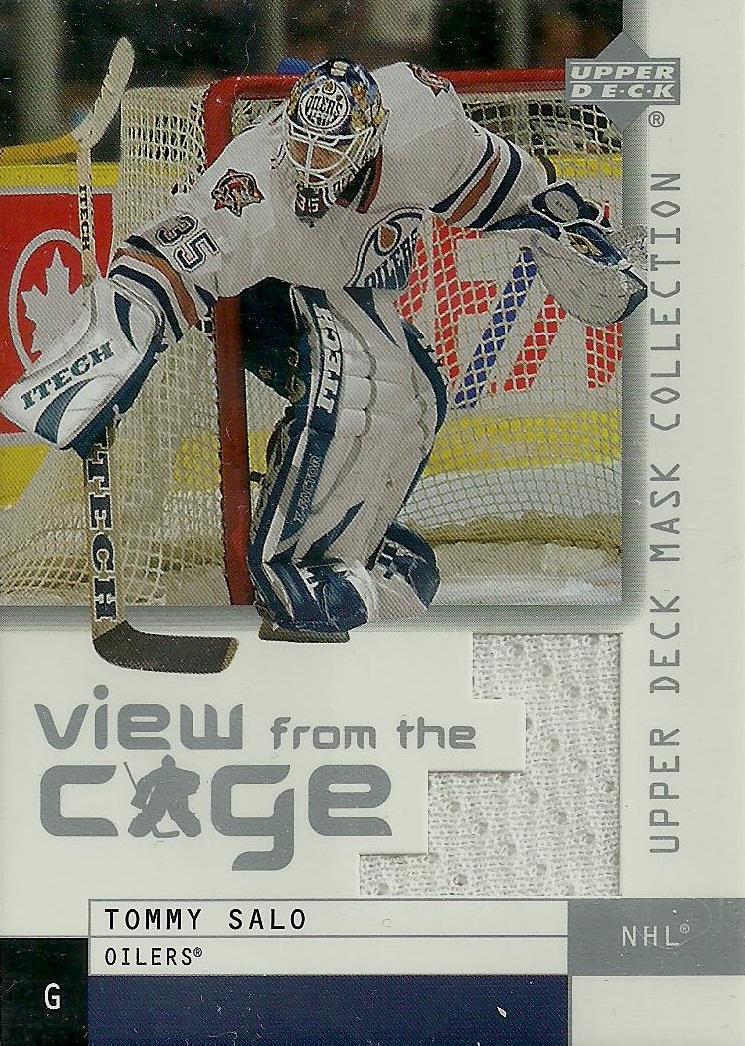
I traded for a card of his with the Oilers a little over a year ago:
That's card #V-TS from Upper Deck's 2002-03 Mask Collection set and View From the Cage sub-set. It shows him wearing Edmonton's turn-of-the-millennium white (home) uniform, with a matching game-worn jersey swatch (that could also very well be from his days on Long Island).
His goaltending style was also reminiscent of that of the 1980s, as he mostly just stood up, waited for a shot to be taken, and would use his reflexes to get to the puck. It was crowd-pleasing, for sure, but it probably worried his coaches more than they care to admit. And his off nights were, thus, extremely off, because he couldn't rely on odds and statistics like butterfly goalies, who are set to block 83-89% of shots just by kneeling and keeping still.
Also, because the Isles were so terrible, he got to play in many World Championships with Team Sweden, more often than not displaying amazing poise under pressure:
- 1994: bronze medal:3 games, 3.33 GAA, .846 save %He was also spectacularly good at the 1994 Olympics, helping secure gold for the Swedes against Team Canada, especially when he stopped Paul Kariya on a penalty shot.
- 1997: silver medal: 10 games, 2.00 GAA, .918 save %
- 1998: gold medal: 9 games, 0.77 GAA, .951 save %
Of course, this being the 1990s Iles, GM Mike Milbury tore into him at an arbitration hearing, then traded him to the Edmonton Oilers, where he would be a workhorse, finishing in the top-8 for games played four straight times, and finishing top-10 in Vezina voting three times.
His Vezina votes were reminiscent of those of the 1980s, as he wasn't dominant or anything, but he just played so many games; his record for those three seasons reads as follows:
![]() |
| from HockeyDB |
He again played in multiple World Championships during that period, four of them as a starter, three of them earning bronze medals:
- 1999: bronze medal: 8 games, 1.84, .921%And, of course, this happened while he was representing Sweden at the 2002 Olympics:
- 2000: 7th place: 6 games, 1.67 GAA
- 2001: bronze medal: 8 games, 1.94, .920%
- 2002: bronze medal: 7 games, 1.96, .919%
He was never the same after that, and he'd only represent Sweden as a backup from that point on, albeit on a silver medal-winning team at the Worlds in 2003 (3 games, 4.15 GAA, .861 save %) and a disappointing fifth-place finish at the 2004 World Cup (one game, 2.00 GAA, .895 save %).
I traded for a card of his with the Oilers a little over a year ago:
That's card #V-TS from Upper Deck's 2002-03 Mask Collection set and View From the Cage sub-set. It shows him wearing Edmonton's turn-of-the-millennium white (home) uniform, with a matching game-worn jersey swatch (that could also very well be from his days on Long Island).
His goaltending style was also reminiscent of that of the 1980s, as he mostly just stood up, waited for a shot to be taken, and would use his reflexes to get to the puck. It was crowd-pleasing, for sure, but it probably worried his coaches more than they care to admit. And his off nights were, thus, extremely off, because he couldn't rely on odds and statistics like butterfly goalies, who are set to block 83-89% of shots just by kneeling and keeping still.
Tuesday, April 18, 2017
Dan Blackburn Autographed Card
Congratulations are in order for the New York Rangers, who have tied their first-round series against the Montréal Canadiens on the strength of a 2-1 win tonight. The Habs did play lights-out in the third, but just couldn't solve Henrik Lundqvist, who was royal for the third time in the series.
Speaking of strong Rangers goaltending, Montrealer Dan Blackburn used to be the man-in-waiting between the pipes for the red, white and blue at the turn of the millennium until a shoulder injury forced him to choose between retiring or attempt playing with two blockers and no catching glove, because nerve issues had him incapable of rotating his would-be glove hand; an MCL strain at the Rangers' training camp then put him in a difficult position: he could either retire and receive $6M in insurance money, covering the end of his contract and a bit more, or forfeit any chance of future insurance and try to earn a spot upon recovery. He wisely opted to retire at age 22, his final game a 5-4 loss at the hands of the Canadiens, the team against which he won his first NHL game as the Rangers' second-youngest goalie of all time.
Here he is wearing the Rags' blue Lady Liberty former alternate (one of my favourite alternate uniforms in hockey history) on card #123 from Topps' 2002-03 O-Pee-Chee set and Topps All Star Rookie sub-set:
Most goalies in the set were pictured horizontally. He signed his card in black sharpie in 2002-03.
Injuries are always the ultimate "What If?", but in Blackburn's case, after winning the WHL Playoff MVP award, the CHL's Goalie Of The Year award and leading his Kootenay Ice to a berth in the Memorial Cup, then making an NHL roster at just 18 years old - the fifth-youngest of all-time in the NHL - the sky was the limit. That, or nerve damage.
Speaking of strong Rangers goaltending, Montrealer Dan Blackburn used to be the man-in-waiting between the pipes for the red, white and blue at the turn of the millennium until a shoulder injury forced him to choose between retiring or attempt playing with two blockers and no catching glove, because nerve issues had him incapable of rotating his would-be glove hand; an MCL strain at the Rangers' training camp then put him in a difficult position: he could either retire and receive $6M in insurance money, covering the end of his contract and a bit more, or forfeit any chance of future insurance and try to earn a spot upon recovery. He wisely opted to retire at age 22, his final game a 5-4 loss at the hands of the Canadiens, the team against which he won his first NHL game as the Rangers' second-youngest goalie of all time.
Here he is wearing the Rags' blue Lady Liberty former alternate (one of my favourite alternate uniforms in hockey history) on card #123 from Topps' 2002-03 O-Pee-Chee set and Topps All Star Rookie sub-set:
Most goalies in the set were pictured horizontally. He signed his card in black sharpie in 2002-03.
Injuries are always the ultimate "What If?", but in Blackburn's case, after winning the WHL Playoff MVP award, the CHL's Goalie Of The Year award and leading his Kootenay Ice to a berth in the Memorial Cup, then making an NHL roster at just 18 years old - the fifth-youngest of all-time in the NHL - the sky was the limit. That, or nerve damage.
Friday, January 6, 2017
Mariusz Czerkawski Jersey Card
If you didn't know anything about hockey and read about Mariusz Czerkawski's career on Wikipedia or something of that ilk 100 years from now, you'd think he was Brett Hull.
We're talking about the first Polish player to play in the NHL, a guy who, when playing for his national team, accumulated 39 points (27 goals, 12 assists) in 25 Juniors-level games and 34 points (17 goals, 17 assists) in in 36 mens' teams games, despite often being the only NHLer on the roster, more often than not playing against teams made up entirely of stars and semi-stars. He was doing it by himself.
And if, again, you didn't know anything about hockey and read up on the NHL, some teams would would appear as more important than the others, namely the Original Six, and perhaps the 1980s dynasties Edmonton Oilers and New York Islanders. Well, Czerkawski played for both the Oil and the Isles, as well as three Original Six teams: the Montréal Canadiens, Boston Bruins and Toronto Maple Leafs. If you didn't have the context that we do - how they all sucked at the end of the 1990s and early 00s - you'd think he may be the link, the one common thread, between great and historical teams.
And he had two 30-goal seasons, and two more over the 25 mark - in the Dead Puck Era. Heck, his All-Star game participation, in the midst of a 70-point season, was probably fully warranted, seeing as he led the Isles with nearly 30 points more than the team's second-best scorer and the fact that the goalie they used the most that year was Kevin Weekes, with 32 games played (Roberto Luongo followed with 24, and Félix Potvin appeared in 22; Luongo had the best save percentage of them all at .904).
Those of us who followed the latter stages of his career, however, feel he fizzled greatly at the end, putting a damper on a relatively fine career, not unlike Sergei Berezin or Sergei Samsonov.
Here is a card showing him wearing the Habs' white (then-home) uniform, which is #14 of Pacific's 2003-04 Exclusive collection and Authentic Game-Worn Jerseys sub-set:
The back is even super-specific as to where the blue game-worn jersey swatch is from:
It's from his days with the Isles, with a matching picture on the back! That's what I call attention to detail!
We're talking about the first Polish player to play in the NHL, a guy who, when playing for his national team, accumulated 39 points (27 goals, 12 assists) in 25 Juniors-level games and 34 points (17 goals, 17 assists) in in 36 mens' teams games, despite often being the only NHLer on the roster, more often than not playing against teams made up entirely of stars and semi-stars. He was doing it by himself.
And if, again, you didn't know anything about hockey and read up on the NHL, some teams would would appear as more important than the others, namely the Original Six, and perhaps the 1980s dynasties Edmonton Oilers and New York Islanders. Well, Czerkawski played for both the Oil and the Isles, as well as three Original Six teams: the Montréal Canadiens, Boston Bruins and Toronto Maple Leafs. If you didn't have the context that we do - how they all sucked at the end of the 1990s and early 00s - you'd think he may be the link, the one common thread, between great and historical teams.
And he had two 30-goal seasons, and two more over the 25 mark - in the Dead Puck Era. Heck, his All-Star game participation, in the midst of a 70-point season, was probably fully warranted, seeing as he led the Isles with nearly 30 points more than the team's second-best scorer and the fact that the goalie they used the most that year was Kevin Weekes, with 32 games played (Roberto Luongo followed with 24, and Félix Potvin appeared in 22; Luongo had the best save percentage of them all at .904).
Those of us who followed the latter stages of his career, however, feel he fizzled greatly at the end, putting a damper on a relatively fine career, not unlike Sergei Berezin or Sergei Samsonov.
Here is a card showing him wearing the Habs' white (then-home) uniform, which is #14 of Pacific's 2003-04 Exclusive collection and Authentic Game-Worn Jerseys sub-set:
The back is even super-specific as to where the blue game-worn jersey swatch is from:
It's from his days with the Isles, with a matching picture on the back! That's what I call attention to detail!
Sunday, December 11, 2016
Mike Dunham Jersey Card
If I were to ask you who had been the last New York Rangers goalie - before tonight - to post back-to-back shutouts, surely your answer would have been Henrik Lundqvist. After all, he's one of the best goalies of all time, a career-long Ranger, a veteran.
However, before Antti Raanta accomplished the feat tonight, the last time a member of the Blueshirts had done so predates even King Henrik, as it was none other than Mike Dunham who blanked teams in two consecutive games in 2003.
The Team USA silver medalist at the 2002 Olympics and bronze medalist at the 1992 World Juniors and 2004 World Championships is now the New York Islanders' goaltending coach; the Isles are having a tough year defensively, so chances are his hair is turning white...
Here he is as a member of the Nashville Predators, with whom he had his best seasons:
It's card #GT-MD from Upper Deck's 2002-03 Series 2 set and Goaltender Threads sub-set; it shows him wearing the Preds' white (then-home) uniform, one that wasn't all that pretty at the time but is much better than what they currently wear...
However, before Antti Raanta accomplished the feat tonight, the last time a member of the Blueshirts had done so predates even King Henrik, as it was none other than Mike Dunham who blanked teams in two consecutive games in 2003.
The Team USA silver medalist at the 2002 Olympics and bronze medalist at the 1992 World Juniors and 2004 World Championships is now the New York Islanders' goaltending coach; the Isles are having a tough year defensively, so chances are his hair is turning white...
Here he is as a member of the Nashville Predators, with whom he had his best seasons:
It's card #GT-MD from Upper Deck's 2002-03 Series 2 set and Goaltender Threads sub-set; it shows him wearing the Preds' white (then-home) uniform, one that wasn't all that pretty at the time but is much better than what they currently wear...
Sunday, October 30, 2016
Dan McGillis: Two Autographed Cards
I featured Dan McGillis nearly two years ago when I inducted him as #33 in my Oilers Numbers Project, but it was time to show him with the team he's most associated with, the Philadelphia Flyers:
What you got every year from McGillis with the Broad Street Bullies was close to or more than 300 bone-crushing hits in the defensive zone, usually good for a top-5 or top-10 spot in the NHL. He did so mainly unpunished, however, as he only topped the 100-PIM mark once (109 with the Edmonton Oilers in 1997-98), with his second-most being the 86 he amassed with the Flyers in 2000-01, when he finished 14th in Norris voting; of note, his teammate Éric Desjardins finished 10th in Norris voting that year, proving they were a formidable pair.
He would usually hover around 60 penalty minutes per year with a +/- over +15; he also topped the 40-point mark twice in Philly, including his career-high of 49 (14 of them goals) in 2000-01.
He signed two cards showing him wearing the Flyers' white (then-home) 1980s/1990s uniform in blue sharpie; first, here's card #262 from Upper Deck's 2001-02 Victory set, leading the rush out of his defensive zone:
And there's also card #119 from Topps' 2002-03 Total set, attempting a pass - likely to Desjardins - to lead the breakout:
The Flyers might be mean, often times dirty, but you have to respect their commitment to their history, their city and their identity, none of which have ever regressed or been on doubt. They are unapologetic, in-your-face and hard to play against, a trait that was true in the days of Bobby Clarke, of Ken Linseman, of Eric Lindros and even now with Radko Gudas keeping opponents honest around their talented crop of young blue-liners.
What you got every year from McGillis with the Broad Street Bullies was close to or more than 300 bone-crushing hits in the defensive zone, usually good for a top-5 or top-10 spot in the NHL. He did so mainly unpunished, however, as he only topped the 100-PIM mark once (109 with the Edmonton Oilers in 1997-98), with his second-most being the 86 he amassed with the Flyers in 2000-01, when he finished 14th in Norris voting; of note, his teammate Éric Desjardins finished 10th in Norris voting that year, proving they were a formidable pair.
He would usually hover around 60 penalty minutes per year with a +/- over +15; he also topped the 40-point mark twice in Philly, including his career-high of 49 (14 of them goals) in 2000-01.
He signed two cards showing him wearing the Flyers' white (then-home) 1980s/1990s uniform in blue sharpie; first, here's card #262 from Upper Deck's 2001-02 Victory set, leading the rush out of his defensive zone:
And there's also card #119 from Topps' 2002-03 Total set, attempting a pass - likely to Desjardins - to lead the breakout:
The Flyers might be mean, often times dirty, but you have to respect their commitment to their history, their city and their identity, none of which have ever regressed or been on doubt. They are unapologetic, in-your-face and hard to play against, a trait that was true in the days of Bobby Clarke, of Ken Linseman, of Eric Lindros and even now with Radko Gudas keeping opponents honest around their talented crop of young blue-liners.
Sunday, October 16, 2016
Jason Allison Jersey Card
I briefly mentioned Jason Allison yesterday and figured I could feature the one-season captain (in 2000-01) of the Boston Bruins today.
Allison was a Washington Capitals draft pick, going 17th overall in 1993, but the Caps grew tired of the power forward's slow development and sent him to the Bruins after three years of alternating between the NHL and AHL and during his fourth season, where he failed to crack their top line.
In his first full season in Boston, in 1997-98, he exploded for 33 goals, 50 assists and 83 points to go along with 60 penalty minutes, resulting in a top-10 finish in Hart voting and top-15 in Selke voting; he kept that pace throughout his time in Beantown, with a high of 36 goals and 95 points in 2000-01.
The Bs then sent him to the Los Angeles Kings (with Mikko Eloranta, for Jozef Stumpel and Glen Murray), where he would enjoy a similar production rate - 74 points in 73 games in 2001-02, and 28 points in 26 games in 2002-03), but injury troubles forced him away from the game for a year and a half.
He made his first comeback with the rough-and-tumble Toronto Maple Leafs in 2005-06, posting 60 points in 66 games with 76 penalty minutes before the speedier game and personal issues forced him out... until 2009-10, when he attempted a second comeback, this time with Brian Burke's truculent Leafs, eventually failing to make the team, but making enough of an impression on Philadelphia Flyers forward Darrell Powe's helmet:
He retired with 485 points and 441 penalty minutes in 552 regular-season NHL games as well as 25 points and just 14 PIMs in 25 playoff games.
Here he is wearing the Kings' black and purple uniform from the turn of the millennium, on card #DM-JA from Upper Deck's 2002-03 Series 1 set and Difference Makers sub-set:
It contains a white game-worn jersey swatch.
He also won two gold medals with Team Canada at the World Juniors, in 1994 and 1995.
Allison was a Washington Capitals draft pick, going 17th overall in 1993, but the Caps grew tired of the power forward's slow development and sent him to the Bruins after three years of alternating between the NHL and AHL and during his fourth season, where he failed to crack their top line.
In his first full season in Boston, in 1997-98, he exploded for 33 goals, 50 assists and 83 points to go along with 60 penalty minutes, resulting in a top-10 finish in Hart voting and top-15 in Selke voting; he kept that pace throughout his time in Beantown, with a high of 36 goals and 95 points in 2000-01.
The Bs then sent him to the Los Angeles Kings (with Mikko Eloranta, for Jozef Stumpel and Glen Murray), where he would enjoy a similar production rate - 74 points in 73 games in 2001-02, and 28 points in 26 games in 2002-03), but injury troubles forced him away from the game for a year and a half.
He made his first comeback with the rough-and-tumble Toronto Maple Leafs in 2005-06, posting 60 points in 66 games with 76 penalty minutes before the speedier game and personal issues forced him out... until 2009-10, when he attempted a second comeback, this time with Brian Burke's truculent Leafs, eventually failing to make the team, but making enough of an impression on Philadelphia Flyers forward Darrell Powe's helmet:
He retired with 485 points and 441 penalty minutes in 552 regular-season NHL games as well as 25 points and just 14 PIMs in 25 playoff games.
Here he is wearing the Kings' black and purple uniform from the turn of the millennium, on card #DM-JA from Upper Deck's 2002-03 Series 1 set and Difference Makers sub-set:
It contains a white game-worn jersey swatch.
He also won two gold medals with Team Canada at the World Juniors, in 1994 and 1995.
Wednesday, July 6, 2016
Bryan Allen: Two Autographed Cards
Here's a cool return I wasn't expecting when I got home (late) yesterday, over two years in the making, as I'd sent Bryan Allen these two cards when the Montréal Canadiens assigned him to the Hamilton Bulldogs in January 2015:
He signed them in blue sharpie and sent them from (presumably) his home in California.
While he hasn't officially retired yet, he did not play during the 2015-16 season. The former fourth-overall pick of the 1998 draft - behind Vincent Lecavalier, David Legwand and Brad Stuart and ahead of the likes of Vitali Vishnevski (5th), Rico Fata (6th), Manny Malhotra (7th), Nikolai Antropov (10th), Alex Tanguay (12th), Martin Skoula (17th), Dmitri Kalinin (18th), Robyn Regehr (19th), Simon Gagné (22nd), Jiri Fischer (25th), Scott Gomez (27th), Ramzi Abid (28th), Jonathan Cheechoo (29th), Andrew Peters (34th), Mike Fisher (44th), Mike Ribeiro (45th), Brad Richards (64th), Jason LaBarbera (66th), Erik Cole (71st), François Beauchemin (75th), Brian Gionta (82nd), Josef Vasicek (91st), Shawn Horcoff (99th), Jaroslav Spacek (117th), Andrew Raycroft (135th), Chris Neil (161st), Andrei Markov (162nd), Pavel Datsyuk (171st), Michael Ryder (216th), and Karlis Skrastins (230th) - played for parts of five seasons with the Vancouver Canucks before being part of the first Roberto Luongo trade, sending Allen, Alex Auld, and Todd Bertuzzi to the Florida Panthers for Luongo, the draft pick that became Sergei Shirokov and Lukas Krajicek.
It was with the Panthers that he would crack the 20-point barrier (25, in 2006-07), but the 6'5", 220-pound defender was mostly known as a stay-at-home defenseman, often cracking or nearing the 100-PIM mark.
After most of five seasons with the Panthers, he spent a year and a half with the Carolina Hurricanes before signing his final contract, a three-season deal with the Anaheim Ducks, who sent him to the Habs in his last year for oft-maligned forward Rene Bourque.
It therefore made sense to send him cards of his first and almost-last teams; here he is in the Canucks' 1990s dark (away) orca logo uniform, on card #298 from Topps' 2002-03 O-Pee-Chee set and Prospects sub-set, allowing me to use him as #5 in my Canucks Numbers Project:
And here he is wearing what was then the Ducks' alternate uniform and is now their home garbs, on card #15 from Panini's 2013-14 Score set:
Because it's the lone return I'm missing from my 2015-16 mailings, I thought this might be from Torrey Mitchell; the fact that it wasn't keeps me hopeful that that one may yet be coming.
He signed them in blue sharpie and sent them from (presumably) his home in California.
While he hasn't officially retired yet, he did not play during the 2015-16 season. The former fourth-overall pick of the 1998 draft - behind Vincent Lecavalier, David Legwand and Brad Stuart and ahead of the likes of Vitali Vishnevski (5th), Rico Fata (6th), Manny Malhotra (7th), Nikolai Antropov (10th), Alex Tanguay (12th), Martin Skoula (17th), Dmitri Kalinin (18th), Robyn Regehr (19th), Simon Gagné (22nd), Jiri Fischer (25th), Scott Gomez (27th), Ramzi Abid (28th), Jonathan Cheechoo (29th), Andrew Peters (34th), Mike Fisher (44th), Mike Ribeiro (45th), Brad Richards (64th), Jason LaBarbera (66th), Erik Cole (71st), François Beauchemin (75th), Brian Gionta (82nd), Josef Vasicek (91st), Shawn Horcoff (99th), Jaroslav Spacek (117th), Andrew Raycroft (135th), Chris Neil (161st), Andrei Markov (162nd), Pavel Datsyuk (171st), Michael Ryder (216th), and Karlis Skrastins (230th) - played for parts of five seasons with the Vancouver Canucks before being part of the first Roberto Luongo trade, sending Allen, Alex Auld, and Todd Bertuzzi to the Florida Panthers for Luongo, the draft pick that became Sergei Shirokov and Lukas Krajicek.
It was with the Panthers that he would crack the 20-point barrier (25, in 2006-07), but the 6'5", 220-pound defender was mostly known as a stay-at-home defenseman, often cracking or nearing the 100-PIM mark.
After most of five seasons with the Panthers, he spent a year and a half with the Carolina Hurricanes before signing his final contract, a three-season deal with the Anaheim Ducks, who sent him to the Habs in his last year for oft-maligned forward Rene Bourque.
It therefore made sense to send him cards of his first and almost-last teams; here he is in the Canucks' 1990s dark (away) orca logo uniform, on card #298 from Topps' 2002-03 O-Pee-Chee set and Prospects sub-set, allowing me to use him as #5 in my Canucks Numbers Project:
And here he is wearing what was then the Ducks' alternate uniform and is now their home garbs, on card #15 from Panini's 2013-14 Score set:
Because it's the lone return I'm missing from my 2015-16 mailings, I thought this might be from Torrey Mitchell; the fact that it wasn't keeps me hopeful that that one may yet be coming.
Monday, June 27, 2016
Tomi Kallio Jersey Card
By not following hockey from pretty much 1997 until 2002, I missed out on a few things, such as having any sympathy for Todd Bertuzzi, having any sympathy for Eric Lindros, and realizing how decent Tomi Kallio's career was.
After a 53-point 1999-2000 season (in 50 games) with his hometown TPS Turku, Kallio made his way to the Atlanta Thrashers, after they plucked him from the Colorado Avalanche at the 1999 expansion draft. The Avs had made him a fourth-round draft pick in 1995.
He had a decent rookie season with the Thrashers, scoring 14 goals with 13 assists for 27 points in 56 games in 2000-01 in the heart of the Dead Puck Era and followed it with a 22-point outing in 60 games in 2001-02 before suiting up for three teams - Atlanta, the Columbus Blue Jackets and the Philadelphia Flyers - in 2002-03.
That was enough uncertainty for him, and he made the move to the Swedish League, where he would play for the next 13 seasons - nine with the Frölunda Indians and four with the Växjö Lakers. He scored the winning goal in the Indians' 2013 league championship game.
He went back to Finland for the 2015-16 season, again with Turku, leading the team with 44 points in 60 games, ahead of former NHLers Éric Perrin (third, 34 points), Henrik Tallinder (sixth, 21 points), and Petteri Nummelin (seventh, 19 points).
He is a decorated international skater, having won three silver (1999, 2001 and 2007) and two bronze (2000 and 2006) World Championship medals with Team Finland; he also played for his country at the 2002 Olympics.
Here he is in the Thrashers' best-looking uniform, the dark blue (away) garbs from their early days, on card #1 from Pacific's 2002-03 Exclusive set and Authentic Game-Worn Jerseys sub-set:
It features a red game-worn jersey swatch that matched the jersey's arms and hips.
I hear he was a fast skater who liked to shoot more than to pass and liked playing in traffic in front of opponents' nets, but he may have lacked the sniper's finishing touch that would have been required for him to be the impact player at least four NHL teams had hoped he'd be. Still, his 211 goals and 464 points in 637 Swedish League games are a decent total, particularly when you add his 34 goals and 87 points in 108 playoff games. His Finnish totals are also good, as he posted 176 points in 266 regular-season games and 31 points in 45 playoff games in his native country.
After a 53-point 1999-2000 season (in 50 games) with his hometown TPS Turku, Kallio made his way to the Atlanta Thrashers, after they plucked him from the Colorado Avalanche at the 1999 expansion draft. The Avs had made him a fourth-round draft pick in 1995.
He had a decent rookie season with the Thrashers, scoring 14 goals with 13 assists for 27 points in 56 games in 2000-01 in the heart of the Dead Puck Era and followed it with a 22-point outing in 60 games in 2001-02 before suiting up for three teams - Atlanta, the Columbus Blue Jackets and the Philadelphia Flyers - in 2002-03.
That was enough uncertainty for him, and he made the move to the Swedish League, where he would play for the next 13 seasons - nine with the Frölunda Indians and four with the Växjö Lakers. He scored the winning goal in the Indians' 2013 league championship game.
He went back to Finland for the 2015-16 season, again with Turku, leading the team with 44 points in 60 games, ahead of former NHLers Éric Perrin (third, 34 points), Henrik Tallinder (sixth, 21 points), and Petteri Nummelin (seventh, 19 points).
He is a decorated international skater, having won three silver (1999, 2001 and 2007) and two bronze (2000 and 2006) World Championship medals with Team Finland; he also played for his country at the 2002 Olympics.
Here he is in the Thrashers' best-looking uniform, the dark blue (away) garbs from their early days, on card #1 from Pacific's 2002-03 Exclusive set and Authentic Game-Worn Jerseys sub-set:
It features a red game-worn jersey swatch that matched the jersey's arms and hips.
I hear he was a fast skater who liked to shoot more than to pass and liked playing in traffic in front of opponents' nets, but he may have lacked the sniper's finishing touch that would have been required for him to be the impact player at least four NHL teams had hoped he'd be. Still, his 211 goals and 464 points in 637 Swedish League games are a decent total, particularly when you add his 34 goals and 87 points in 108 playoff games. His Finnish totals are also good, as he posted 176 points in 266 regular-season games and 31 points in 45 playoff games in his native country.
Sunday, May 1, 2016
Ty Conklin Autographed Card
The Edmonton Oilers may not have won the first overall pick in the NHL's lottery last night, but that won't stop me from checking off #1 from my Oilers Numbers Project with this card of Ty Conklin's:
It's card #284 from In The Game's 2002-03 First Edition set, showing him in the team's turn-of-the-millennium white (home) jersey, with the "oil driller" shoulder patches. He signed it in blue sharpie in January 2012 in his second stint with the Detroit Red Wings.
Though he was undrafted, he was a star goalie for the University Of New Hampshire Wildcats from 1998 until 2001, prompting the Oilers to sign him as a free agent. He was a huge part of their future in nets until he went unprepared in Game 1 of the 2006 Stanley Cup Final after an injury to Dwayne Roloson, making a huge mistake letting in the game-winning goal in an empty net, essentially giving the puck to Carolina Hurricanes captain Rod Brind'Amour.
He never again suited up for the Oilers.
He did have two pretty good seasons in his NHL career, notably in 2007-08 with the Pittsburgh Penguins, going 18-8-5 with a .923 save percentage and 2.51 GAA, playing in the Winter Classic against the Buffalo Sabres, earning the Second Star.
He also had a decent 2009-10 season as Chris Mason's backup with the St. Louis Blues, playing in 26 games, going 10-10-2 with a .921 save percentage and 2.48 GAA.
Essentially, however, he'll be remembered as a goalie who had six seasons with a save percentage under the .900 barrier, suiting up for six different NHL teams interspersed with stints in the AHL and in Germany.
It's card #284 from In The Game's 2002-03 First Edition set, showing him in the team's turn-of-the-millennium white (home) jersey, with the "oil driller" shoulder patches. He signed it in blue sharpie in January 2012 in his second stint with the Detroit Red Wings.
Though he was undrafted, he was a star goalie for the University Of New Hampshire Wildcats from 1998 until 2001, prompting the Oilers to sign him as a free agent. He was a huge part of their future in nets until he went unprepared in Game 1 of the 2006 Stanley Cup Final after an injury to Dwayne Roloson, making a huge mistake letting in the game-winning goal in an empty net, essentially giving the puck to Carolina Hurricanes captain Rod Brind'Amour.
He never again suited up for the Oilers.
He did have two pretty good seasons in his NHL career, notably in 2007-08 with the Pittsburgh Penguins, going 18-8-5 with a .923 save percentage and 2.51 GAA, playing in the Winter Classic against the Buffalo Sabres, earning the Second Star.
He also had a decent 2009-10 season as Chris Mason's backup with the St. Louis Blues, playing in 26 games, going 10-10-2 with a .921 save percentage and 2.48 GAA.
Essentially, however, he'll be remembered as a goalie who had six seasons with a save percentage under the .900 barrier, suiting up for six different NHL teams interspersed with stints in the AHL and in Germany.
Wednesday, February 17, 2016
Jean-Sébastien Giguère Jersey Card
For the longest time, my memories of this Jean-Sébastien Giguère card were that it was a one that contained a piece of a game-used glove; I was wrong:
As you can see, though the sub-set is called Great Gloves, it actually contains a white game-worn jersey swatch under a goalie-shaped die-cut hole. It's card #GG-JG from Upper Deck's 2002-03 Mask Collection set, which I was once offered $30 for.
It shows J.S. Giguère in perhaps the Mighty Ducks of Anaheim's best white (then-home) uniform, devoid of purple and where teal isn't overly dominant a colour, and black and grey make for perfect highlights.
The Conn Smythe and Stanley Cup winner, at this point, was wearing the same equipment - Koho - as his boyhood idol, Patrick Roy, and the card not only shows this extremely well, but it also shows the square butterfly drop with which he would stifle opponents during his prime.
As you can see, though the sub-set is called Great Gloves, it actually contains a white game-worn jersey swatch under a goalie-shaped die-cut hole. It's card #GG-JG from Upper Deck's 2002-03 Mask Collection set, which I was once offered $30 for.
It shows J.S. Giguère in perhaps the Mighty Ducks of Anaheim's best white (then-home) uniform, devoid of purple and where teal isn't overly dominant a colour, and black and grey make for perfect highlights.
The Conn Smythe and Stanley Cup winner, at this point, was wearing the same equipment - Koho - as his boyhood idol, Patrick Roy, and the card not only shows this extremely well, but it also shows the square butterfly drop with which he would stifle opponents during his prime.
Tuesday, September 22, 2015
Paul Kariya Jersey Card
Remember when a player scoring 50 goals in a single season happened enough for card companies to have complete sub-sets of them in their card collections? Last season, only Alex Ovechkin reached that milestone, marking the sixth time he's reached it; there are only seven other active NHLers with 50-goal seasons, and they are: Jaromir Jagr (1995-96, 2000-01, and 2005-06), Jarome Iginla (2001-02 and 2007-08), Vincent Lecavalier (2006-07), Sidney Crosby (2009-10), Steven Stamkos (2009-10 and 2011-12), Corey Perry (2010-11), and Evgeni Malkin (2011-12), it in addition to Ovi (2005-06, 2007-08, 2008-09, 2009-10, 2013-14 and 2014-15), as well as Dany Heatley (2005-06 and 2006-07) and Ilya Kovalchuk (2005-06 and 2007-08), who will be playing overseas this year. That doesn't make for a huge set.
The following card comes from Upper Deck's 2002-03 Series 2 collection's Reaching Fifty sub-set, which included the likes of Brett Hull, Peter Bondra, Iginla, Jagr, Wayne Gretzky, John LeClair, Joe Sakic, Keith Tkachuk, Mario Lemieux, Mike Modano, Pavel Bure, Sergei Fedorov, Steve Yzerman, and this one, #50-PK in the set, Paul Kariya:
It shows him wearing the Mighty Ducks Of Anaheim's purple (then-away) uniform, though the consecutive white and grey lines were actually from the white (home) jersey. Unlike the previous time I've featured him, though, he has actually worn this one in an NHL game.
He has never won the Stanley Cup, but does have two Lady Byng trophies at home and made the First All-Star Team three times and Second All-Star Team twice, in addition to being nominated for the Hart a couple of times and playing in seven All-Star Games. He has suited up for Team Canada several times, winning gold medals at the 1993 World Juniors, 1994 World championships and 2002 Olympics, and silver at the 1991 Phoenix Cup (the then-name of the U-18 tournament), 1994 Olympics and 1996 World Championships.
He had to retire after 15 seasons due to concussions, and has since been outspoken about the dangers of players returning from them too soon - though he doesn't do so in hockey-related environments, having even shunned his good friend Teemu Selanne's jersey retirement ceremony.
His 989 points in 989 games are a big achievement, particularly the fact that most of it occurred in the Dead Puck Era. I've very happy I got this card in a trade for a couple of Eric Lindros cards, and a double of a Peter Forsberg jersey card I'll get to here eventually.
The following card comes from Upper Deck's 2002-03 Series 2 collection's Reaching Fifty sub-set, which included the likes of Brett Hull, Peter Bondra, Iginla, Jagr, Wayne Gretzky, John LeClair, Joe Sakic, Keith Tkachuk, Mario Lemieux, Mike Modano, Pavel Bure, Sergei Fedorov, Steve Yzerman, and this one, #50-PK in the set, Paul Kariya:
It shows him wearing the Mighty Ducks Of Anaheim's purple (then-away) uniform, though the consecutive white and grey lines were actually from the white (home) jersey. Unlike the previous time I've featured him, though, he has actually worn this one in an NHL game.
He has never won the Stanley Cup, but does have two Lady Byng trophies at home and made the First All-Star Team three times and Second All-Star Team twice, in addition to being nominated for the Hart a couple of times and playing in seven All-Star Games. He has suited up for Team Canada several times, winning gold medals at the 1993 World Juniors, 1994 World championships and 2002 Olympics, and silver at the 1991 Phoenix Cup (the then-name of the U-18 tournament), 1994 Olympics and 1996 World Championships.
He had to retire after 15 seasons due to concussions, and has since been outspoken about the dangers of players returning from them too soon - though he doesn't do so in hockey-related environments, having even shunned his good friend Teemu Selanne's jersey retirement ceremony.
His 989 points in 989 games are a big achievement, particularly the fact that most of it occurred in the Dead Puck Era. I've very happy I got this card in a trade for a couple of Eric Lindros cards, and a double of a Peter Forsberg jersey card I'll get to here eventually.
Thursday, June 4, 2015
Patrick Lalime Autograph Card
It's often forgotten just how good Patrick Lalime was, probably because his Ottawa Senators would fall to the Toronto Maple Leafs every Spring. However, he finished in the top-10 for Vezina Trophy votes twice - and not even in his spectacular rookie season, where he went undefeated in his first 16 NHL starts, going 14-0-2 with the Pittsburgh Penguins after injuries befell Ken Wregget and Tom Barrasso - not unlike the situation Andrew Hammond faced with the Sens this year - and got an All-Rookie Team nod.
Upon leaving Ottawa, Lalime had somewhat underwhelming seasons with the St. Louis Blues and Chicago Blackhawks (due to injury in the latter case) before redeeming and reinventing himself as a reliable backup with the Buffalo Sabres for his final three seasons in the league.
He then turned to broadcasting, first as the colour commentator and analyst for Sens games on RDS, and this year for Montréal Canadiens games on TVA Sports. While he currently pales in comparison to his Habs counterpart on RDS broadcasts (Marc Denis), as his whole network does, hopefully he can improve enough over the 11 remaining seasons of his station's broadcast deal to make up for lost ground.
Like Jeff Glass before him and Robin Lehner nowadays, Lalime wore #40 with the Sens, as can be seen here in this beautiful silver foil card from In The Game's 2002-03 Be A Player Signature Series card (#035 in the set, signed on-card in thin black sharpie with his jersey number tagged at the end), showing him wearing the team's beautiful, original white (then-home) uniform:
He's exhibiting the perfect butterfly-style basic position, with his glove around the mid-body like I teach kids to do (except I prefer when it stands out straight, not downwards like here, because split-seconds matter more than ever before nowadays). His masks were cool and pretty much always featured Marvin The Martian from the Looney Tunes animations.
Upon leaving Ottawa, Lalime had somewhat underwhelming seasons with the St. Louis Blues and Chicago Blackhawks (due to injury in the latter case) before redeeming and reinventing himself as a reliable backup with the Buffalo Sabres for his final three seasons in the league.
He then turned to broadcasting, first as the colour commentator and analyst for Sens games on RDS, and this year for Montréal Canadiens games on TVA Sports. While he currently pales in comparison to his Habs counterpart on RDS broadcasts (Marc Denis), as his whole network does, hopefully he can improve enough over the 11 remaining seasons of his station's broadcast deal to make up for lost ground.
Like Jeff Glass before him and Robin Lehner nowadays, Lalime wore #40 with the Sens, as can be seen here in this beautiful silver foil card from In The Game's 2002-03 Be A Player Signature Series card (#035 in the set, signed on-card in thin black sharpie with his jersey number tagged at the end), showing him wearing the team's beautiful, original white (then-home) uniform:
He's exhibiting the perfect butterfly-style basic position, with his glove around the mid-body like I teach kids to do (except I prefer when it stands out straight, not downwards like here, because split-seconds matter more than ever before nowadays). His masks were cool and pretty much always featured Marvin The Martian from the Looney Tunes animations.
Monday, January 5, 2015
Emmanuel ''Manny'' Fernandez Jersey Card
In case you haven't heard, the Minnesota Wild are having goaltending issues at the moment. Darcy Kuemper needs to get his confidence back but because of his new contract (and the fact that he played in too many games to not have to clear waivers), he can't be sent down to the AHL for seasoning, and Niklas Backstrom's play is a reflection of his team's defense: not as stellar as they had shown to be in the past.
GM Chuck Fletcher has denied reports he was looking to acquire the Buffalo Sabres' Jhonas Enroth, and Ilya Bryzgalov, who had been hanging around the team waiting for a situation such as this one, signed on with the Anaheim Ducks for the year.
If you can't call the Ghostbusters, who can you call?
With the trend of having former goalies dress up for NHL games, I'd suggest Emmanuel ''Manny'' Fernandez, who has won the Jennings Trophy with the Wild, and whose 2.24 GAA in the team's inaugural season is an NHL record for lowest on a first-year club. He even had a winning record for the expansion team that year. As a matter of fact, despite having played in the team's first six seasons, he only had one year where he didn't have a clear winning record.
And it wasn't all just because of (his uncle) Jacques Lemaire's defense-first system, either: Fernandez' save percentages with the Wild were often remarkable, with peaks of .920 (2000-01), .924 (2002-03) and .919 (2005-06).
Fernandez even won a second Jennings trophy late in his career, with the Boston Bruins in 2008-09, and is barely 40 years old right now, younger than Dominik Hasek, Ed Belfour and Tim Thomas were in their final seasons.
Then again, Hasek and Thomas are also kind of looking for work at the moment...
But we already know Fernandez looks good wearing the Wild's colours:
It's card #13 from the Authentic Game-Worn Jersey sub-set of Pacific's 2002-03 Exclusive set, which I got in a re-pack of cards three or four years ago, and features a red swatch while showing him with the team's green (then-away) uniform.
GM Chuck Fletcher has denied reports he was looking to acquire the Buffalo Sabres' Jhonas Enroth, and Ilya Bryzgalov, who had been hanging around the team waiting for a situation such as this one, signed on with the Anaheim Ducks for the year.
If you can't call the Ghostbusters, who can you call?
With the trend of having former goalies dress up for NHL games, I'd suggest Emmanuel ''Manny'' Fernandez, who has won the Jennings Trophy with the Wild, and whose 2.24 GAA in the team's inaugural season is an NHL record for lowest on a first-year club. He even had a winning record for the expansion team that year. As a matter of fact, despite having played in the team's first six seasons, he only had one year where he didn't have a clear winning record.
And it wasn't all just because of (his uncle) Jacques Lemaire's defense-first system, either: Fernandez' save percentages with the Wild were often remarkable, with peaks of .920 (2000-01), .924 (2002-03) and .919 (2005-06).
Fernandez even won a second Jennings trophy late in his career, with the Boston Bruins in 2008-09, and is barely 40 years old right now, younger than Dominik Hasek, Ed Belfour and Tim Thomas were in their final seasons.
Then again, Hasek and Thomas are also kind of looking for work at the moment...
But we already know Fernandez looks good wearing the Wild's colours:
It's card #13 from the Authentic Game-Worn Jersey sub-set of Pacific's 2002-03 Exclusive set, which I got in a re-pack of cards three or four years ago, and features a red swatch while showing him with the team's green (then-away) uniform.
Tuesday, December 16, 2014
Martin Erat Jersey Card
I hope the Nashville Predators don't win the Stanley Cup this year, because it might incite weird debates, such as ''do we send former Washington Capitals GM George McPhee a ring? Or perhaps Martin Erat?''
You might recall the Caps acquired Erat at the trade deadline two seasons ago for what they were hoping was a long playoff run, and it cost them highly-touted prospect Filip Forsberg - currently the favourite in the running for the Calder Trophy, the rookie leader in points and the NHL leader in +/-.
Erat's career started to dwindle in Nashville, and he asked for a trade, making his value plummet - though David Poile still managed to acquire quite an asset in return; Erat then didn't do so well in Washington either, and asked for another trade, which happened at last year's trade deadline.
He is currently with the lowly Phoenix Coyotes, with 12 points in 30 games, good for 7th on the team.
He is a three-time 20-goal scorer (with a high of 23 in 2007-08), and five-time 50-point maker (with a high of 58 in 2011-12), with three more years at 49 points, which is to say he's been a steady contributor for the better part of a decade, though in the NHL, many first-liners get their 50 points, so it could have been more of a matter of the Preds not having anyone better to play ahead of him. Honestly, I wouldn't know, living in the East and following mostly the Calgary Flames, Edmonton Oilers and Los Angeles Kings out West, I didn't catch too many of Nashville's games these past few years; I would have thought he'd be in the same category as a Radim Vrbata, but Vrbata's proving to be solid this year in a brand new context.
Suiting up for the Czech Republic, he has medals of each kind: gold at the World Juniors (2001), silver (2006) and bronze (2012) at the World Championships, and bronze at the Olympics (2006).
Here's a card of the speedy winger wearing the Predators' awful all-yellow then-home uniform, from Upper Deck's 2002-03 Series 1 set (card #HP-ME of the New NHL Hot Spots / Game Used Jersey sub-set) featuring a blue swatch (likely from the away uniform):
Judging from his position and the fact that his helmet isn't strapped on, the picture is probably from a pre-game skate.
You might recall the Caps acquired Erat at the trade deadline two seasons ago for what they were hoping was a long playoff run, and it cost them highly-touted prospect Filip Forsberg - currently the favourite in the running for the Calder Trophy, the rookie leader in points and the NHL leader in +/-.
Erat's career started to dwindle in Nashville, and he asked for a trade, making his value plummet - though David Poile still managed to acquire quite an asset in return; Erat then didn't do so well in Washington either, and asked for another trade, which happened at last year's trade deadline.
He is currently with the lowly Phoenix Coyotes, with 12 points in 30 games, good for 7th on the team.
He is a three-time 20-goal scorer (with a high of 23 in 2007-08), and five-time 50-point maker (with a high of 58 in 2011-12), with three more years at 49 points, which is to say he's been a steady contributor for the better part of a decade, though in the NHL, many first-liners get their 50 points, so it could have been more of a matter of the Preds not having anyone better to play ahead of him. Honestly, I wouldn't know, living in the East and following mostly the Calgary Flames, Edmonton Oilers and Los Angeles Kings out West, I didn't catch too many of Nashville's games these past few years; I would have thought he'd be in the same category as a Radim Vrbata, but Vrbata's proving to be solid this year in a brand new context.
Suiting up for the Czech Republic, he has medals of each kind: gold at the World Juniors (2001), silver (2006) and bronze (2012) at the World Championships, and bronze at the Olympics (2006).
Here's a card of the speedy winger wearing the Predators' awful all-yellow then-home uniform, from Upper Deck's 2002-03 Series 1 set (card #HP-ME of the New NHL Hot Spots / Game Used Jersey sub-set) featuring a blue swatch (likely from the away uniform):
Judging from his position and the fact that his helmet isn't strapped on, the picture is probably from a pre-game skate.
Tuesday, October 21, 2014
Daniel Brière Autographed Card
I had meant to write Daniel Brière last season, when he was a member of the Montréal Canadiens, but as early as New Year's Day the trade rumours began due to the limited ice time he was getting from head coach Michel Therrien, and I didn't want the mail to get lost in the shuffle should he indeed have to change teams again. Also, I had already knocked off #48 from my Habs Numbers Project with Jean-Jacques Daigneault and James 'J.T.' Wyman, so I felt I could wait a bit.
The trade came this summer, and I wrote about my feelings toward it here. We'll see how he fares with the Colorado Avalanche, but for now head coach Patrick Roy is trying to give him top-9 minutes by slotting him on the right wing, although he'll be counted on for leadership more than his total points; chances are he'll see more ice time in the playoffs in Denver than he did in Montréal, though.
The Avs were in Montréal last weekend, and I had the chance to tell Brière my appreciation of his patience while he was in town; I didn't have anything for him to sign, but he did remember having signed for me back in his days with the Philadelphia Flyers, so I thought I could feature that card here:
I didn't have a card of his with the Flyers at the time (it must have been in his first year with the team in 2007-08), so instead I brought this 2002-03 Rookie Update card by Upper Deck (#15 in the set), showing him in his first season with the Buffalo Sabres, wearing the team's white (home) turn-of-the-century uniform. He signed it in blue sharpie.
A first-round draft pick (24th overall) of the Phoenix Coyotes in 1996, Brière had been a star player in Juniors with the Drummondville Voltigeurs, racking up seasons of 123 points (including 51 goals, in 72 games) in 1994-95, 163 points (on 67 goals, in 67 games) in 1995-96, and 130 points (thanks to 52 goals, in just 59 games) in 1996-97.
He spent the 1997-98 season with the AHL's Springfield Falcons, scoring 36 goals and adding 56 assists for 92 points in 68 games, then spent the following three seasons hovering between the AHL and the NHL, finally settling with the Coyotes in 2001-02 (with 60 points in 78 games), but the team dealt him to Buffalo at the tail end of the following season.
He had tremendous success with the Sabres, with 230 points in 225 games in the Dead Puck Era despite his diminutive stature (5'10'', 180 pounds), sharing the team's captaincy with Chris Drury from 2004 until 2007.
Both left in the summer of 2007, being the highest-coveted free agents that summer; Drury signed with the New York Rangers, while Brière went to Philadelphia. With 283 points in 364 games with the Flyers and an 'A' on his jersey, Brière was definitely an impact player in the City of Brotherly Love; he was even more of a monster come playoff time, with 72 points in 68 post-season games with the team, including a league-leading 30 in their 2009-10 Stanley Cup bid, which was also a team record.
He also has four gold medals in four tries with Team Canada. That's winner and clutch, right there. I wish him the best with the Avs, and here's hoping he's found enough stability for me to write to him this year...
The trade came this summer, and I wrote about my feelings toward it here. We'll see how he fares with the Colorado Avalanche, but for now head coach Patrick Roy is trying to give him top-9 minutes by slotting him on the right wing, although he'll be counted on for leadership more than his total points; chances are he'll see more ice time in the playoffs in Denver than he did in Montréal, though.
The Avs were in Montréal last weekend, and I had the chance to tell Brière my appreciation of his patience while he was in town; I didn't have anything for him to sign, but he did remember having signed for me back in his days with the Philadelphia Flyers, so I thought I could feature that card here:
I didn't have a card of his with the Flyers at the time (it must have been in his first year with the team in 2007-08), so instead I brought this 2002-03 Rookie Update card by Upper Deck (#15 in the set), showing him in his first season with the Buffalo Sabres, wearing the team's white (home) turn-of-the-century uniform. He signed it in blue sharpie.
A first-round draft pick (24th overall) of the Phoenix Coyotes in 1996, Brière had been a star player in Juniors with the Drummondville Voltigeurs, racking up seasons of 123 points (including 51 goals, in 72 games) in 1994-95, 163 points (on 67 goals, in 67 games) in 1995-96, and 130 points (thanks to 52 goals, in just 59 games) in 1996-97.
He spent the 1997-98 season with the AHL's Springfield Falcons, scoring 36 goals and adding 56 assists for 92 points in 68 games, then spent the following three seasons hovering between the AHL and the NHL, finally settling with the Coyotes in 2001-02 (with 60 points in 78 games), but the team dealt him to Buffalo at the tail end of the following season.
He had tremendous success with the Sabres, with 230 points in 225 games in the Dead Puck Era despite his diminutive stature (5'10'', 180 pounds), sharing the team's captaincy with Chris Drury from 2004 until 2007.
Both left in the summer of 2007, being the highest-coveted free agents that summer; Drury signed with the New York Rangers, while Brière went to Philadelphia. With 283 points in 364 games with the Flyers and an 'A' on his jersey, Brière was definitely an impact player in the City of Brotherly Love; he was even more of a monster come playoff time, with 72 points in 68 post-season games with the team, including a league-leading 30 in their 2009-10 Stanley Cup bid, which was also a team record.
He also has four gold medals in four tries with Team Canada. That's winner and clutch, right there. I wish him the best with the Avs, and here's hoping he's found enough stability for me to write to him this year...
Thursday, July 24, 2014
Andrew Brunette: 7 Autographed Cards (Part 2)
(continued from the previous post)
After three seasons with the Colorado Avalanche, Andrew Brunette went back to the Minnesota Wild, signing as a free agent for three seasons. Consistency being a strong suit, he was just as productive in his second go-round with the Wild as he'd been in the first:
Of his time in the center of the continent, I have four cards; first, here are two of the Wild's white uniform:
The card of the left is from Topps' 2002-03 Total set (card #245) - at that time, the white uniform was used for home games; on the right is card #249 from Panini's 2010-11 Score set, where white is for away games. Notice the alternate captain's 'A'; he also wore the captain's 'C' on 4 separate month-long stints back when the team rotated the title amongst its leaders.
I also have these two ''landscape-format'' cards:
The top card is from Upper Deck's 2002-03 Vintage set (card #130), again in white; the card on the right is #119 from Panini's 2011-12 Score set, showing him with the Wild's green alternate home uniform, but listing him as a member of the Blackhawks, as he'd signed with them as a free agent over the summer.
When all was said and done, he had suited up for 6 different NHL teams, had had his rights switch teams 8 times, he'd played in over 1100 games, scoring 268 goals with 465 assists for 733 points (plus 35 points in 49 playoff games). He was 9th in the league for assists (48) in 2001-02, and got a fair amount of votes for the Lady Byng 7 times; he finished with less than 20 PIMs seven times, including a low of just 4 penalty minutes in 78 games with Chicago in 2011-12.
I had sent him these 7 cards and a fan letter on February 5th, 2014, care of the Wild, where he now acts as a Hockey Operations Advisor; I received them all back, signed in black sharpie with his jersey number tagged at the end (15 for all, except for the Owen Sound Platers card where he's sporting #16), on July 23rd, 2014, good for a 168-day round trip. All told, that brings my 2013-14 totals to 29/74.
After three seasons with the Colorado Avalanche, Andrew Brunette went back to the Minnesota Wild, signing as a free agent for three seasons. Consistency being a strong suit, he was just as productive in his second go-round with the Wild as he'd been in the first:
2001-02: 21 goals, 48 assists, 69 points (in 81 games)
2002-03: 18 goals, 28 assists, 46 points (in 82 games)
2003-04: 15 goals, 34 assists, 49 points (in 82 games)
2008-09: 22 goals, 28 assists, 50 points (in 80 games)As you can see, age was pretty much never a factor, and neither were teammates. Also, he was as durable as they come. He once played in 509 consecutive games, and between 2001-02 and 2010-11, he just missed 3 games in total. I didn't count his last season with the Chicago Blackhawks in 2011-12 though he'd only missed 4, nor the three before where he'd only missed 11 in total.
2009-10: 25 goals, 36 assists, 61 points (in 82 games)
2010-11: 18 goals, 28 assists, 46 points (in 82 games)
Of his time in the center of the continent, I have four cards; first, here are two of the Wild's white uniform:
The card of the left is from Topps' 2002-03 Total set (card #245) - at that time, the white uniform was used for home games; on the right is card #249 from Panini's 2010-11 Score set, where white is for away games. Notice the alternate captain's 'A'; he also wore the captain's 'C' on 4 separate month-long stints back when the team rotated the title amongst its leaders.
I also have these two ''landscape-format'' cards:
The top card is from Upper Deck's 2002-03 Vintage set (card #130), again in white; the card on the right is #119 from Panini's 2011-12 Score set, showing him with the Wild's green alternate home uniform, but listing him as a member of the Blackhawks, as he'd signed with them as a free agent over the summer.
When all was said and done, he had suited up for 6 different NHL teams, had had his rights switch teams 8 times, he'd played in over 1100 games, scoring 268 goals with 465 assists for 733 points (plus 35 points in 49 playoff games). He was 9th in the league for assists (48) in 2001-02, and got a fair amount of votes for the Lady Byng 7 times; he finished with less than 20 PIMs seven times, including a low of just 4 penalty minutes in 78 games with Chicago in 2011-12.
I had sent him these 7 cards and a fan letter on February 5th, 2014, care of the Wild, where he now acts as a Hockey Operations Advisor; I received them all back, signed in black sharpie with his jersey number tagged at the end (15 for all, except for the Owen Sound Platers card where he's sporting #16), on July 23rd, 2014, good for a 168-day round trip. All told, that brings my 2013-14 totals to 29/74.
Saturday, July 12, 2014
Marcel Hossa Jersey Card
I miss Marcel Hossa.
After failing to secure an NHL contract on favorable terms, he has now spent seven seasons in the KHL, four of them in three separate stints with Dinamo Riga. He actually was the league's leading goal scorer in 2009-10, with 35 goals in 56 games. Apart from a sub-par season in 2012-13 with the lowly Lev Praha, he has been a point-per-game player (or close) in the KHL - a rare feat - including posting 41 points (off 22 goals) in 50 games this past year.
At 32 years old and coming off his third straight Olympics with Team Slovakia, and a silver medal at the 2012 World Championships - so after both individual and team success, and having matured
- I think he could be a terrific middle-six forward in the NHL, a second-line winger on a playoff-bubble team, or a third-liner with some powerplay time (up to a minute per game) on a deep team that doesn't use its third line exclusively as a checking and grinding line.
Just because he won't turn out to be another Marian Hossa doesn't mean he can't be his own man, and that that wouldn't be enough. Even on this side of the pond, he participated in the YoungStars game, and when the New York Rangers put him on their top line for a month, he responded with 8 goals and 18 points in 11 games. It was after an injury and when he was relegated to a lower echelon (from the first line to the third) that things went sour, eventually leading to his being traded to the Phoenix Coyotes - a lose-lose situation if I've ever seen one - and subsequent fall from grace in North America.
Speaking of his good things he's done while in the NHL, here's a card from Topps' 2002-03 Bowman set (card #FFJ-MH from the Fabric Of The Future sub-sub-set of the YoungStars sub-set, featuring a big white jersey swatch that fits with his Montréal Canadiens' home uniform from the picture):
Notice he's wearing jersey #81, which would be what he'd use for pretty much the rest of his career, except when his brother Marian's also on the team, in which case Marcel would switch to #88 to 18; the first time I met Marcel, he signed two cards where he was sporting #36 with the Habs.
After failing to secure an NHL contract on favorable terms, he has now spent seven seasons in the KHL, four of them in three separate stints with Dinamo Riga. He actually was the league's leading goal scorer in 2009-10, with 35 goals in 56 games. Apart from a sub-par season in 2012-13 with the lowly Lev Praha, he has been a point-per-game player (or close) in the KHL - a rare feat - including posting 41 points (off 22 goals) in 50 games this past year.
At 32 years old and coming off his third straight Olympics with Team Slovakia, and a silver medal at the 2012 World Championships - so after both individual and team success, and having matured
- I think he could be a terrific middle-six forward in the NHL, a second-line winger on a playoff-bubble team, or a third-liner with some powerplay time (up to a minute per game) on a deep team that doesn't use its third line exclusively as a checking and grinding line.
Just because he won't turn out to be another Marian Hossa doesn't mean he can't be his own man, and that that wouldn't be enough. Even on this side of the pond, he participated in the YoungStars game, and when the New York Rangers put him on their top line for a month, he responded with 8 goals and 18 points in 11 games. It was after an injury and when he was relegated to a lower echelon (from the first line to the third) that things went sour, eventually leading to his being traded to the Phoenix Coyotes - a lose-lose situation if I've ever seen one - and subsequent fall from grace in North America.
Speaking of his good things he's done while in the NHL, here's a card from Topps' 2002-03 Bowman set (card #FFJ-MH from the Fabric Of The Future sub-sub-set of the YoungStars sub-set, featuring a big white jersey swatch that fits with his Montréal Canadiens' home uniform from the picture):
Notice he's wearing jersey #81, which would be what he'd use for pretty much the rest of his career, except when his brother Marian's also on the team, in which case Marcel would switch to #88 to 18; the first time I met Marcel, he signed two cards where he was sporting #36 with the Habs.
Subscribe to:
Posts (Atom)