(team and product links go to sponsored Amazon products, player links go to related pages on my blog, news links go to source pages)
It was Boxing Day at Walmart and I was in the area, so I figured I'd stop to see which, if any, hockey card boxes were on sale; it turns out the 2019-20 Parkhurst blaster boxes from Upper Deck were nearly half off - at $19.99 instead of $34.95 - so I went ahead and picked up... three boxes.
Instead of following in last year's footsteps and making this a semi-"prime" set, UD decided to scale the Parkhurst brand - if not its price tag, which went up a couple of dollars per box - back into less glossy and more low-range ballparks, with a feel to the hand that is reminiscent of Panini's take on Score cards; the base cards do keep the general look and greeniness of the Parkhust modern era, however:
As far as statistics go, only the last season and the player's career statistics are featured on the backs of cards, but at least every player gets a short blurb. What's really cool for autograph seekers like myself is the fact that Parkhurst is the first brand to feature players who switched teams in the summertime in their new uniforms:
Out of 36 packs and 360 total cards, I pulled a fair amount of insert cards, including eight All-Stars (pictured below are Erik Karlsson, Sidney Crosby, Connor McDavid and Patrick Kane, missing are two each of Auston Matthews and Nikita Kucherov):
You'll notice the players are wearing their All-Star Game jerseys, but the stats on the back are of the regular season; perhaps ASG stats would have been a nice touch here.
I also landed 36 "regular" rookie cards, including the four pictured below - Nick Suzuki, Noah Dobson, Kevin Bloyle and Jack Hughes - plus Blake Lizotte, Will Borgen, Teddy Blueger, Karson Kuhlman, Carsen Twarynski, Nico Sturm, Nikita Gusev, Tobias Bjornfot, Jacob Middleton, Zach Senyshyn, Barrett Hayton, Dominik Kubalik, Rudolfs Balcers, Josh Teves, Mario Ferraro, Joel L'Espérance (twice), Adam Johnson (twice), Hughes (again), Kole Sherwood (twice), Taro Hirose, Dante Fabbro (twice), Erik Brannstrom, Filip Zadina (twice), Carl Grundstrum, Victor Olofsson, Ville Heinola and Max Veronneau:
As is customary in this day and age, there were also "Silver" versions of the base cards (Nazem Kadri, Ryan Pulock, Dylan Strome, Brock Boeser, Aaron Ekblad, Jason Zucker and Andrei Svechnikov):
There were also Silver inserts of Crosby, Kuhlman and Vitaly Abramov:
And since you can't have Silver without Gold, I landed three of those as well, rookies Ryan Kuffner and Max Jones, as well as the base card of Nicklas Backstrom:
As per years past, a lot of rookies also found their way into the Prominent Prospects sub-set:
You can see via the Suzuki card that the picture used on these cards is the same as that of the "regular" rookie card, but used differently; other pulls in that sub-set: Rasmus Sandin, Adam Fox, Ilya Mikheyev, Zadina, Dobson, Trent Frederic, and Alexandre Texier. These cards have a nice, rigid feel and are all-foil.
A nice semi-foil sub-set is Hail Storm, as can be attested by the cards featuring Vladimir Tarasenko, Brent Burns, Elias Petterson and Johnny Gaudreau:
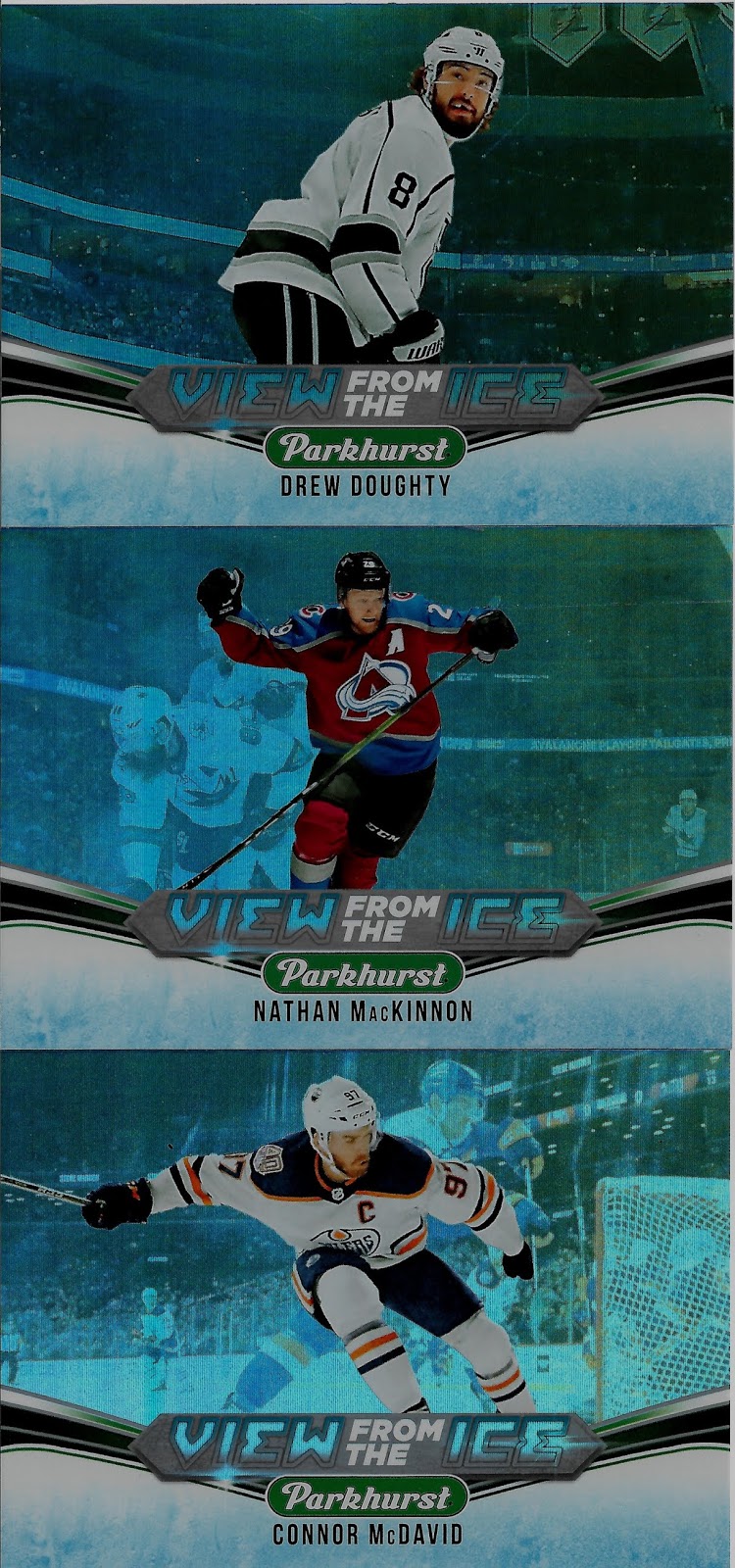
A returning sub-set is View From The Ice, rendering stunning photographs of Drew Doughty, Nathan MacKinnon and Connor McDavid via foil treatment:
And, last but not least in the foil inserts, the Parkies, featuring McDavid, Ryan Poehling, John Tavares, Matt Murray, Alexander Radulov, Alex Ovechkin, Zadina and Jonathan Marchessault:
I wasn't all that impressed with the first few packs and halfway through my first box, I was seriously doubting the relevance of my purchase - and the collation is pretty weak, as I have a bunch of doubles - but the fact that the cards aren't overly glossy and will be easy-ish to get signed felt more and more like a plus as the break went on, and the plethora of inserts just seemed to add to that as I kept digging.
This has turned into a solid 8/10.
Showing posts with label Silver Version. Show all posts
Thursday, December 26, 2019
Saturday, December 14, 2019
Tim Thomas Jersey Card
Spoiler Alert #1: I'm writing a book about the 100 best goalies of all time.
Spoiler Alert #2: it will differ from The Hockey News' list from last year.
Spoiler Alert #3: Tim Thomas will be included in it.
All of this was true before he came out this week and talked about the brain damage he's suffered because of all of his past concussions. It took a lot of courage to come forward and explain why he stepped away from the game. You can't help but feel for a guy who was so messed up he couldn't decide what to do or what to eat as he got out of bed, who had to resort to mapping out his days on paper and then choosing activities and willing himself to complete at least part of that list, whether it's crossing a couple of items off of it or half the list.
At the heart of it all stands a human being who has trouble living his daily life, his family who's been there for him the entire time, and a guy whose public life was fodder for sports journalists for a very short period of time.
We're talking about the best goalie in the world for a three-year run, who led the league in save percentage and goals-against average and won the Jennings Trophy and Vezina in 2008-09, and led the league in the same categories in 2010-11, winning another Vezina, but also bring the Stanley Cup to the city of Boston for the first time in 39 years, winning the Conn Smythe in one of the best displays of post-season goaltending since Patrick Roy's retirement.
In and of itself, that is amazing, as is the fact that he "made it" full-time in the NHL at the age of 30, became a true star at 33 when others actually start to decline, and was the last Québec Nordiques draft pick (217th overall, ninth round, 1994) to play in the NHL.
But there was also his political stances, his support of the Tea Party, his adherence to conspiracy theories ("Climate Change Is A Hoax" invented by companies who want to profit from selling "clean" energy), his refusal to join the Boston Bruins at the White House to meet President Barack Obama after their Cup win, and his support of Chik-Fil-A's homophobic and religious stances.
Needless to say, I disagree with all of the above political positions, but he had a right to have and express them. And none of that had any incidence on his play. It is a fact that in the 101 years of NHL hockey, the 110 years of professional hockey and the 125 years of the sport's existence, that three-year run alone makes him one of the 100 best to ever do the job, and his very good half-seasons (1997-98 and 1998-99) and elite-level full seasons (2001-02 and 2004-05) in Finland confirm it, too.
Granted, as a former goalie and goaltending coach to minor-league players and hockey schools myself, I would never teach his "style" to large groups of students, but some of his highlight-reel, Dominik Hasek-style moves are definitely worthy of further exploration, the same way Félix Potvin's paddle-down move had a decent four-year run and may warrant getting revisited in the future.
So here is Thomas, in his full Bruins glory, wearing their white (away) uniform, on the "Silver" two-jersey version of card #122 from Upper Deck's 2012-13 Artifacts set:
It features two black game-worn jersey swatches and is numbered 35/125.
Spoiler Alert #2: it will differ from The Hockey News' list from last year.
Spoiler Alert #3: Tim Thomas will be included in it.
All of this was true before he came out this week and talked about the brain damage he's suffered because of all of his past concussions. It took a lot of courage to come forward and explain why he stepped away from the game. You can't help but feel for a guy who was so messed up he couldn't decide what to do or what to eat as he got out of bed, who had to resort to mapping out his days on paper and then choosing activities and willing himself to complete at least part of that list, whether it's crossing a couple of items off of it or half the list.
At the heart of it all stands a human being who has trouble living his daily life, his family who's been there for him the entire time, and a guy whose public life was fodder for sports journalists for a very short period of time.
We're talking about the best goalie in the world for a three-year run, who led the league in save percentage and goals-against average and won the Jennings Trophy and Vezina in 2008-09, and led the league in the same categories in 2010-11, winning another Vezina, but also bring the Stanley Cup to the city of Boston for the first time in 39 years, winning the Conn Smythe in one of the best displays of post-season goaltending since Patrick Roy's retirement.
In and of itself, that is amazing, as is the fact that he "made it" full-time in the NHL at the age of 30, became a true star at 33 when others actually start to decline, and was the last Québec Nordiques draft pick (217th overall, ninth round, 1994) to play in the NHL.
But there was also his political stances, his support of the Tea Party, his adherence to conspiracy theories ("Climate Change Is A Hoax" invented by companies who want to profit from selling "clean" energy), his refusal to join the Boston Bruins at the White House to meet President Barack Obama after their Cup win, and his support of Chik-Fil-A's homophobic and religious stances.
Needless to say, I disagree with all of the above political positions, but he had a right to have and express them. And none of that had any incidence on his play. It is a fact that in the 101 years of NHL hockey, the 110 years of professional hockey and the 125 years of the sport's existence, that three-year run alone makes him one of the 100 best to ever do the job, and his very good half-seasons (1997-98 and 1998-99) and elite-level full seasons (2001-02 and 2004-05) in Finland confirm it, too.
Granted, as a former goalie and goaltending coach to minor-league players and hockey schools myself, I would never teach his "style" to large groups of students, but some of his highlight-reel, Dominik Hasek-style moves are definitely worthy of further exploration, the same way Félix Potvin's paddle-down move had a decent four-year run and may warrant getting revisited in the future.
So here is Thomas, in his full Bruins glory, wearing their white (away) uniform, on the "Silver" two-jersey version of card #122 from Upper Deck's 2012-13 Artifacts set:
It features two black game-worn jersey swatches and is numbered 35/125.
Tuesday, December 3, 2019
Johan Franzen Jersey Card
It's not getting any better for Mike Babcock's reputation, as Chris Chelios had things to say on the Spittin' Chicklets podcast, and Johan Franzen corroborated he was on the bad end of Babcock's moods, going so far as saying he was “the worst person I have ever met. A great coach, but he's a terrible
person, the worst I ever met. He’s a bully who was attacking people. It
could be a cleaner at the arena in Detroit or anybody. He would lay into
people without any reason.”
So not just scratching Mike Modano playing for his hometown Detroit Red Wings for ten straight games so he could retire with 1500 games played, scratching Jason Spezza in what would have been his first game as a member of his hometown Toronto Maple Leafs because it was against his former team - but actual verbal abuse rough enough to launch a player suffering from a concussion into a full-blown depression.
And Franzen came to Detroit the same year Babcock started, the 2005-06 season, playing two games in 2015-16, the year after Babcock left - and had been on LTIR since.
The Mule wasn't just a bit player who won an Olympic gold medal with Team Sweden in 2006 and a Stanley Cup with the Wings in 2008; he had 18 points in 16 games during that Cup run and 23 points in 23 games the following team when the Wings lost the the Pittsburgh Penguins in 7 games. He holds the team records for most game-winning goals in a single month (6), most goals in a single playoff series (9), most game-winners in a playoff year (5), most points in a playoff game (6), shares the team record for most consecutive playoff point streak (12 games, with Gordie Howe) and the mark for most goals in a post-season (13, with Henrik Zetterberg) and the NHL record for most points in a 40-game series (9).
In my lifetime, he's probably the third-best playoff performer I've seen play for Motown, after Nicklas Lidstrom and Zetterberg, ahead of Pavel Datsyuk, Mike Vernon, Steve Yzerman, Brendan Shanahan and Sergei Fedorov.
His regular-season numbers were nothing to sneeze at either, with four 25-goal seasons in five years - with a high of 34 in 2008-09 - and the one where he didn't put up those numbers on an even better pace, with 10 goals, 11 assists and 21 points in 23 games in 2009-10.
At 6'4" and 230 pounds, he wasn't physically weak, in case carrying the Wings on his back in the postseason didn't clue you in on that. He wasn't mentally weak either. But he still hasn't recovered from the physicality of the game coupled with the PTSD that came with Babcock piling on with his own shit.
I hope he can continue to improve as he turns 40 in 20 days, and lives a great retirement. He's more than earned it.
Here he is wearing the Red Wings' white (away) uniform on the dual jersey silver version of card #41 from Upper Deck's 2012-13 Artifacts set, numbered 80/125:
I got this one on Ebay a couple of weeks ago hoping to talk about Franzen again eventually, I just had no idea it would come so soon. It features two red game-worn jersey swatches.
Sunday, September 29, 2019
Éric Dazé Autograph Card
(As per years past, this is a twin-post with my "regular" blog, where I predicted the Chicago Blackhawks would finish sixth in the Central Division in 2019-20).
You may recall I featured a similar card of Éric Dazé back in 2015, #179 from In The Game's 1998-99 Be A Player collection, showing him in the team's classic red (then-away) uniform, signed on-card in black sharpie:
The scan is actually a poor reflection of the various shades of silver and gold alternating throughout the foil, with silver being the dominant colour, but you can tell it's different from the one from four years ago because the "accent aigü" on the final "é" of "Dazé" is farther away from his left leg.
Dazé was one of the lone bright spots of a decimated roster on the Hawks from the mid-1990s to the early 00s, before back pain cut his career short and limited him to 20 games in 2003-04 and 2005-06; he actually retired at age 30 after playing 11:56 in the opening period of the opening game in October 2005, when it was clear that he couldn't sustain the pace of NHL-level action despite five surgeries for a herniated disc.
That being said, the Montrealer was one of the best shooters of his era, ending his career with 226 goals in just 601 games and a shooting percentage of 14.1% in the Dead Puck Era, when the Rocket Richard Trophy was often awarded to players who didn't even hit the 50 mark. He tallied four 30-goal seasons (with a high of 38 at the age of 26 in 2001-02), and never had fewer than 22 even when playing in just 54 (2002-03) and 59 (1999-2000) games.
It was the era of the power forward, and the 6'6", 220-pound behemoth was right in his element. If only he didn't have to carry the offensive load by himself...
He suited up for Team Canada three times, winning gold at the 1995 World Juniors, where he was named to the tournament's All-Star Team.
It's a shame that a bad back and a season-long lockout (2004-05) robbed hockey fans of Dazé's prime. He was destined for great things and had already been a runner-up for the Calder and was starting to collect Lady Byng votes as well.
You may recall I featured a similar card of Éric Dazé back in 2015, #179 from In The Game's 1998-99 Be A Player collection, showing him in the team's classic red (then-away) uniform, signed on-card in black sharpie:
The scan is actually a poor reflection of the various shades of silver and gold alternating throughout the foil, with silver being the dominant colour, but you can tell it's different from the one from four years ago because the "accent aigü" on the final "é" of "Dazé" is farther away from his left leg.
Dazé was one of the lone bright spots of a decimated roster on the Hawks from the mid-1990s to the early 00s, before back pain cut his career short and limited him to 20 games in 2003-04 and 2005-06; he actually retired at age 30 after playing 11:56 in the opening period of the opening game in October 2005, when it was clear that he couldn't sustain the pace of NHL-level action despite five surgeries for a herniated disc.
That being said, the Montrealer was one of the best shooters of his era, ending his career with 226 goals in just 601 games and a shooting percentage of 14.1% in the Dead Puck Era, when the Rocket Richard Trophy was often awarded to players who didn't even hit the 50 mark. He tallied four 30-goal seasons (with a high of 38 at the age of 26 in 2001-02), and never had fewer than 22 even when playing in just 54 (2002-03) and 59 (1999-2000) games.
It was the era of the power forward, and the 6'6", 220-pound behemoth was right in his element. If only he didn't have to carry the offensive load by himself...
He suited up for Team Canada three times, winning gold at the 1995 World Juniors, where he was named to the tournament's All-Star Team.
It's a shame that a bad back and a season-long lockout (2004-05) robbed hockey fans of Dazé's prime. He was destined for great things and had already been a runner-up for the Calder and was starting to collect Lady Byng votes as well.
Monday, August 26, 2019
Antoine Bibeau Jersey Card
Antoine Bibeau was a sixth-round draft pick of the Toronto Maple Leafs in 2013 but has spent most of his time plying his trade at the AHL level, including the last couple of seasons with the San Jose Barracuda. He's been quoted as saying this summer that his goal coming into training camp is to force the San Jose Sharks to keep him as Martin Jones' backup in the NHL, despite not having played as well as 21-year-old Josef Korenar last season:
Still, the previous season, in his age 23 season, he represented the Barracuda in the AHL's All-Star Game, finishing with a 2.39 GAA, .919 save percentage and five shutouts in 43 games. He certainly still has potential, and his NHL-level statistics (a win, a loss and a 1.99 GAA in two games) do inspire some kind of confidence.
Bibeau has the rare distinction of having played for four (!!) different teams in the LHJMQ - the Lewiston MAINEiacs, Prince Edward Island Rocket, Charlottetown Islanders and Val d'Or Foreur - in his for seasons of Juniors. As a mater of fact, today's card shows him wearing the Foreurs' green (away) uniform, but contains a blue game-worn jersey swatch from his days in PEI:
That's the Silver Version of card #GUM-06 from In The Game's 2013-14 Between The Pipes set and Game-Used Jersey sub-set. He won the Hap Emms Trophy as the Memorial Cup's best goalie just months after this card was issued.
![]() |
| Courtesy of HockeyDB |
Bibeau has the rare distinction of having played for four (!!) different teams in the LHJMQ - the Lewiston MAINEiacs, Prince Edward Island Rocket, Charlottetown Islanders and Val d'Or Foreur - in his for seasons of Juniors. As a mater of fact, today's card shows him wearing the Foreurs' green (away) uniform, but contains a blue game-worn jersey swatch from his days in PEI:
That's the Silver Version of card #GUM-06 from In The Game's 2013-14 Between The Pipes set and Game-Used Jersey sub-set. He won the Hap Emms Trophy as the Memorial Cup's best goalie just months after this card was issued.
Labels:
2013-14,
Antoine Bibeau,
Between The Pipes,
Card,
CHL,
Foreurs De Val d'Or,
Game-Used Jersey,
Hockey,
In The Game,
Insert,
Jersey Card,
LHJMQ,
Prince Edward Island Rocket,
Silver Version,
Swatch Card,
variant
Monday, November 13, 2017
Shawn McEachern Autograph card
Shawn McEachern had an interesting career, twice scoring over 30 goals per season (31 in 1998-99 and 32 in 2000-01), twice coming close (28 goals in 1992-93 and 29 in 1999-2000), and suiting up for two stints each with the Pittsburgh Penguins (the team that drafted him 110th overall in 1987) and his hometown Boston Bruins.
His history with the Pens alone is worth looking into, as it took him four years to join the team after being drafted, playing with the Boston College Terriers for three years then Team USA at the 1992 Olympics (a fourth-place finish in Albertville), but after he scored his 28 goals, Pittsburgh sent him to the Los Angeles Kings for Marty McSorley in August 1994, only to trade back for him the following February, with Tomas Sandstrom, in exchange for... McSorley and Jim Paek.
That being said, as a Montrealer who was looking for other options to satisfy my hockey cravings other than via the Montréal Canadiens, it's his six seasons with the Ottawa Senators that defines the speedster for me: 142 goals, 162 assists and 304 points in 454 games right in the Dead Puck Era, on a team that would regularly finish with over 100 points per season (before the loser points came into effect).
The turn-of-the-millennium Sens were serious contenders, flying high with their skill during the season, but usually falling flat come playoff time, when the bullying Toronto Maple Leafs would just play dirty and knock them out, in more ways than one.
McEachern represented that team extremely well and was an accurate reflection of it: quick, opportune, and mostly getting the job done by giving his best effort. But something was missing - that finishing touch. As quick as McEachern was, as many goals as he's scored - 256 in the NHL, all told - his signature play was taking the puck in the neutral zone and zoom past a defender with a clear path to the goalie, sometimes on a two-on-one, as most of the team was made up of equally-fast and skilled players with good offensive instincts; except it didn't matter, because McEachern was going too fast for his own puck control ability, and he'd get tunnel vision, not seeing his teammate, not seeing any other move than to shoot right at the goalie. Sometimes it'd go in, and sometimes a rebound would go to a teammate, but the deeper in the postseason it got, the more the opposing goalies would just pull it in, stop play and erase the menace.
He was like the 1990s' Russ Courtnall that way, and where Courtnall was a member of Team Canada's 1991 Canada Cup victory, McEachern was on the American squad that won the inaugural 1996 World Cup.
And now he'll be immortalized as #15 in my Sens Numbers Project, with the silver signed insert version of card #248 from In The Game's 1998-99 Be A Player set:
It shows him wearing the Sens' best-looking, original garbs, sporting the alternate captain's "A".
His history with the Pens alone is worth looking into, as it took him four years to join the team after being drafted, playing with the Boston College Terriers for three years then Team USA at the 1992 Olympics (a fourth-place finish in Albertville), but after he scored his 28 goals, Pittsburgh sent him to the Los Angeles Kings for Marty McSorley in August 1994, only to trade back for him the following February, with Tomas Sandstrom, in exchange for... McSorley and Jim Paek.
That being said, as a Montrealer who was looking for other options to satisfy my hockey cravings other than via the Montréal Canadiens, it's his six seasons with the Ottawa Senators that defines the speedster for me: 142 goals, 162 assists and 304 points in 454 games right in the Dead Puck Era, on a team that would regularly finish with over 100 points per season (before the loser points came into effect).
The turn-of-the-millennium Sens were serious contenders, flying high with their skill during the season, but usually falling flat come playoff time, when the bullying Toronto Maple Leafs would just play dirty and knock them out, in more ways than one.
McEachern represented that team extremely well and was an accurate reflection of it: quick, opportune, and mostly getting the job done by giving his best effort. But something was missing - that finishing touch. As quick as McEachern was, as many goals as he's scored - 256 in the NHL, all told - his signature play was taking the puck in the neutral zone and zoom past a defender with a clear path to the goalie, sometimes on a two-on-one, as most of the team was made up of equally-fast and skilled players with good offensive instincts; except it didn't matter, because McEachern was going too fast for his own puck control ability, and he'd get tunnel vision, not seeing his teammate, not seeing any other move than to shoot right at the goalie. Sometimes it'd go in, and sometimes a rebound would go to a teammate, but the deeper in the postseason it got, the more the opposing goalies would just pull it in, stop play and erase the menace.
He was like the 1990s' Russ Courtnall that way, and where Courtnall was a member of Team Canada's 1991 Canada Cup victory, McEachern was on the American squad that won the inaugural 1996 World Cup.
And now he'll be immortalized as #15 in my Sens Numbers Project, with the silver signed insert version of card #248 from In The Game's 1998-99 Be A Player set:
It shows him wearing the Sens' best-looking, original garbs, sporting the alternate captain's "A".
Wednesday, November 1, 2017
Joe Murphy Autograph Card
I've featured Joe Murphy before, but at that time, I focused more on his time with the Edmonton Oilers, which was mostly rooted in success, including a starring role in the team's 1990 Stanley Cup championship as well as career-highs for goals (35), assists (47) and points (82) in 1991-92.
Today, I'd like to focus more on his, uh, eccentricities - if not just outright oddball behaviour. The 1999-2000 timeframe was particularly intense, as it started with his attending the New York Rangers' training camp, then signing with the Boston Bruins midway through camp without giving the Rangers a chance to match the offer, with someone from the team's staff allegedly throwing Murphy's equipment in the Hudson River in retaliation.
It didn't take long before he started telling his Boston teammates off, calling them "heartless" and "out of shape", and yelling at head coach Pat Burns in the locker room and on the bench, leading to the team suspending him for insubordination - which was actually negotiated down from having his contract terminated, as was the Bs' first reflex.
After a week on waivers, Washington Capitals GM George McPhee (now in charge of the Vegas Golden Knights' hockey operations) gave him his final chance to play in the NHL. He was so-so to finish the 1999-2000 season (13 points in 29 games in Washington), but 14 games into the 2000-01 campaign (1 goal, 5 assists and 6 points), he and a few teammates went out on the town after a team supper and Murphy got in trouble by insisting a specific lady get in his limousine and ride back with him to his hotel room, and - the lady refusing - probably out of fear of getting raped in the car in addition to just not wanting to; her male companion then struck Murphy with a blow to the head. With a bottle. Murphy was demoted to the AHL, refused to report, and went into a year-long legal battle, claiming Workers' Comp because the event happened while he was traveling for work. He lost both the case and the appeal.
He'd weirded out before, piling up his equipment into a pyramid with his sticks on top in a triangle shape, telling teammates and trainers not to undo his pile because "The mother ship's coming, and I want to make sure I'm ready to get on board".
Or when he told "Iron" Mike Keenan - of all coaches - "Joe-Joe is tired" when it was his turn to hit the ice. Yes, the guy who was calling the 1999-2000 Bruins (Joe Thornton, Anson Carter, captain Ray Bourque, Steve Heinze) lazy and out of shape was a flake and a sloth.
It's no wonder, really, that he had trouble finding work after a 25-goal season with the San Jose Sharks in 1998-99...
Speaking of which, this is what he looked like in teal:
That's the (silver) signed insert version of card #271 from In The Game's 1998-99 Be A Player set, which he signed on-card in thin black sharpie, adding his uniform number (17) at the end. That was not a good look for the Sharks, by the way.
Today, I'd like to focus more on his, uh, eccentricities - if not just outright oddball behaviour. The 1999-2000 timeframe was particularly intense, as it started with his attending the New York Rangers' training camp, then signing with the Boston Bruins midway through camp without giving the Rangers a chance to match the offer, with someone from the team's staff allegedly throwing Murphy's equipment in the Hudson River in retaliation.
It didn't take long before he started telling his Boston teammates off, calling them "heartless" and "out of shape", and yelling at head coach Pat Burns in the locker room and on the bench, leading to the team suspending him for insubordination - which was actually negotiated down from having his contract terminated, as was the Bs' first reflex.
After a week on waivers, Washington Capitals GM George McPhee (now in charge of the Vegas Golden Knights' hockey operations) gave him his final chance to play in the NHL. He was so-so to finish the 1999-2000 season (13 points in 29 games in Washington), but 14 games into the 2000-01 campaign (1 goal, 5 assists and 6 points), he and a few teammates went out on the town after a team supper and Murphy got in trouble by insisting a specific lady get in his limousine and ride back with him to his hotel room, and - the lady refusing - probably out of fear of getting raped in the car in addition to just not wanting to; her male companion then struck Murphy with a blow to the head. With a bottle. Murphy was demoted to the AHL, refused to report, and went into a year-long legal battle, claiming Workers' Comp because the event happened while he was traveling for work. He lost both the case and the appeal.
He'd weirded out before, piling up his equipment into a pyramid with his sticks on top in a triangle shape, telling teammates and trainers not to undo his pile because "The mother ship's coming, and I want to make sure I'm ready to get on board".
Or when he told "Iron" Mike Keenan - of all coaches - "Joe-Joe is tired" when it was his turn to hit the ice. Yes, the guy who was calling the 1999-2000 Bruins (Joe Thornton, Anson Carter, captain Ray Bourque, Steve Heinze) lazy and out of shape was a flake and a sloth.
It's no wonder, really, that he had trouble finding work after a 25-goal season with the San Jose Sharks in 1998-99...
Speaking of which, this is what he looked like in teal:
That's the (silver) signed insert version of card #271 from In The Game's 1998-99 Be A Player set, which he signed on-card in thin black sharpie, adding his uniform number (17) at the end. That was not a good look for the Sharks, by the way.
Saturday, October 21, 2017
Liam Liston Jersey Card
When he first started playing for the WHL's Brandon Wheat Kings, goalie Liam Liston was viewed as a top prospect - he even suited up in the 2011 Home Hardware CHL/NHL Top Prospects Game. After all, he spent most of his minor-league hockey with GAAs under 2.25 with decent save percentages. Sportsnet even asked him to pen a few blog posts ahead of the 2011 Draft, about player expectations and one piece mentioning his concussion issues.
We'll never know for sure what weighed heavier in Liston's never getting drafted, not just in 2011, but 2012 as well, but it's fair to say that the concussion that ended his 2010-11 postseason may have had an impact. His abysmal statistics the following year as well:
Here's what it looked like in comparison to his teammates, first with the Wheat Kings, a team that included future NHLers Mark Stone, Micheal Ferland, and Ryan Pulock:
Now let's have a look at how he fared with the Lethbridge Hurricanes (he did get the team's only shutout):
He's worst or second-worst by any metric, be it save percentage, wins percentage or goals-against average.
And his 20-year-old season with the Vancouver Giants was even worse:
I can relate, in a way, because I too was a star goalie in Bantam and Midget, and I too was brought into Juniors with some level of expectation, but Liston had the courage to play his chance out, whereas I was seen by the Laval Titan as not being a "team player" (they had two sayings: "every Titan has to always be ready to fight, especially the backup goalie", and "we all shave our heads into a Mohawk come playoff time", which would have been a shame, what with my rock star coif), leading to their sending me to the Halifax Mooseheads, who had a certain Jean-Sébastien Giguère in nets already and no available school where I could continue my post-secondary/not-university education, at which time I opted to retire.
Liston had the balls to take it as far as he could, and studied law later to boot. He has a stable life. I'm an independent musician and freelance writer/translator who lives paycheck-to-paycheck. He clearly has the better life and made the best choices, although we do have in common that we both teach youth hockey in our spare time.
Here he is wearing the Giants' white (home) uniform on card #M-42 from In The Game's 2012-13 Between The Pipes set and Game-Used Jersey sub-set:
It features a game-worn swatch from the 2011 CHL/NHL Prospects Game, according to ITG:
It's the Silver Version, too.
We'll never know for sure what weighed heavier in Liston's never getting drafted, not just in 2011, but 2012 as well, but it's fair to say that the concussion that ended his 2010-11 postseason may have had an impact. His abysmal statistics the following year as well:
![]() |
| From HockeyDB |
Now let's have a look at how he fared with the Lethbridge Hurricanes (he did get the team's only shutout):
He's worst or second-worst by any metric, be it save percentage, wins percentage or goals-against average.
And his 20-year-old season with the Vancouver Giants was even worse:
Liston had the balls to take it as far as he could, and studied law later to boot. He has a stable life. I'm an independent musician and freelance writer/translator who lives paycheck-to-paycheck. He clearly has the better life and made the best choices, although we do have in common that we both teach youth hockey in our spare time.
Here he is wearing the Giants' white (home) uniform on card #M-42 from In The Game's 2012-13 Between The Pipes set and Game-Used Jersey sub-set:
It features a game-worn swatch from the 2011 CHL/NHL Prospects Game, according to ITG:
It's the Silver Version, too.
Tuesday, July 11, 2017
Rick Tocchet Autograph Card
Rick Tocchet.
I wasn't a huge fan of his during his playing days, when he was a power forward comparable to Wendel Clark, Dino Ciccarelli, Brian Bellows and Ray Sheppard, a notch below the pre-eminent one of the 1980s (Cam Neely) and the perfected versions of the 1990s (Eric Lindros, Todd Bertuzzi).
That being said - and even when contextualizing that his best seasons took place between 1987 and 1993, at the height of NHL scoring prowess and right before the Dead Puck Era - one has to give him his dues: fans and head coaches loved him, as can be attested by his four (1989, 1990, 1991 and 1993) All-Star Game appearances; he reached the 40-goal plateau three times, twice with the Philadelphia Flyers (45 in 1988-89 and 40 in 1990-91) and once with the Pittsburgh Penguins (48 in 1992-93, which ranked third on the team behind Mario Lemieux's 69 and Kevin Stevens' 55); he surpassed the 100-point mark in 1992-93, one of four members of the Pens to do so that year, with Jaromir Jagr's 94 just shy of making it five; he won the Stanley Cup with Pittsburgh in 1991-92; and he holds the Flyers' career mark for Gordie Howe hat tricks (with 9), as well as the entire NHL's (with 18).
He also surpassed the 200-PIM mark four times during his career, and had at least 150 penalty minutes nine times.
He played for the Flyers (twice), the Pens, two half-seasons with the Los Angeles Kings and the same with the Boston Bruins and Phoenix Coyotes while I stopped actively following hockey, before going back to Philly to bookend a career that saw him score 440 regular-season goals with 512 assists for 952 points in 1144 games, with 2972 penalty minutes around all that production.
His playoff contributions amounted to 52 goals, 60 assists and 112 points with 471 penalty minutes in 145 games. He reached the Conference Finals twice with the Flyers, in 1987 and 2000.
After his playing career, he became an assistant coach (to Wayne Gretzky) with the Coyotes. His tenure was most notable for having been named the leader in a gambling ring that put Gretzky's wife, Janet Jones, in the spotlight in 2006.
He followed that up with a head coaching stint with the Tampa Bay Lightning, missing the playoffs twice with terrible records:
Keep in mind those teams included Martin St-Louis, Vincent Lecavalier and Steven Stamkos up front both years, and Alex Tanguay on left wing and Victor Hedman on defense the second...
And yet, now that he's helped the Pens to consecutive Cup wins as an assistant to head coach Mike Sullivan, he interviewed for many teams this summer, eventually finding a fit back to a two-time stomping ground - the Arizona Coyotes. None of the articles I've read mention how long his contract is for; then again, he's already the franchise's 18th head coach, the 7th since its move to the desert.
Speaking of which, here he is wearing the team's "Peyote Coyote" jersey design ("dark" away version), on the silver signed insert version of card #105 from In The Game's 1998-99 Be A Player set:
I miss those uniforms...
I wasn't a huge fan of his during his playing days, when he was a power forward comparable to Wendel Clark, Dino Ciccarelli, Brian Bellows and Ray Sheppard, a notch below the pre-eminent one of the 1980s (Cam Neely) and the perfected versions of the 1990s (Eric Lindros, Todd Bertuzzi).
That being said - and even when contextualizing that his best seasons took place between 1987 and 1993, at the height of NHL scoring prowess and right before the Dead Puck Era - one has to give him his dues: fans and head coaches loved him, as can be attested by his four (1989, 1990, 1991 and 1993) All-Star Game appearances; he reached the 40-goal plateau three times, twice with the Philadelphia Flyers (45 in 1988-89 and 40 in 1990-91) and once with the Pittsburgh Penguins (48 in 1992-93, which ranked third on the team behind Mario Lemieux's 69 and Kevin Stevens' 55); he surpassed the 100-point mark in 1992-93, one of four members of the Pens to do so that year, with Jaromir Jagr's 94 just shy of making it five; he won the Stanley Cup with Pittsburgh in 1991-92; and he holds the Flyers' career mark for Gordie Howe hat tricks (with 9), as well as the entire NHL's (with 18).
He also surpassed the 200-PIM mark four times during his career, and had at least 150 penalty minutes nine times.
He played for the Flyers (twice), the Pens, two half-seasons with the Los Angeles Kings and the same with the Boston Bruins and Phoenix Coyotes while I stopped actively following hockey, before going back to Philly to bookend a career that saw him score 440 regular-season goals with 512 assists for 952 points in 1144 games, with 2972 penalty minutes around all that production.
His playoff contributions amounted to 52 goals, 60 assists and 112 points with 471 penalty minutes in 145 games. He reached the Conference Finals twice with the Flyers, in 1987 and 2000.
After his playing career, he became an assistant coach (to Wayne Gretzky) with the Coyotes. His tenure was most notable for having been named the leader in a gambling ring that put Gretzky's wife, Janet Jones, in the spotlight in 2006.
He followed that up with a head coaching stint with the Tampa Bay Lightning, missing the playoffs twice with terrible records:
![]() |
| Courtesy of Wikipedia |
And yet, now that he's helped the Pens to consecutive Cup wins as an assistant to head coach Mike Sullivan, he interviewed for many teams this summer, eventually finding a fit back to a two-time stomping ground - the Arizona Coyotes. None of the articles I've read mention how long his contract is for; then again, he's already the franchise's 18th head coach, the 7th since its move to the desert.
Speaking of which, here he is wearing the team's "Peyote Coyote" jersey design ("dark" away version), on the silver signed insert version of card #105 from In The Game's 1998-99 Be A Player set:
I miss those uniforms...
Monday, April 10, 2017
Rob Blake Autograph Card
Depending how you look at it, the Los Angeles Kings either succumbed to public pressure or didn't fall prey to feelings and matters of the heart when they fired GM Dean Lombardi and head coach Darryl Sutter earlier today, i.e. the two architects of the team's pair of Stanley Cups.
The coach has yet to be named, but stepping into the spotlight as the general manager will be Rob Blake, the team's former two-time captain and Lombardi's assistant since 2013. He was on board for the 2014 Cup, and had also won one as a player with the Colorado Avalanche.
The question on everyone's mind is how the former Team Canada star will fare as a GM, whether he'll be more like Joe Sakic (currently in over his head and hurting the Avs' chances by not improving their defense) or more like Steve Yzerman (building a contender with his Tampa Bay Lightning).
Still, he's already in the Hall Of Fame as a Norris Trophy winner two-team captain (he also wore the "C" with the San Jose Sharks before retiring) and member of the Triple Gold Club (the 2001 Cup, 1994 and 1997 World Championship gold and 2002 Olympic gold); there's no chance he can ruin his playing legacy even if he fails to build a championship team in L.A.
Here he is as captain of the Kings, wearing their old white (with purple, black and silver accents) uniform, on the signed (silver) insert version of card #212 from In The Game's 1998-99 Be A Player set:
It's signed on-card in thin blue sharpie.
The coach has yet to be named, but stepping into the spotlight as the general manager will be Rob Blake, the team's former two-time captain and Lombardi's assistant since 2013. He was on board for the 2014 Cup, and had also won one as a player with the Colorado Avalanche.
The question on everyone's mind is how the former Team Canada star will fare as a GM, whether he'll be more like Joe Sakic (currently in over his head and hurting the Avs' chances by not improving their defense) or more like Steve Yzerman (building a contender with his Tampa Bay Lightning).
Still, he's already in the Hall Of Fame as a Norris Trophy winner two-team captain (he also wore the "C" with the San Jose Sharks before retiring) and member of the Triple Gold Club (the 2001 Cup, 1994 and 1997 World Championship gold and 2002 Olympic gold); there's no chance he can ruin his playing legacy even if he fails to build a championship team in L.A.
Here he is as captain of the Kings, wearing their old white (with purple, black and silver accents) uniform, on the signed (silver) insert version of card #212 from In The Game's 1998-99 Be A Player set:
It's signed on-card in thin blue sharpie.
Thursday, April 6, 2017
Steve Konowalchuk Autograph Card
The Washington Capitals have clinched the Presidents' Trophy for the second consecutive season, but getting out of the Metropolitan Division won't be a cakewalk, seeing as it's home to three of the top five teams in the league - points-wise, at least, although the division's basement-dwellers were among the worst in the league - but it must be pointed out that one of those will be eliminated when the Pittsburgh Penguins take on the Columbus Blue Jackets. Hopefully, the Jackets make it through.
The Caps really are a force, having the most offensive depth in the league (Alexander Ovechkin, Nicklas Backstrom, T.J. Oshie, Evgeny Kuznetsov, Justin Williams, André Burakovsky, Tom Wilson, Marcus Johansson, Lars Eller, Daniel Winnik, and Jay Beagle), the best goalie in the game in Braden Holtby, a very reliable defense that operates without a superstar (John Carlson, Dmitry Orlov, Matt Niskanen, Karl Alzner, Brooks Orpik, trade deadline acquisition Kevin Shattenkirk, Nate Schmidt, John Erskine and Taylor Chorney), and one of the best coaching minds in the league in Barry Trotz.
Here's an error card of former Cap two-way center Steve Konowalchuk (spelled "Konowalchuk"), showing him with the team's turn-of-the-millennium dark blue (away) uniform with the Capitol building logo, which is the signed silver version insert of card #13 from In The Game's 2000-01 Be A Player Signature Series set, autographed on-card in thin black sharpie:
When he first joined the Caps, who had drafted him 58th overall in 1991, he was slotted behind Dale Hunter, Dave Poulin, Michal Pivonka and Joé Juneau but climbed the ranks steadily, earning his teammates' respect enough to serve as captain (2001-03) until he was traded to the Colorado Avalanche. He could be depended upon for 40-some points each season in the era between the first two Gary Bettman-led lockouts (from 1995-96 until 2003-04).
He earned enough league-wide respect to not only be selected as a depth player for Team USA's 1996 World Cup run, but even to suit up in a game and help it earn the win. He also played in the 2000 (5th-place finish) and 2002 (7th place) World Championships.
Following his playing career, he spent time with the Avs in player development roles and two seasons as an assistant coach before becoming the WHL's Seattle Thunderbirds head coach in 2011-12; the team lost in the Finals last season and boasts an even better record (46-20-0, for a .681 win percentage) this year.
The Caps really are a force, having the most offensive depth in the league (Alexander Ovechkin, Nicklas Backstrom, T.J. Oshie, Evgeny Kuznetsov, Justin Williams, André Burakovsky, Tom Wilson, Marcus Johansson, Lars Eller, Daniel Winnik, and Jay Beagle), the best goalie in the game in Braden Holtby, a very reliable defense that operates without a superstar (John Carlson, Dmitry Orlov, Matt Niskanen, Karl Alzner, Brooks Orpik, trade deadline acquisition Kevin Shattenkirk, Nate Schmidt, John Erskine and Taylor Chorney), and one of the best coaching minds in the league in Barry Trotz.
Here's an error card of former Cap two-way center Steve Konowalchuk (spelled "Konowalchuk"), showing him with the team's turn-of-the-millennium dark blue (away) uniform with the Capitol building logo, which is the signed silver version insert of card #13 from In The Game's 2000-01 Be A Player Signature Series set, autographed on-card in thin black sharpie:
When he first joined the Caps, who had drafted him 58th overall in 1991, he was slotted behind Dale Hunter, Dave Poulin, Michal Pivonka and Joé Juneau but climbed the ranks steadily, earning his teammates' respect enough to serve as captain (2001-03) until he was traded to the Colorado Avalanche. He could be depended upon for 40-some points each season in the era between the first two Gary Bettman-led lockouts (from 1995-96 until 2003-04).
He earned enough league-wide respect to not only be selected as a depth player for Team USA's 1996 World Cup run, but even to suit up in a game and help it earn the win. He also played in the 2000 (5th-place finish) and 2002 (7th place) World Championships.
Following his playing career, he spent time with the Avs in player development roles and two seasons as an assistant coach before becoming the WHL's Seattle Thunderbirds head coach in 2011-12; the team lost in the Finals last season and boasts an even better record (46-20-0, for a .681 win percentage) this year.
Friday, March 24, 2017
Éric Fichaud Autograph Card
Sometimes, a player's career is one of opportunities and a string of luck - both good and bad.
Case in point: Éric Fichaud. A classic butterfly goalie in Québec's Patrick Roy era (1986-2001), LHJMQ scouts were high on him because of his perfect technique; he had moderate success in Midget AAA, but it was believed that increasing his reflex speed by upping his competition would mold him into an ideal starter - which he became, leading the Chicoutimi Saguenéens to a league championship and a Memorial Cup berth, which it lost to the Kamloops Blazers, but enabled Fichaud to nab top goalie honors.
The Toronto Maple Leafs jumped on the opportunity to draft him, despite having Félix Potvin in the fold, possibly thinking that having two Sags alumni in the crease would make for better teamwork. However, they couldn't pass up the opportunity to trade his rights to the New York Islanders the following season, for Benoît Hogue and a fifth-round pick; the trade shook Fichaud, however, and his play suffered, enabling Chicoutimi teammate Marc Denis to make his own mark and earn his time in the spotlight.
He had respectable numbers of an awful Islanders team, one so bad that Tommy Soderstrom just left the team in 1996-97, enabling Fichaud to back up Tommy Salo full-time and appear in 34 games himself.
Everything changed in 1997-98, when Fichaud suffered a shoulder injury that would first sideline him for six games, then hurt enough to warrant an operation, forcing him out for the remainder of the season. He would never again have a save percentage above .900 in the NHL and it, essentially, relegated him to "good AHL goalie" status, though his nine-game stint in Germany in 2001-02 with the Krefeld Penguins was particularly spectacular (1.64 GAA and .944 save percentage).
For the two years prior and the two after that season - which he split with the AHL's Manitoba Moose, who at the time were the Vancouver Canucks' top affiliate - he was on the Montréal Canadiens' depth chart, first with the Québec Citadelles, then the Hamilton Bulldogs.
From the 2004-05 season until 2007-08, he played in the semi-professional LNAH, first with the Québec RadioX team, then a single season with the St. Georges CRS Express.
Today, I look back at the 1998-99 season, which he split between the Nashville Predators (9 games, 3.22 GAA and .895 save percentage) and their AHL affiliate Milwaukee Admirals (8 games, 3.13 GAA and .90 save percentage) with the signed (silver) version of card #227 from In The Game's 1998-99 Be A Player set, signed in thin black sharpie:
I wasn't a fan of Koho equipment growing up, which I found to be too stiff and bulky. You may recall from earlier posts that despite my idol Patrick Roy making the switch to Koho from 1992-93 onward, I was mostly a Brian's guy myself.
Nowadays, Fichaud is a hockey analyst on TV. After a stint at Radio-Canada, he can now be seen and heard on TVA Sports.
Case in point: Éric Fichaud. A classic butterfly goalie in Québec's Patrick Roy era (1986-2001), LHJMQ scouts were high on him because of his perfect technique; he had moderate success in Midget AAA, but it was believed that increasing his reflex speed by upping his competition would mold him into an ideal starter - which he became, leading the Chicoutimi Saguenéens to a league championship and a Memorial Cup berth, which it lost to the Kamloops Blazers, but enabled Fichaud to nab top goalie honors.
The Toronto Maple Leafs jumped on the opportunity to draft him, despite having Félix Potvin in the fold, possibly thinking that having two Sags alumni in the crease would make for better teamwork. However, they couldn't pass up the opportunity to trade his rights to the New York Islanders the following season, for Benoît Hogue and a fifth-round pick; the trade shook Fichaud, however, and his play suffered, enabling Chicoutimi teammate Marc Denis to make his own mark and earn his time in the spotlight.
He had respectable numbers of an awful Islanders team, one so bad that Tommy Soderstrom just left the team in 1996-97, enabling Fichaud to back up Tommy Salo full-time and appear in 34 games himself.
Everything changed in 1997-98, when Fichaud suffered a shoulder injury that would first sideline him for six games, then hurt enough to warrant an operation, forcing him out for the remainder of the season. He would never again have a save percentage above .900 in the NHL and it, essentially, relegated him to "good AHL goalie" status, though his nine-game stint in Germany in 2001-02 with the Krefeld Penguins was particularly spectacular (1.64 GAA and .944 save percentage).
For the two years prior and the two after that season - which he split with the AHL's Manitoba Moose, who at the time were the Vancouver Canucks' top affiliate - he was on the Montréal Canadiens' depth chart, first with the Québec Citadelles, then the Hamilton Bulldogs.
From the 2004-05 season until 2007-08, he played in the semi-professional LNAH, first with the Québec RadioX team, then a single season with the St. Georges CRS Express.
Today, I look back at the 1998-99 season, which he split between the Nashville Predators (9 games, 3.22 GAA and .895 save percentage) and their AHL affiliate Milwaukee Admirals (8 games, 3.13 GAA and .90 save percentage) with the signed (silver) version of card #227 from In The Game's 1998-99 Be A Player set, signed in thin black sharpie:
I wasn't a fan of Koho equipment growing up, which I found to be too stiff and bulky. You may recall from earlier posts that despite my idol Patrick Roy making the switch to Koho from 1992-93 onward, I was mostly a Brian's guy myself.
Nowadays, Fichaud is a hockey analyst on TV. After a stint at Radio-Canada, he can now be seen and heard on TVA Sports.
Tuesday, February 7, 2017
Pat Falloon Autograph Card
10. X. Ten.
Ten days from now, I will lose my daytime job as a marketing consultant and translator at a market research firm I'd been with for over five years, after spending ten with another one before that. Both had been founded in 1984.
Which leads me to this Pat Falloon card I thought I'd feature today, featuring him wearing #10 with the Edmonton Oilers:
It's the (silver) signed insert version of card #205 from In The Game's 1998-99 Be A Player set, showing him wearing the Oilers' dark blue (away) turn-of-the-millennium uniform.
People like to rag on Falloon as a failed draft pick, and though the second-overall pick didn't reach the 1000-point or 1000-game mark, his 0.56 point-per-game average (322 points in 575 NHL games) is better than many. It just falls very short of Eric Lindros' (1.14), the guy who was picked ahead of him, relegating Falloon to the rank of "consolation prize"...
Which is how I'm trying to view my upcoming situation: I released two books in 2016. I played shows. I wrote new music. I have a shot at my first-overall passion, and I'm going for it; if it fails, I'll see what other options lie before me, and if and when I get there, I'll use it to make the best of both of us - the job and I - and how to use each other's strengths to make for a better team overall.
That's where I'm at, just past my mid-thirties.
Ten days from now, I will lose my daytime job as a marketing consultant and translator at a market research firm I'd been with for over five years, after spending ten with another one before that. Both had been founded in 1984.
Which leads me to this Pat Falloon card I thought I'd feature today, featuring him wearing #10 with the Edmonton Oilers:
It's the (silver) signed insert version of card #205 from In The Game's 1998-99 Be A Player set, showing him wearing the Oilers' dark blue (away) turn-of-the-millennium uniform.
People like to rag on Falloon as a failed draft pick, and though the second-overall pick didn't reach the 1000-point or 1000-game mark, his 0.56 point-per-game average (322 points in 575 NHL games) is better than many. It just falls very short of Eric Lindros' (1.14), the guy who was picked ahead of him, relegating Falloon to the rank of "consolation prize"...
Which is how I'm trying to view my upcoming situation: I released two books in 2016. I played shows. I wrote new music. I have a shot at my first-overall passion, and I'm going for it; if it fails, I'll see what other options lie before me, and if and when I get there, I'll use it to make the best of both of us - the job and I - and how to use each other's strengths to make for a better team overall.
That's where I'm at, just past my mid-thirties.
Thursday, February 2, 2017
Turner Stevenson Autograph Card
Montréal Canadiens captain Max Pacioretty has been on a tear lately, which may have something to do with playing with offensive genius Alexander Radulov and perhaps also with Team USA head coach John Tortorella singling him out during the World Cup. Or perhaps he has finally found the maturity to be able to lead an NHL team.
Whatever the reason, though, Pacioretty has now elevated his game to that of a big-time player, no longer a 30-goal scorer specializing in scoring hat tricks in 6-3 losses but an actual difference maker.
That's a pretty long detour to come back to Turner Stevenson, isn't it?
Pacioretty was a 22th overall pick in 2007, thought to be a power forward in the making; Stevenson was drafted 12th overall in 1990, with similar aspirations.
Obviously, with 75 goals in 644 games, Stevenson became something other than a first-line John LeClair-type, but no one can take away his Stanley Cup (2002-03, with the New Jersey Devils), something Pacioretty still lacks; the latter does have three straight 30-goal seasons and is five removed from a fourth this year, however.
I actually thought the 2005-06 Philadelphia Flyers, coached by Ken Hitchcock and featuring Stevenson in a reduced role but also the likes of Simon Gagné, Mike Richards, Jeff Carter, Peter Forsberg, Joni Pitkanen, R.J. Umberger, Éric Desjardins, Derian Hatcher, Petr Nedved, Donald Brashear and an injured Keith Primeau would win it again, but unfortunately, they were brought down by Carter and Richards' lack of maturity and hard-partying ways, as well as shoddy goaltending from Robert Esche and Antero Niittymaki.
And so today, reminiscing about the times when the Habs would select heavy guys from the WHL in the first round instead of American kids looking at four years of College Hockey, I have decided to feature the signed silver version of card #71 from In The Game's 1998-99 Be A Player set:
It shows him wearing the Canadiens' white (then-home) uniform, and a thin black-sharpied on-card autograph.
Whatever the reason, though, Pacioretty has now elevated his game to that of a big-time player, no longer a 30-goal scorer specializing in scoring hat tricks in 6-3 losses but an actual difference maker.
That's a pretty long detour to come back to Turner Stevenson, isn't it?
Pacioretty was a 22th overall pick in 2007, thought to be a power forward in the making; Stevenson was drafted 12th overall in 1990, with similar aspirations.
Obviously, with 75 goals in 644 games, Stevenson became something other than a first-line John LeClair-type, but no one can take away his Stanley Cup (2002-03, with the New Jersey Devils), something Pacioretty still lacks; the latter does have three straight 30-goal seasons and is five removed from a fourth this year, however.
I actually thought the 2005-06 Philadelphia Flyers, coached by Ken Hitchcock and featuring Stevenson in a reduced role but also the likes of Simon Gagné, Mike Richards, Jeff Carter, Peter Forsberg, Joni Pitkanen, R.J. Umberger, Éric Desjardins, Derian Hatcher, Petr Nedved, Donald Brashear and an injured Keith Primeau would win it again, but unfortunately, they were brought down by Carter and Richards' lack of maturity and hard-partying ways, as well as shoddy goaltending from Robert Esche and Antero Niittymaki.
And so today, reminiscing about the times when the Habs would select heavy guys from the WHL in the first round instead of American kids looking at four years of College Hockey, I have decided to feature the signed silver version of card #71 from In The Game's 1998-99 Be A Player set:
It shows him wearing the Canadiens' white (then-home) uniform, and a thin black-sharpied on-card autograph.
Monday, December 12, 2016
Daren Puppa Autograph Card
Daren Puppa had a decent career that was marred by inconsistency and back injuries toward the end. He was a runner-up for the Vezina Trophy in 1989-90 and had two clear-cut seasons as a #1 goalie, winning 31 games with the Buffalo Sabres in 1989-90 and 29 with the Tampa Bay Lightning in 1995-96, leading them to their first-ever playoff appearance.
He is also the only NHL player to have been selected twice in an expansion draft, as the Florida Panthers took him off the Toronto Maple Leafs' roster in the summer of 1993 but had him plucked by Tampa who, like the Ottawa Senators and San Jose Sharks, were allowed to each pick two players from the Panthers and Anaheim Mighty Ducks. This was a compensatory selection because it had been deemed that the Ducks and Cats had benefited from better drafting rules than the Sens, Bolts and Sharks in the two years prior.
Here is Puppa with the Bolts, wearing their original black (away) uniform, on the signed insert version of card #281 from In The Game's 1998-99 Be A Player set:
He signed it in thin black sharpie (bottom right).
Nowadays, he is a realtor in the Tampa area.
He is also the only NHL player to have been selected twice in an expansion draft, as the Florida Panthers took him off the Toronto Maple Leafs' roster in the summer of 1993 but had him plucked by Tampa who, like the Ottawa Senators and San Jose Sharks, were allowed to each pick two players from the Panthers and Anaheim Mighty Ducks. This was a compensatory selection because it had been deemed that the Ducks and Cats had benefited from better drafting rules than the Sens, Bolts and Sharks in the two years prior.
Here is Puppa with the Bolts, wearing their original black (away) uniform, on the signed insert version of card #281 from In The Game's 1998-99 Be A Player set:
He signed it in thin black sharpie (bottom right).
Nowadays, he is a realtor in the Tampa area.
Tuesday, October 25, 2016
Stu Grimson Autograph Card
There may not have been a better nickname for an NHL enforcer in the 1990s than Stu Grimson's "The Grim Reaper", although it took him years to actually get the hang of it and stop being a punching bag and magnet for penalty minutes.
Grimson was drafted twice: 186th overall (10th round) by the Detroit Red Wigs in 1983, and 143rd overall (7th round) by the Calgary Flames in 1985, after failing to land a contract with the Wings. He only played 4 games over two seasons with the Flames before switching organizations and making his mark with the Chicago Blackhawks, with whom he developed a heated rivalry against the Wings and their tough guys, Joey Kocur and Bob Probert.
He would eventually play for the Wings, though, in the lockout-shortened 1994-95 season, losing in the Stanley Cup Final to Jacques Lemaire's trap-happy New Jersey Devils, but his time with the Hawks and his two stints with the Mighty Ducks of Anaheim are what I remember best of him.
Upon retiring, he finished his law degree and became a lawyer, even working with the NHLPA during and after the 2004-05 lockout.
Nowadays, he's also a part-time colour commentator for the Nashville Predators, the team he last played for, in 2001-02, when he posted 2 points and 76 penalty minutes in 30 games.
Here he is with the Mighty Ducks' classic purple and teal (away) uniform, on the signed insert silver version of card #152 from In The Game's 1998-99 Be A Player set:
It features an on-card black sharpie signature.
He might be affable in real life and smiling on the card, but keep in mind he collected 2113 penalty minutes in 729regular-season NHL game sand another 120 in 42 playoff games. You did not want to mess with him on the ice from 1990 until 2001.
Grimson was drafted twice: 186th overall (10th round) by the Detroit Red Wigs in 1983, and 143rd overall (7th round) by the Calgary Flames in 1985, after failing to land a contract with the Wings. He only played 4 games over two seasons with the Flames before switching organizations and making his mark with the Chicago Blackhawks, with whom he developed a heated rivalry against the Wings and their tough guys, Joey Kocur and Bob Probert.
He would eventually play for the Wings, though, in the lockout-shortened 1994-95 season, losing in the Stanley Cup Final to Jacques Lemaire's trap-happy New Jersey Devils, but his time with the Hawks and his two stints with the Mighty Ducks of Anaheim are what I remember best of him.
Upon retiring, he finished his law degree and became a lawyer, even working with the NHLPA during and after the 2004-05 lockout.
Nowadays, he's also a part-time colour commentator for the Nashville Predators, the team he last played for, in 2001-02, when he posted 2 points and 76 penalty minutes in 30 games.
Here he is with the Mighty Ducks' classic purple and teal (away) uniform, on the signed insert silver version of card #152 from In The Game's 1998-99 Be A Player set:
It features an on-card black sharpie signature.
He might be affable in real life and smiling on the card, but keep in mind he collected 2113 penalty minutes in 729regular-season NHL game sand another 120 in 42 playoff games. You did not want to mess with him on the ice from 1990 until 2001.
Tuesday, August 30, 2016
Andrei Kovalenko Autograph Card
I mentioned Andrei Kovalenko a lot on this blog but hadn't featured yet, so I thought I could correct that while at the same time using him as one the two representatives of #51 (with Philippe Cornet) in my Oilers Numbers Project with the signed insert version of card #202 from In The Game's 1998-99 Be A Player set, showing him in the Edmonton Oilers' blue (away) turn-of-the-millennium uniform with the "Oil Driller" shoulder patches:
Kovalenko was an eighth round draft pick (148th overall) in 1990, one of three players selected by the Québec Nordiques (with Owen Nolan and Alexander Karpovtsev) who would end up as NHL regulars (Ryan Hughes and Brad Zavisha would also combine for a handful of games) in an exceptional draft crop.
The 68 points he posted as a rookie in 1992-93 were a career high, but he had posted nine goals in ten games with the Colorado Avalanche when they traded him to the Montréal Canadiens along with Martin Rucinsky and Jocelyn Thibault for the Habs' then-captain Mike Keane and the greatest clutch goaltender of all time, Patrick Roy.
Though he was traded to the Oilers just nine months later (for Scott Thornton), he did find a way into the Habs' record books by scoring the final goal at the famed Montréal Forum; he had his lone 30-goal season in the Albertan tundra (32, in 1996-97), before moving on to play with the Philadelphia Flyers, Carolina Hurricanes and Boston Bruins, then in the KHL for nine seasons, with the Yaroslavl Lokomotiv (4), Omsk Avangard (2), and Cherepovets Severstal (3).
He also made history with the Canes, scoring the very first goal at the RBC Center (now known as the PNC Arena) in Raleigh.
He is now the head of the KHLPA.
Kovalenko was an eighth round draft pick (148th overall) in 1990, one of three players selected by the Québec Nordiques (with Owen Nolan and Alexander Karpovtsev) who would end up as NHL regulars (Ryan Hughes and Brad Zavisha would also combine for a handful of games) in an exceptional draft crop.
The 68 points he posted as a rookie in 1992-93 were a career high, but he had posted nine goals in ten games with the Colorado Avalanche when they traded him to the Montréal Canadiens along with Martin Rucinsky and Jocelyn Thibault for the Habs' then-captain Mike Keane and the greatest clutch goaltender of all time, Patrick Roy.
Though he was traded to the Oilers just nine months later (for Scott Thornton), he did find a way into the Habs' record books by scoring the final goal at the famed Montréal Forum; he had his lone 30-goal season in the Albertan tundra (32, in 1996-97), before moving on to play with the Philadelphia Flyers, Carolina Hurricanes and Boston Bruins, then in the KHL for nine seasons, with the Yaroslavl Lokomotiv (4), Omsk Avangard (2), and Cherepovets Severstal (3).
He also made history with the Canes, scoring the very first goal at the RBC Center (now known as the PNC Arena) in Raleigh.
He is now the head of the KHLPA.
Sunday, August 7, 2016
Keith Primeau Autograph Card
Here's how I envision a conversation about the Carolina Hurricanes going, about pretty much any season in their history, including the one time I would have been wrong about them, in their surprising and unlikely Stanley Cup-winning season in 2006:
1: It's too bad about the Hurricanes, eh?
2: What?
1: That they're still the Hurricanes, and won't amount to much this season. Or ever.
Don't get me wrong, I have tremendous faith that their current crop of young defensemen will be very good, either as the Québec Nordiques or on different teams because you can't put two-thirds of your salary cap on just six players whose job isn't to get the puck on the opposite net as much as keep it off their own. Especially on a team that doesn't spend to the cap.
But for too long, the Canes have relied on too few offensive players - and usually the wrong ones. Jeff Skinner has been a magnet for disappointment since concussion issues took their toll; Eric Staal aged at a 2:1 ratio; Jordan Staal is a very good second-line center at best; and the rest of their forwards are usually scraps signed at a huge discount because they have just disappointed one or (too) many teams (Lee Stempniak, Alexander Semin).
Their goalies are usually overrated (Cam Ward, Trevor Kidd, Eddie Lack), and their defense has been made up of has-beens for a while now (Ron Hainsey, hi; hello, James Wisniewski) before they started drafting right (Justin Faulk, Noah Hanifin). Which has some people optimistic about next season.
It's like they started building themselves an identity around two-way tough players like Rod Brind'Amour and Keith Primeau, then changed their minds, then just sucked for no reason other than mismanagement and not being able to afford either talent or talent-seekers.
Just like the Hartford Whalers never amounted to much, so did the Canes when the team left Connecticut for Greensboro, then Raleigh. Urgh.
Speaking of Primeau, here he is looking uncomfortable in the Canes' white (then-home) uniform, on the signed insert version of card #23 from In The Game's 1998-99 Be A Player set:
It was signed on-card with a fading thin black sharpie, kind of like the Hurricanes themselves now that owner Peter Karmanos - a great man who has been responsible for many great things in American hockey, just not winning NHL franchises - is being sued by his children for money relating to the franchise, which could spell relocation within the next couple of years.
1: It's too bad about the Hurricanes, eh?
2: What?
1: That they're still the Hurricanes, and won't amount to much this season. Or ever.
Don't get me wrong, I have tremendous faith that their current crop of young defensemen will be very good, either as the Québec Nordiques or on different teams because you can't put two-thirds of your salary cap on just six players whose job isn't to get the puck on the opposite net as much as keep it off their own. Especially on a team that doesn't spend to the cap.
But for too long, the Canes have relied on too few offensive players - and usually the wrong ones. Jeff Skinner has been a magnet for disappointment since concussion issues took their toll; Eric Staal aged at a 2:1 ratio; Jordan Staal is a very good second-line center at best; and the rest of their forwards are usually scraps signed at a huge discount because they have just disappointed one or (too) many teams (Lee Stempniak, Alexander Semin).
Their goalies are usually overrated (Cam Ward, Trevor Kidd, Eddie Lack), and their defense has been made up of has-beens for a while now (Ron Hainsey, hi; hello, James Wisniewski) before they started drafting right (Justin Faulk, Noah Hanifin). Which has some people optimistic about next season.
It's like they started building themselves an identity around two-way tough players like Rod Brind'Amour and Keith Primeau, then changed their minds, then just sucked for no reason other than mismanagement and not being able to afford either talent or talent-seekers.
Just like the Hartford Whalers never amounted to much, so did the Canes when the team left Connecticut for Greensboro, then Raleigh. Urgh.
Speaking of Primeau, here he is looking uncomfortable in the Canes' white (then-home) uniform, on the signed insert version of card #23 from In The Game's 1998-99 Be A Player set:
It was signed on-card with a fading thin black sharpie, kind of like the Hurricanes themselves now that owner Peter Karmanos - a great man who has been responsible for many great things in American hockey, just not winning NHL franchises - is being sued by his children for money relating to the franchise, which could spell relocation within the next couple of years.
Saturday, July 30, 2016
Robbie Tallas Autograph Card
Robbie Tallas last played in the NHL when the Chicago Blackhawks sent him on the ice for 12 games in 2000-01, but he has suited up twice since becoming the Florida Panthers' goaltending coach, first after an injury to José Theodore, and the last time roughly a year ago when both starter Roberto Luongo and backup Al Montoya fell to injury in the same game.
He is mostly known for the 87 games (over five seasons) where he played for the Boston Bruins, posting a 26-35-10 record with the Bs (and going 2-7-0 with the Hawks), with a career 2.91 GAA and .891 save percentage (in the dead puck era).
Here he is wearing the Bruins' white (then-home) late-1990s uniform, on card #158 from In The Game's 1998-99 Be A Player set:
The Edmonton native and undrafted professional had his best pro seasons in 1997-98 in the NHL (6-3-3, 1.83 GAA, .926 save % and one shutout in 14 games in Boston) and in 2003-04 in Finland (8-8-4 record, 1.99 GAA, .922 save % and one shutout in 22 games with Hämeenlinnan Pallokerho (HPK, a.k.a. The Knights).
He's been a goaltending consultant/coach with the Panthers since 2009.
If he does ever play even a single minute of play replacing an injured goalie, he will appear in his 100th NHL game.
He is mostly known for the 87 games (over five seasons) where he played for the Boston Bruins, posting a 26-35-10 record with the Bs (and going 2-7-0 with the Hawks), with a career 2.91 GAA and .891 save percentage (in the dead puck era).
Here he is wearing the Bruins' white (then-home) late-1990s uniform, on card #158 from In The Game's 1998-99 Be A Player set:
The Edmonton native and undrafted professional had his best pro seasons in 1997-98 in the NHL (6-3-3, 1.83 GAA, .926 save % and one shutout in 14 games in Boston) and in 2003-04 in Finland (8-8-4 record, 1.99 GAA, .922 save % and one shutout in 22 games with Hämeenlinnan Pallokerho (HPK, a.k.a. The Knights).
He's been a goaltending consultant/coach with the Panthers since 2009.
If he does ever play even a single minute of play replacing an injured goalie, he will appear in his 100th NHL game.
Friday, July 15, 2016
Wade Redden Autograph Card
Were you tired of hearing about the Nashville Predators' defense this summer? And why could Wade Redden possibly have anything to do with any of that?
Well, Redden signed on as the Preds' player development coach for defensemen, where he'll get to mentor his own former mentor Lance Pitlick's son, Rem. All of Nashville's prospects on D stand to benefit from the experience of a former NHL alternate captain who has 1023 regular-season and 106 playoff NHL games on his resume despite spending two full seasons in the AHL just because his contract was too hefty to allow him to remain on the New York Rangers roster.
The kids will get to find out that even All-Stars (and Norris top-5 finishers) can take blindside hits and have to pick themselves up and keep fighting for their spots at times.
He has a World Cup title (2004) and two World Junior Championship gold medals (1995 and 1996) as a member of Team Canada, with whom he also won silver at the 2005 World Championships.
Here he is, sporting the Ottawa Senators' best-looking white (then-home) uniform, from In The Game's 1998-99 Be A Player set:
It's signed on-card in thin white sharpie.
Well, Redden signed on as the Preds' player development coach for defensemen, where he'll get to mentor his own former mentor Lance Pitlick's son, Rem. All of Nashville's prospects on D stand to benefit from the experience of a former NHL alternate captain who has 1023 regular-season and 106 playoff NHL games on his resume despite spending two full seasons in the AHL just because his contract was too hefty to allow him to remain on the New York Rangers roster.
The kids will get to find out that even All-Stars (and Norris top-5 finishers) can take blindside hits and have to pick themselves up and keep fighting for their spots at times.
He has a World Cup title (2004) and two World Junior Championship gold medals (1995 and 1996) as a member of Team Canada, with whom he also won silver at the 2005 World Championships.
Here he is, sporting the Ottawa Senators' best-looking white (then-home) uniform, from In The Game's 1998-99 Be A Player set:
It's signed on-card in thin white sharpie.
Subscribe to:
Posts (Atom)