Hockey runs in Marc Chouinard's veins; his father Jean played in the IHL, uncles Jacques (captain) and Pierre (alternate) suited up for the Québec Remparts in the LHJMQ and each wore a letter, uncle Guy played in the NHL for over a decade with the Atlanta Flames, Calgary Flames and St. Louis Blues before coaching in the LHJMQ for 30 years and in the Québec Collège system for the past decade or so, and cousin Éric Chouinard was a first-round selection of the Montréal Canadiens, so when Marc's name was called 32nd overall by the Winnipeg Jets in 1995, narry a soul was surprised.
Marc may have been 6'5" tall, he wasn't much over 200 pounds for a lot of his career, usually playing between 200 and 205, only reaching 218lbs in 2003-04; he was likely drafted to become a power forward, but even in the "Q" - a league that produced a fair portion of the NHL's toughest players from 1995 until the year-long lockout - he was more of a point-per-game gentlemanly player than a tough guy.
He had his best offensive seasons around the lockout, posting 11 goals and 21 points (with 17 penalty minutes) in 45 games in 2003-04 and 14 goals and 30 points (34 PIMs) in 74 games in 2005-06, both spent with the Minnesota Wild. He only started piling up penalty minutes when he moved to Europe, first with 30 points and 72 PIMs in 54 games over two seasons playing for Swtzerland's HC Fribourg-Gotteron, then 11 points and 20 penalty minutes in 19 games with the Cologne (Koln) Sharks in Germany in 2009-10. In both places, he was a much better point producer in the playoffs than the regular season, doing so at a near point-per-game clip.
I feel the best uniform he's worn, however, is the Mighty Ducks Of Anaheim's turn-of-the-millennium garbs, as seen on the signed insert version of card #18 from In The Game's 2001-02 Be A Player Signature Series set:
It looks darker in the scan than to the naked eye; it's really sharp in person, the silver and darker grey foil letting the uniform's colours pop out of the card. It is signed very clearly, in black sharpie.
Showing posts with label Mighty Ducks Of Anaheim. Show all posts
Wednesday, December 2, 2020
Tuesday, February 4, 2020
Tony Hrkac: Two Autographed Cards
(team and product links go to sponsored Amazon products, player links go to related pages on my blog, news links go to source pages)
The last time I featured two autographed Tony Hrkac cards, I purposely skimmed through his time with the Mighty Ducks of Anaheim because I knew I had this post as a back-up.
His 140 games with Anaheim was the third-most he spent with any one organization, after the 201 with the St. Louis Blues and 160 with the Atlanta Thrashers. His 38 points with the Mighty Ducks in 2000-01 at age 34 is his fifth-highest total in the NHL, coming in the heart of the Dead Puck Era and his even (+0) plus/minus rating was tied for second-best on the team, with only Antti Aalto falling into the positives at +1, in only 12 games, mind you. The team's stars were all in deep minuses: Paul Kariya (67 points, -9), Teemu Selanne (59 points, -8), Oleg Tverdovsky (53 points, -11), Marty McInnis (42 points, -21) and Matt Cullen (40 points, -23) all brought forth a negative differential, making life difficult on goalies Guy Hebert (41 games, 12-23-4, 2 shutouts, 3.12 GAA and .897 save percentage) and Jean-Sébastien Giguère (34 games, 11-17-5, 4 shutouts, 2.57 GAA and .911 save percentage).
Card #5 from Pacific's 2001-02 Pacific series encapsulates his time in California very well:
The purple (technically "eggplant") and jade uniform was their main away gear from the team's inception in 1993 until 2006, when Disney sold the team and it changed its look and took the "Mighty" out of its name to not interfere with Disney's copyrights from the kids' film franchise, with the team opting to modify its brand and look at the same time.
However, I mostly tend to remember Hrkac as a member of the Blues and Québec Nordiques, as the early 90s were when I followed the sport and the NHL the most religiously, and I also have him sporting the Nords' beautiful blue (away) uniform from the late 80s/early 90s, before they started incorporating red on the contours of the numbers:
That's card #172 from Topps' 1990-91 Bowman set, which enables me to enter Hrkac as #28 in my Nordiques Numbers Project. You might recall he's also there as #40, and he is a rare player who went from wearing a "regular" (read: below #35) number in 1989-90 to a "high number" (40 and up) in 1990-91; back in the day, it was customary for goalies to wear #1, #20, #29, or a number between 30 and 35, while tough guys and goons were given available numbers between 30 and 39 and other skaters typically had lower numbers - except for stars, who could get "the doubles" (11, 22, 44, 55, 66, 77, 88 and 99). The numbers above 40 were typically reserved for rookies who had yet to "earn" their lower number.
Hrkac signed these in blue sharpie when he came out of retirement at age 42, from 2008 to 2010, with the Houston Aeros of the AHL. His 2008-09 playoff run was particularly impressive, as he posted 14 points in 19 games in a deep postseason run.
He's been a pro scout with the Tampa Bay Lightning since 2015, who have acquired the likes of Anton Stralman, Michaël Bournival, Gabriel Dumont, Peter Budaj, Louis Domingue, Dan Girardi, Ryan McDonagh, Mikhail Sergachev, Eddie Pasquale, Cameron Gaunce, Danick Martel, J.T. Miller, Curtis McElhinney, Jan Rutta, Luke Schenn, Kevin Shattenkirk and Pat Maroon via other means than drafting during his tenure, so either he is passionate about my blog or he travels from Montréal to New York a lot.
The last time I featured two autographed Tony Hrkac cards, I purposely skimmed through his time with the Mighty Ducks of Anaheim because I knew I had this post as a back-up.
His 140 games with Anaheim was the third-most he spent with any one organization, after the 201 with the St. Louis Blues and 160 with the Atlanta Thrashers. His 38 points with the Mighty Ducks in 2000-01 at age 34 is his fifth-highest total in the NHL, coming in the heart of the Dead Puck Era and his even (+0) plus/minus rating was tied for second-best on the team, with only Antti Aalto falling into the positives at +1, in only 12 games, mind you. The team's stars were all in deep minuses: Paul Kariya (67 points, -9), Teemu Selanne (59 points, -8), Oleg Tverdovsky (53 points, -11), Marty McInnis (42 points, -21) and Matt Cullen (40 points, -23) all brought forth a negative differential, making life difficult on goalies Guy Hebert (41 games, 12-23-4, 2 shutouts, 3.12 GAA and .897 save percentage) and Jean-Sébastien Giguère (34 games, 11-17-5, 4 shutouts, 2.57 GAA and .911 save percentage).
Card #5 from Pacific's 2001-02 Pacific series encapsulates his time in California very well:
The purple (technically "eggplant") and jade uniform was their main away gear from the team's inception in 1993 until 2006, when Disney sold the team and it changed its look and took the "Mighty" out of its name to not interfere with Disney's copyrights from the kids' film franchise, with the team opting to modify its brand and look at the same time.
However, I mostly tend to remember Hrkac as a member of the Blues and Québec Nordiques, as the early 90s were when I followed the sport and the NHL the most religiously, and I also have him sporting the Nords' beautiful blue (away) uniform from the late 80s/early 90s, before they started incorporating red on the contours of the numbers:
That's card #172 from Topps' 1990-91 Bowman set, which enables me to enter Hrkac as #28 in my Nordiques Numbers Project. You might recall he's also there as #40, and he is a rare player who went from wearing a "regular" (read: below #35) number in 1989-90 to a "high number" (40 and up) in 1990-91; back in the day, it was customary for goalies to wear #1, #20, #29, or a number between 30 and 35, while tough guys and goons were given available numbers between 30 and 39 and other skaters typically had lower numbers - except for stars, who could get "the doubles" (11, 22, 44, 55, 66, 77, 88 and 99). The numbers above 40 were typically reserved for rookies who had yet to "earn" their lower number.
Hrkac signed these in blue sharpie when he came out of retirement at age 42, from 2008 to 2010, with the Houston Aeros of the AHL. His 2008-09 playoff run was particularly impressive, as he posted 14 points in 19 games in a deep postseason run.
He's been a pro scout with the Tampa Bay Lightning since 2015, who have acquired the likes of Anton Stralman, Michaël Bournival, Gabriel Dumont, Peter Budaj, Louis Domingue, Dan Girardi, Ryan McDonagh, Mikhail Sergachev, Eddie Pasquale, Cameron Gaunce, Danick Martel, J.T. Miller, Curtis McElhinney, Jan Rutta, Luke Schenn, Kevin Shattenkirk and Pat Maroon via other means than drafting during his tenure, so either he is passionate about my blog or he travels from Montréal to New York a lot.
Thursday, January 12, 2017
Jean-Sébastien Giguère Patch Card
Here's a pretend patch card manufactured by Upper Deck for their 2003-04 Trilogy set, featuring Jean-Sébastien Giguère of the Anaheim Mighty Ducks:
It's card #108 as per the back, probably a variant of the original.
I have featured Giguère many times before and will feature him many more times as well, as he was one of my regular pulls - and a goalie I admired very much. That Conn Smythe performance was one for the ages...
It's card #108 as per the back, probably a variant of the original.
I have featured Giguère many times before and will feature him many more times as well, as he was one of my regular pulls - and a goalie I admired very much. That Conn Smythe performance was one for the ages...
Tuesday, October 25, 2016
Stu Grimson Autograph Card
There may not have been a better nickname for an NHL enforcer in the 1990s than Stu Grimson's "The Grim Reaper", although it took him years to actually get the hang of it and stop being a punching bag and magnet for penalty minutes.
Grimson was drafted twice: 186th overall (10th round) by the Detroit Red Wigs in 1983, and 143rd overall (7th round) by the Calgary Flames in 1985, after failing to land a contract with the Wings. He only played 4 games over two seasons with the Flames before switching organizations and making his mark with the Chicago Blackhawks, with whom he developed a heated rivalry against the Wings and their tough guys, Joey Kocur and Bob Probert.
He would eventually play for the Wings, though, in the lockout-shortened 1994-95 season, losing in the Stanley Cup Final to Jacques Lemaire's trap-happy New Jersey Devils, but his time with the Hawks and his two stints with the Mighty Ducks of Anaheim are what I remember best of him.
Upon retiring, he finished his law degree and became a lawyer, even working with the NHLPA during and after the 2004-05 lockout.
Nowadays, he's also a part-time colour commentator for the Nashville Predators, the team he last played for, in 2001-02, when he posted 2 points and 76 penalty minutes in 30 games.
Here he is with the Mighty Ducks' classic purple and teal (away) uniform, on the signed insert silver version of card #152 from In The Game's 1998-99 Be A Player set:
It features an on-card black sharpie signature.
He might be affable in real life and smiling on the card, but keep in mind he collected 2113 penalty minutes in 729regular-season NHL game sand another 120 in 42 playoff games. You did not want to mess with him on the ice from 1990 until 2001.
Grimson was drafted twice: 186th overall (10th round) by the Detroit Red Wigs in 1983, and 143rd overall (7th round) by the Calgary Flames in 1985, after failing to land a contract with the Wings. He only played 4 games over two seasons with the Flames before switching organizations and making his mark with the Chicago Blackhawks, with whom he developed a heated rivalry against the Wings and their tough guys, Joey Kocur and Bob Probert.
He would eventually play for the Wings, though, in the lockout-shortened 1994-95 season, losing in the Stanley Cup Final to Jacques Lemaire's trap-happy New Jersey Devils, but his time with the Hawks and his two stints with the Mighty Ducks of Anaheim are what I remember best of him.
Upon retiring, he finished his law degree and became a lawyer, even working with the NHLPA during and after the 2004-05 lockout.
Nowadays, he's also a part-time colour commentator for the Nashville Predators, the team he last played for, in 2001-02, when he posted 2 points and 76 penalty minutes in 30 games.
Here he is with the Mighty Ducks' classic purple and teal (away) uniform, on the signed insert silver version of card #152 from In The Game's 1998-99 Be A Player set:
It features an on-card black sharpie signature.
He might be affable in real life and smiling on the card, but keep in mind he collected 2113 penalty minutes in 729regular-season NHL game sand another 120 in 42 playoff games. You did not want to mess with him on the ice from 1990 until 2001.
Sunday, September 18, 2016
Scott Young Autograph Card
The World Cup in underway, and with it endless debates about how Adidas is ruining hockey uniforms worse than Reebok did post-lockout, which is saying something. Do I agree? Mostly, yes, for their designs are a simplistic-yet-sub-par take on classics, their stripes on the side are annoying to the eye, and they lack imagination and creativity as a whole. Oh, and the whole ads on the uniforms thing.
Team Russia, the Czech Republic, Team Sweden and Team Finland are relatively true to their usual garbs, so that's fine, although the blue Finnish uniform feels like it's out of the 1990s ECHL a bit:
Team North America looks pretty decent in person, but it's nothing more than a compilation of the best bits of the New York Islanders' last two alternate uniforms:
Team USA and Team Canada are a mixed bag, and Team Europe, well, I'll give 'em points for originality, but that's pretty much it.
Which brings me to a uniform that the Mighty Ducks Of Anaheim once wore that Adidas would be fond of, what with their broad shoulder designs that go too low and useless stripes in odd places, on the signed insert version of card #143 from Pinnacle's 1997-98 Be A Player set:
That's Scott Young, who signed the card in black sharpie. Young's an international competition veteran who dressed for Team USA roughly a dozen times, including three Olympics (with silver in 2002), three World Junior Championships (with bronze in 1986), a handful of World Championships and was with the American team when they won the inaugural 1996 World Cup, posting 4 points (2 goals and 2 assists) in 7 games.
Team Russia, the Czech Republic, Team Sweden and Team Finland are relatively true to their usual garbs, so that's fine, although the blue Finnish uniform feels like it's out of the 1990s ECHL a bit:
Team North America looks pretty decent in person, but it's nothing more than a compilation of the best bits of the New York Islanders' last two alternate uniforms:
Team USA and Team Canada are a mixed bag, and Team Europe, well, I'll give 'em points for originality, but that's pretty much it.
Which brings me to a uniform that the Mighty Ducks Of Anaheim once wore that Adidas would be fond of, what with their broad shoulder designs that go too low and useless stripes in odd places, on the signed insert version of card #143 from Pinnacle's 1997-98 Be A Player set:
That's Scott Young, who signed the card in black sharpie. Young's an international competition veteran who dressed for Team USA roughly a dozen times, including three Olympics (with silver in 2002), three World Junior Championships (with bronze in 1986), a handful of World Championships and was with the American team when they won the inaugural 1996 World Cup, posting 4 points (2 goals and 2 assists) in 7 games.
Saturday, April 30, 2016
Corey Perry Jersey Card
Inevitably, the Anaheim Ducks lost a Game 7 after winning their division; as was the case when he was with the Washington Capitals, head coach Bruce Boudreau was soon dismissed. Goal-less sniper Corey Perry (who I dropped in my keeper pool along with Ryan Getzlaf in favor of Henrik Lundqvist and Jakub Voracek) shouldered the blame, but it was still on the coach to devise a strategy to beat his adversaries and to have the know-how to prepare his team for the ultimate game.
Boudreau. Who is 1-7 in Game 7s. And whose teams - always the highest seed and, thus, playing at home - inevitably fall behind in the decisive game.
Perry can cry that his four assists in seven games are a disappointment, but Boudreau never provided him with an environment in which he could get better match-ups against the Nashville Predators' best defensemen, nor with a game plan that would use his strengths against the opponents' weaknesses.
Perry's won the Stanley Cup and three gold medals with Team Canada (at the 2005 World Juniors as well as the 2010 and 2014 Olympics); he can play under pressure, he can play a disciplined game (apart from not giving cheap shots, which come just after goal scoring as his main contributions to the game), he's experienced enough to let the opportunities come to him and not force a play that will lead to an awful mistake. He's a safe player to have on the ice. He shouldn't take the blame by himself.
Here is the 2010-11 Hart and Maurice Richard winner wearing the Mighty Ducks of Anaheim's purple (away) uniform from Fleer's 2005-06 Fleer Ultra collection and Scoring Kings sub-set, manufactured by Upper Deck:
It features a white swatch from a jersey that was worn in a rookie photo shoot.
Boudreau. Who is 1-7 in Game 7s. And whose teams - always the highest seed and, thus, playing at home - inevitably fall behind in the decisive game.
Perry can cry that his four assists in seven games are a disappointment, but Boudreau never provided him with an environment in which he could get better match-ups against the Nashville Predators' best defensemen, nor with a game plan that would use his strengths against the opponents' weaknesses.
Perry's won the Stanley Cup and three gold medals with Team Canada (at the 2005 World Juniors as well as the 2010 and 2014 Olympics); he can play under pressure, he can play a disciplined game (apart from not giving cheap shots, which come just after goal scoring as his main contributions to the game), he's experienced enough to let the opportunities come to him and not force a play that will lead to an awful mistake. He's a safe player to have on the ice. He shouldn't take the blame by himself.
Here is the 2010-11 Hart and Maurice Richard winner wearing the Mighty Ducks of Anaheim's purple (away) uniform from Fleer's 2005-06 Fleer Ultra collection and Scoring Kings sub-set, manufactured by Upper Deck:
It features a white swatch from a jersey that was worn in a rookie photo shoot.
Wednesday, February 17, 2016
Jean-Sébastien Giguère Jersey Card
For the longest time, my memories of this Jean-Sébastien Giguère card were that it was a one that contained a piece of a game-used glove; I was wrong:
As you can see, though the sub-set is called Great Gloves, it actually contains a white game-worn jersey swatch under a goalie-shaped die-cut hole. It's card #GG-JG from Upper Deck's 2002-03 Mask Collection set, which I was once offered $30 for.
It shows J.S. Giguère in perhaps the Mighty Ducks of Anaheim's best white (then-home) uniform, devoid of purple and where teal isn't overly dominant a colour, and black and grey make for perfect highlights.
The Conn Smythe and Stanley Cup winner, at this point, was wearing the same equipment - Koho - as his boyhood idol, Patrick Roy, and the card not only shows this extremely well, but it also shows the square butterfly drop with which he would stifle opponents during his prime.
As you can see, though the sub-set is called Great Gloves, it actually contains a white game-worn jersey swatch under a goalie-shaped die-cut hole. It's card #GG-JG from Upper Deck's 2002-03 Mask Collection set, which I was once offered $30 for.
It shows J.S. Giguère in perhaps the Mighty Ducks of Anaheim's best white (then-home) uniform, devoid of purple and where teal isn't overly dominant a colour, and black and grey make for perfect highlights.
The Conn Smythe and Stanley Cup winner, at this point, was wearing the same equipment - Koho - as his boyhood idol, Patrick Roy, and the card not only shows this extremely well, but it also shows the square butterfly drop with which he would stifle opponents during his prime.
Tuesday, September 22, 2015
Paul Kariya Jersey Card
Remember when a player scoring 50 goals in a single season happened enough for card companies to have complete sub-sets of them in their card collections? Last season, only Alex Ovechkin reached that milestone, marking the sixth time he's reached it; there are only seven other active NHLers with 50-goal seasons, and they are: Jaromir Jagr (1995-96, 2000-01, and 2005-06), Jarome Iginla (2001-02 and 2007-08), Vincent Lecavalier (2006-07), Sidney Crosby (2009-10), Steven Stamkos (2009-10 and 2011-12), Corey Perry (2010-11), and Evgeni Malkin (2011-12), it in addition to Ovi (2005-06, 2007-08, 2008-09, 2009-10, 2013-14 and 2014-15), as well as Dany Heatley (2005-06 and 2006-07) and Ilya Kovalchuk (2005-06 and 2007-08), who will be playing overseas this year. That doesn't make for a huge set.
The following card comes from Upper Deck's 2002-03 Series 2 collection's Reaching Fifty sub-set, which included the likes of Brett Hull, Peter Bondra, Iginla, Jagr, Wayne Gretzky, John LeClair, Joe Sakic, Keith Tkachuk, Mario Lemieux, Mike Modano, Pavel Bure, Sergei Fedorov, Steve Yzerman, and this one, #50-PK in the set, Paul Kariya:
It shows him wearing the Mighty Ducks Of Anaheim's purple (then-away) uniform, though the consecutive white and grey lines were actually from the white (home) jersey. Unlike the previous time I've featured him, though, he has actually worn this one in an NHL game.
He has never won the Stanley Cup, but does have two Lady Byng trophies at home and made the First All-Star Team three times and Second All-Star Team twice, in addition to being nominated for the Hart a couple of times and playing in seven All-Star Games. He has suited up for Team Canada several times, winning gold medals at the 1993 World Juniors, 1994 World championships and 2002 Olympics, and silver at the 1991 Phoenix Cup (the then-name of the U-18 tournament), 1994 Olympics and 1996 World Championships.
He had to retire after 15 seasons due to concussions, and has since been outspoken about the dangers of players returning from them too soon - though he doesn't do so in hockey-related environments, having even shunned his good friend Teemu Selanne's jersey retirement ceremony.
His 989 points in 989 games are a big achievement, particularly the fact that most of it occurred in the Dead Puck Era. I've very happy I got this card in a trade for a couple of Eric Lindros cards, and a double of a Peter Forsberg jersey card I'll get to here eventually.
The following card comes from Upper Deck's 2002-03 Series 2 collection's Reaching Fifty sub-set, which included the likes of Brett Hull, Peter Bondra, Iginla, Jagr, Wayne Gretzky, John LeClair, Joe Sakic, Keith Tkachuk, Mario Lemieux, Mike Modano, Pavel Bure, Sergei Fedorov, Steve Yzerman, and this one, #50-PK in the set, Paul Kariya:
It shows him wearing the Mighty Ducks Of Anaheim's purple (then-away) uniform, though the consecutive white and grey lines were actually from the white (home) jersey. Unlike the previous time I've featured him, though, he has actually worn this one in an NHL game.
He has never won the Stanley Cup, but does have two Lady Byng trophies at home and made the First All-Star Team three times and Second All-Star Team twice, in addition to being nominated for the Hart a couple of times and playing in seven All-Star Games. He has suited up for Team Canada several times, winning gold medals at the 1993 World Juniors, 1994 World championships and 2002 Olympics, and silver at the 1991 Phoenix Cup (the then-name of the U-18 tournament), 1994 Olympics and 1996 World Championships.
He had to retire after 15 seasons due to concussions, and has since been outspoken about the dangers of players returning from them too soon - though he doesn't do so in hockey-related environments, having even shunned his good friend Teemu Selanne's jersey retirement ceremony.
His 989 points in 989 games are a big achievement, particularly the fact that most of it occurred in the Dead Puck Era. I've very happy I got this card in a trade for a couple of Eric Lindros cards, and a double of a Peter Forsberg jersey card I'll get to here eventually.
Sunday, May 31, 2015
Tomas Sandstrom Autograph Card
Someone asked Daniel Brière recently how he'd feel about retiring at this point, just 27 games shy of #1000, and I loved his answer: ''With the two lock-outs, I would have reached that milestone already. Plus, with all the playoff games in which I was just as productive as in the regular season, we're way past 1000. And I played 973 more than some so-called experts had predicted considering my size (5'9'')''.
And that got me thinking about all the players who narrowly missed milestones, such as Martin Brodeur (9 wins short of 700, 3 losses short of 400), Rick Middleton (988 points), Brett Hull (1391 points), Luc Robitaille (1394 points), and Paul Coffey (396 goals).
And one player I've talked about a few years ago who finished with 857 points in 983 games, Tomas Sandstrom, seen here as a member of the Anaheim Mighty Ducks, sporting their white (home) late-1990s uniform:
It's the signed insert version of card #153 from In The Game's 1998-99 Be A Player set, featuring a thin black-sharpied autograph.
His playing style was similar to that of Esa Tikkanen, where he had good size for his era (6-foot, 200 pounds), good speed, good hands, a great accurate shot, and a mouth that never stopped yapping, with the bonus of never backing down from challenges and answering the bell when he ignited fires, although not so much with his fists as, say, perhaps with his stick or elbows.
Sandstrom's most memorable Stanley Cup run was when he posted 25 points in 24 games in 1992-93 with Wayne Gretzky's Los Angeles Kings, which he ultimately lost to Patrick Roy's Montréal Canadiens, but he did enjoy one that ended with a Cup win, in 1996-97, with the Detroit Red Wings, where he had 4 assists (and 24 penalty minutes) in 20 games for Scotty Bowman's team.
He played his final NHL season in Anaheim before closing out his career with three more in Sweden. Of note that while he was born in Finland, he is a Swede and played for the Tre Kronor internationally. Then again, the history between the two countries is reminiscent of that between Slovakia and the Czech Republic or Québec and Canada in that each one's largest minority consists of the other's peoples, more or less, and their respective rights are (mostly) protected in their constitutions. And, to some extent, wouldn't most of the world's problems be solved if dual-country overlapping borders and dual citizenship were a more common occurence?
Anyhow, World Peace - like the Anaheim Ducks' Stanley Cup aspirations - is not for this year.
And that got me thinking about all the players who narrowly missed milestones, such as Martin Brodeur (9 wins short of 700, 3 losses short of 400), Rick Middleton (988 points), Brett Hull (1391 points), Luc Robitaille (1394 points), and Paul Coffey (396 goals).
And one player I've talked about a few years ago who finished with 857 points in 983 games, Tomas Sandstrom, seen here as a member of the Anaheim Mighty Ducks, sporting their white (home) late-1990s uniform:
It's the signed insert version of card #153 from In The Game's 1998-99 Be A Player set, featuring a thin black-sharpied autograph.
His playing style was similar to that of Esa Tikkanen, where he had good size for his era (6-foot, 200 pounds), good speed, good hands, a great accurate shot, and a mouth that never stopped yapping, with the bonus of never backing down from challenges and answering the bell when he ignited fires, although not so much with his fists as, say, perhaps with his stick or elbows.
Sandstrom's most memorable Stanley Cup run was when he posted 25 points in 24 games in 1992-93 with Wayne Gretzky's Los Angeles Kings, which he ultimately lost to Patrick Roy's Montréal Canadiens, but he did enjoy one that ended with a Cup win, in 1996-97, with the Detroit Red Wings, where he had 4 assists (and 24 penalty minutes) in 20 games for Scotty Bowman's team.
He played his final NHL season in Anaheim before closing out his career with three more in Sweden. Of note that while he was born in Finland, he is a Swede and played for the Tre Kronor internationally. Then again, the history between the two countries is reminiscent of that between Slovakia and the Czech Republic or Québec and Canada in that each one's largest minority consists of the other's peoples, more or less, and their respective rights are (mostly) protected in their constitutions. And, to some extent, wouldn't most of the world's problems be solved if dual-country overlapping borders and dual citizenship were a more common occurence?
Anyhow, World Peace - like the Anaheim Ducks' Stanley Cup aspirations - is not for this year.
Monday, January 12, 2015
Teemu Selanne Jersey Card
It was just a few hours ago that the Anaheim Ducks retired Teemu Selanne's number, in an hour-and-a-half ceremony that was classy, solemn, and yet a tad lengthy (the jersey itself could have taken less than 8 minutes to get to the rafters, for example, even Selanne and his family looked at a loss at some point), but more than his speech or the rising itself, what got to me the most was that both the Ducks and the Winnipeg Jets (not quite the franchise that had drafted him, but its spiritual successor of sorts) wore not just Selanne jerseys, but different ones, with the Jets sporting their early-to-mid-1990s white uniform (with horizontal arm stripes), and some Ducks even sporting the much-maligned Disney third uniform (and too many orange ones from last year's Stadium Series, probably so they could sell whatever's left over):
By now, I'm sure you're aware he's going to be a first-ballot Hall Of Famer. Before even coming to North America, he won the Finnish League's trophies for best goal-scorer, most gentlemanly player and his team (Jokerit Helsinki) won its league championship.
He holds the NHL rookie scoring records with an astounding 76 goals and 132 points, and finished his career with 684 goals (good for 11th of all-time) and 1457 points (15th of all-time) in 1451 games. The only team with which he was far from the point-per-game rhythm was his season with the Colorado Avalanche, where his 16 goals and 32 points in 78 games were a bit of a disappointment.
As a member of the Ducks franchise, he leads the team with 457 career goals, and his 988 points are just short of the 1000 mark. He also had 44 goals and 88 points in 130 playoff games, including 15 points in 21 games in 2006-07 when he won the Stanley Cup.
Both his 500th and 600th goals were scored against the Avs.
Sure, he had four 100-point seasons and two more in the 90s, but his point production that struck me the most were his 80 points in 73 games at the age of 39 in 2010-11. He was also - fittingly - the first recipient of the Maurice 'Rocket' Richard Trophy as top goal scorer in 1998-99, marking the third time he led the league in goals.
He also won a Masterton Trophy and was a perennial contender for the Lady Byng and Hart as well, though he was often a finalist but never a winner of those. He did end up on two end-of-season First All-Star Teams, and two Second All-Star Teams as well, and played in a total of 10 All-Star Games.
Internationally, the Finnish Flash has probably won his own weight in medals despite playing for often-neglected and perennial underdogs Team Finland, often classified behind Canada, the United States, Russia and Sweden if only because Finland has a smaller population. Still, he has a silver (2006) and three bronze (1998, 2010, and 2014) Olympic medals, and his 43 career points at the Games are, indeed, an IIHF record, and he also has silver (1999) and bronze (2008) medals from the World Championships. He was named the MVP of the 2014 Games and the best forward of the 2006 ones, and MVP of the 1999 Worlds.
I wrote to him in April, and I never really expected an answer back - I just wanted him to know how I felt about him as a player and as the classy human that he is. I tried to save up enough money for a trip to his final game in Anaheim, but I just couldn't get it together fast enough. It turned out to be a tear-inducer, though.
I have a couple of jersey cards of his, and I thought I could feature this one today, from Upper Deck's 2000-01 Pros & Prospects set (#TS of the Game Jersey sub-set), showing him with the Mighty Ducks Of Anaheim's classic white (home) uniform and featuring a black swatch:
The Finnish Flash retired as one of the most charismatic players in the game; Grandfather Time, Jaromir Jagr, seems poised to take up the mantle, but Selanne will never be forgotten.
We could think of no better way to honour Teemu. pic.twitter.com/h0SUmQJlAZ
— Winnipeg Jets (@NHLJets) January 12, 2015
By now, I'm sure you're aware he's going to be a first-ballot Hall Of Famer. Before even coming to North America, he won the Finnish League's trophies for best goal-scorer, most gentlemanly player and his team (Jokerit Helsinki) won its league championship.
He holds the NHL rookie scoring records with an astounding 76 goals and 132 points, and finished his career with 684 goals (good for 11th of all-time) and 1457 points (15th of all-time) in 1451 games. The only team with which he was far from the point-per-game rhythm was his season with the Colorado Avalanche, where his 16 goals and 32 points in 78 games were a bit of a disappointment.
As a member of the Ducks franchise, he leads the team with 457 career goals, and his 988 points are just short of the 1000 mark. He also had 44 goals and 88 points in 130 playoff games, including 15 points in 21 games in 2006-07 when he won the Stanley Cup.
Both his 500th and 600th goals were scored against the Avs.
Sure, he had four 100-point seasons and two more in the 90s, but his point production that struck me the most were his 80 points in 73 games at the age of 39 in 2010-11. He was also - fittingly - the first recipient of the Maurice 'Rocket' Richard Trophy as top goal scorer in 1998-99, marking the third time he led the league in goals.
He also won a Masterton Trophy and was a perennial contender for the Lady Byng and Hart as well, though he was often a finalist but never a winner of those. He did end up on two end-of-season First All-Star Teams, and two Second All-Star Teams as well, and played in a total of 10 All-Star Games.
Internationally, the Finnish Flash has probably won his own weight in medals despite playing for often-neglected and perennial underdogs Team Finland, often classified behind Canada, the United States, Russia and Sweden if only because Finland has a smaller population. Still, he has a silver (2006) and three bronze (1998, 2010, and 2014) Olympic medals, and his 43 career points at the Games are, indeed, an IIHF record, and he also has silver (1999) and bronze (2008) medals from the World Championships. He was named the MVP of the 2014 Games and the best forward of the 2006 ones, and MVP of the 1999 Worlds.
I wrote to him in April, and I never really expected an answer back - I just wanted him to know how I felt about him as a player and as the classy human that he is. I tried to save up enough money for a trip to his final game in Anaheim, but I just couldn't get it together fast enough. It turned out to be a tear-inducer, though.
I have a couple of jersey cards of his, and I thought I could feature this one today, from Upper Deck's 2000-01 Pros & Prospects set (#TS of the Game Jersey sub-set), showing him with the Mighty Ducks Of Anaheim's classic white (home) uniform and featuring a black swatch:
The Finnish Flash retired as one of the most charismatic players in the game; Grandfather Time, Jaromir Jagr, seems poised to take up the mantle, but Selanne will never be forgotten.
Thursday, December 11, 2014
Rob Niedermayer: Two Jersey Cards
One thing that's cool about follow-up sets is when they put the effort to make a player collectable by showing him wearing different uniforms on the cards, such as these two cards of Rob Niedermayer from Upper Deck:
The card on top, showing him wearing the Mighty Ducks Of Anaheim's white (then-home) jersey with a matching swatch is from the 2005-06 Series 1 set (card #J-RN), while the bottom one, showing him in the Mighty Ducks' purple and teal (away) uniform with a teal swatch is from the follow-up 2005-06 Series 2 collection (card #J2-NI). The cards themselves kept the same design and colour scheme, but to show the alternate captain wearing both uniforms, I thought, was a nice touch.
One can safely say that Rob was more of a grinder than his brother Scott Niedermayer, who was a superstar and Hall Of Famer, yet Rob ended up being the type of team player you want to make a deep run. He started on that trend by winning gold with Team Canada at the World Juniors (1993), and helped his Florida Panthers to a Stanley Cup Finals in 1996 (where they were swept by the Colorado Avalanche), in his third NHL season.
After a short stint with the Calgary Flames, he was sent to the Mighty Ducks and made it to the Finals in his very first season there as well, this time losing to his brother's New Jersey Devils. He spent 6 seasons in Anaheim, where he did win the Cup - with brother Scott in tow - in 2007, three years after the siblings won gold together at the 2004 World Championships. The shut-down line Rob formed with Samuel Pahlsson and Travis Moen was essential to the Ducks beating the Ottawa Senators that year- as well as the Detroit Red Wings and San Jose Sharks in previous rounds.
After his time with the then-Anaheim Ducks, Rob spent a season in New Jersey, and another with the Buffalo Sabres, before heading to Switzerland for a final 14 games in 2011-12, with the storied HC Lugano, a seven-time league champion team established in 1941.
Never flashy, he passed the 40-point mark just twice in his career, with 61 (off a career-high 26 goals) in 1995-96, and 51 in 1998-99 (off second-best goals total, 18) - both times with the Panthers. He's the type of player I could see making a fine assistant coach in the AHL or NHL, or head coach in Juniors.
The card on top, showing him wearing the Mighty Ducks Of Anaheim's white (then-home) jersey with a matching swatch is from the 2005-06 Series 1 set (card #J-RN), while the bottom one, showing him in the Mighty Ducks' purple and teal (away) uniform with a teal swatch is from the follow-up 2005-06 Series 2 collection (card #J2-NI). The cards themselves kept the same design and colour scheme, but to show the alternate captain wearing both uniforms, I thought, was a nice touch.
One can safely say that Rob was more of a grinder than his brother Scott Niedermayer, who was a superstar and Hall Of Famer, yet Rob ended up being the type of team player you want to make a deep run. He started on that trend by winning gold with Team Canada at the World Juniors (1993), and helped his Florida Panthers to a Stanley Cup Finals in 1996 (where they were swept by the Colorado Avalanche), in his third NHL season.
After a short stint with the Calgary Flames, he was sent to the Mighty Ducks and made it to the Finals in his very first season there as well, this time losing to his brother's New Jersey Devils. He spent 6 seasons in Anaheim, where he did win the Cup - with brother Scott in tow - in 2007, three years after the siblings won gold together at the 2004 World Championships. The shut-down line Rob formed with Samuel Pahlsson and Travis Moen was essential to the Ducks beating the Ottawa Senators that year- as well as the Detroit Red Wings and San Jose Sharks in previous rounds.
After his time with the then-Anaheim Ducks, Rob spent a season in New Jersey, and another with the Buffalo Sabres, before heading to Switzerland for a final 14 games in 2011-12, with the storied HC Lugano, a seven-time league champion team established in 1941.
Never flashy, he passed the 40-point mark just twice in his career, with 61 (off a career-high 26 goals) in 1995-96, and 51 in 1998-99 (off second-best goals total, 18) - both times with the Panthers. He's the type of player I could see making a fine assistant coach in the AHL or NHL, or head coach in Juniors.
Thursday, July 10, 2014
Chad Kilger Autograph Card
Draft day came and went, and so did July 1st. And there were still hockey pundits who justified a draft position or salary not on performance but on a mix of potential and size, and some ability - Benoît Pouliot's deal with the Edmonton Oilers comes to mind.
Pouliot had been a fourth-overall pick in 2005. Alexandre Volchkov was chosen fourth in 1996. As were Bryan Allen in 1998, Pavel Brendl in 1999, Rostislav Klesla in 2000, and Nikolai Zherdev in 2003. Going further back, Jason Bonsignore in 1994, Todd Warriner in 1992, and Darrin Shannon in 1988. Not all of them were the best choice, in retrospect.
Which brings me to the fourth pick of 1995, Chad Kilger. As of four years ago, he was the most popular fireman in all of Cornwall, Ontario, and would have been even without his career 714 NHL games and time spent playing for four different Canadian NHL teams (the Winnipeg Jets, Oilers, Montréal Canadiens, and Toronto Maple Leafs), if only because his father was a career politician in the city.
I don't have anything new to report, just came across this card of his when unpacking:
It shows him wearing the Anaheim Mighty Ducks' white (home) uniform, sporting #95 for the simple reason that it was at the draft and they'd just picked him. It's from Upper Deck's 1995-96 Be A Player set (card #S167, meaning it is the signed insert version of card #167 - which is part of the Rookie Quotebook sub-set - and is autographed on-card in thin black sharpie). They don't show the team's logo (nor reference it in any way) for the simple fact that while they may have had the NHLPA's permission to use photos of their players, they hadn't secure an NHL copyright.
His signature includes his jersey number with the Kingston Frontenacs (18), his junior team prior to being drafted.
Funny thing: as I was researching for news to use in this post, I came across this article about possible corruption and wrong-doings regarding his hiring as a fireman... which uses my card from my post 4 years ago without crediting me, who got the autograph in person (same over-cropped bottom, too):
Pouliot had been a fourth-overall pick in 2005. Alexandre Volchkov was chosen fourth in 1996. As were Bryan Allen in 1998, Pavel Brendl in 1999, Rostislav Klesla in 2000, and Nikolai Zherdev in 2003. Going further back, Jason Bonsignore in 1994, Todd Warriner in 1992, and Darrin Shannon in 1988. Not all of them were the best choice, in retrospect.
Which brings me to the fourth pick of 1995, Chad Kilger. As of four years ago, he was the most popular fireman in all of Cornwall, Ontario, and would have been even without his career 714 NHL games and time spent playing for four different Canadian NHL teams (the Winnipeg Jets, Oilers, Montréal Canadiens, and Toronto Maple Leafs), if only because his father was a career politician in the city.
I don't have anything new to report, just came across this card of his when unpacking:
It shows him wearing the Anaheim Mighty Ducks' white (home) uniform, sporting #95 for the simple reason that it was at the draft and they'd just picked him. It's from Upper Deck's 1995-96 Be A Player set (card #S167, meaning it is the signed insert version of card #167 - which is part of the Rookie Quotebook sub-set - and is autographed on-card in thin black sharpie). They don't show the team's logo (nor reference it in any way) for the simple fact that while they may have had the NHLPA's permission to use photos of their players, they hadn't secure an NHL copyright.
His signature includes his jersey number with the Kingston Frontenacs (18), his junior team prior to being drafted.
Funny thing: as I was researching for news to use in this post, I came across this article about possible corruption and wrong-doings regarding his hiring as a fireman... which uses my card from my post 4 years ago without crediting me, who got the autograph in person (same over-cropped bottom, too):
Friday, May 9, 2014
Ryan Getzlaf Jersey Card
I knew I had this one stashed somewhere!
After featuring swatch cards of his from this year and last year, here is one I had in a box of jersey cards I unpacked this week, from Upper Deck's 2006-07 Be A Player Portraits (card #FE-RG, part of the First Exposures sub-set):
It shows him in the final Mighty Ducks Of Anaheim jersey (before they became the Anaheim Ducks), with a white swatch from a rookie photo shoot.
The Ducks' captain finished second in scoring behind Sidney Crosby this year, and would be my choice for winner of the Hart trophy; cynics and critics contend that he's had more than just some help from Corey Perry in recording the best season of his career, to which I answer this: would the Ducks have won their division without him? And how come Crosby - playing with the 8th-leading goal scorer (35), golden Olympian Chris Kunitz - couldn't do better than fall 8 points behind the Boston Bruins, in the Eastern Conference, perceived as being much weaker than the Western Conference?
You've got to give credit where it's due, and Getzlaf deserves to be recognized.
After featuring swatch cards of his from this year and last year, here is one I had in a box of jersey cards I unpacked this week, from Upper Deck's 2006-07 Be A Player Portraits (card #FE-RG, part of the First Exposures sub-set):
It shows him in the final Mighty Ducks Of Anaheim jersey (before they became the Anaheim Ducks), with a white swatch from a rookie photo shoot.
The Ducks' captain finished second in scoring behind Sidney Crosby this year, and would be my choice for winner of the Hart trophy; cynics and critics contend that he's had more than just some help from Corey Perry in recording the best season of his career, to which I answer this: would the Ducks have won their division without him? And how come Crosby - playing with the 8th-leading goal scorer (35), golden Olympian Chris Kunitz - couldn't do better than fall 8 points behind the Boston Bruins, in the Eastern Conference, perceived as being much weaker than the Western Conference?
You've got to give credit where it's due, and Getzlaf deserves to be recognized.
Sunday, April 27, 2014
Stéphan Lebeau: 6 Autographed Items (Part 2)
(continued from the previous post)
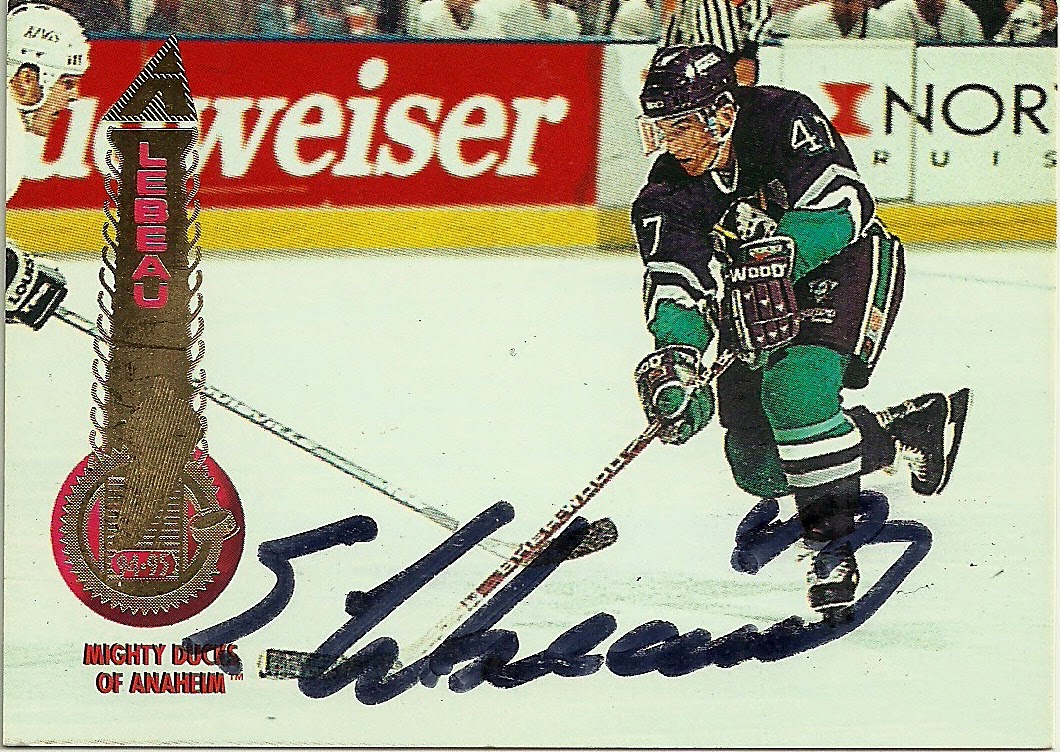
The next season started slower for most of the team, and Stéphan Lebeau was among those who paid for it, as he was traded mid-season to the Mighty Ducks Of Anaheim. Over two half-seasons in Anaheim - the second one due to the lock-out - Lebeau had 34 points in 60 games; to put it into context, his 16 assists in 1994-95 were second in team totals and his 24 points were good enough for third, despite having missed 10 games due to injury.
From that era, here is a beautiful 1994-95 Pinnacle card (#67 in the set) from Pinnacle Brands (notice how his skate bottoms are now black):
Teal and purple, so 1990s! I chose to feature Lebeau today because of this card: the Anaheim Ducks winning last night, and the Los Angeles Kings (notice the defender on the left of the card?) playing a team that is usually teal-coloured tonight (the San Jose Sharks).
Still, despite being one of the team leaders in Anaheim, the Mighty Ducks chose not to offer him a new contract, and he spent his final six years of pro hockey in the Swiss League, playing for three different teams for two seasons each, totaling 349 points (143 of them goals) in 222 games.
Upon retiring, he first moved back to Sherbrooke and became involved in minor hockey at Bishop's College (Midget AAA), until he was named an assistant coach with the AHL's Hamilton Bulldogs this year. My guess is he'll be the team's head coach before next Christmas.
I had sent him these 5 cards on April 3rd, 2014, care of the Bulldogs, and got them all back signed in black sharpie - with his jersey number (47) on the top-right of his autograph - 22 days later (April 25th, 2014), along with this note on one of the index cards I'd used to protect the cards:
It reads: ''Hello Sebastian, thanks for your comments, Stéphan''.
The next season started slower for most of the team, and Stéphan Lebeau was among those who paid for it, as he was traded mid-season to the Mighty Ducks Of Anaheim. Over two half-seasons in Anaheim - the second one due to the lock-out - Lebeau had 34 points in 60 games; to put it into context, his 16 assists in 1994-95 were second in team totals and his 24 points were good enough for third, despite having missed 10 games due to injury.
From that era, here is a beautiful 1994-95 Pinnacle card (#67 in the set) from Pinnacle Brands (notice how his skate bottoms are now black):
Teal and purple, so 1990s! I chose to feature Lebeau today because of this card: the Anaheim Ducks winning last night, and the Los Angeles Kings (notice the defender on the left of the card?) playing a team that is usually teal-coloured tonight (the San Jose Sharks).
Still, despite being one of the team leaders in Anaheim, the Mighty Ducks chose not to offer him a new contract, and he spent his final six years of pro hockey in the Swiss League, playing for three different teams for two seasons each, totaling 349 points (143 of them goals) in 222 games.
Upon retiring, he first moved back to Sherbrooke and became involved in minor hockey at Bishop's College (Midget AAA), until he was named an assistant coach with the AHL's Hamilton Bulldogs this year. My guess is he'll be the team's head coach before next Christmas.
I had sent him these 5 cards on April 3rd, 2014, care of the Bulldogs, and got them all back signed in black sharpie - with his jersey number (47) on the top-right of his autograph - 22 days later (April 25th, 2014), along with this note on one of the index cards I'd used to protect the cards:
It reads: ''Hello Sebastian, thanks for your comments, Stéphan''.
Thursday, January 17, 2013
Guy Hebert Autograph Card
I'm preparing for two hockey pool drafts (a keeper in its second year tomorrow, a one-season deal on Saturday), and my 2013 predictions for my regular blog, and I have to say I don't think the Anaheim Ducks will be making the playoffs this year, which doesn't bode well for my keeper pool, seeing as I have both Corey Perry and Ryan Getzlaf in it...
But it got me thinking about this Guy Hebert card from In The Game's 1999-00 Be A Player Millenium Signature Series (card #5) - yes, another one from that set - signed in thin black sharpie!
I love Hebert's position in this card, awaiting the shot, focused, looking like a gladiator, his equipment white like his Mighty Ducks Of Anaheim (home) jersey.
Since the Ducks changed their name, we can almost view the Mighty Ducks as either a period of the team's history, or just a different team altogether, and Hebert, to me, pretty much represented the team. Sure, many will point to Paul Kariya and Teemu Selanne as the key figures, but Kariya never produced as much without Selanne, who was lucky enough to also have Saku Koivu share to a special bond with.
But Hebert made Team USA 4 times (at the 1990 Goodwill Games, 1994 World Championships, 1996 World Cup and 1998 Nagano Olympics), the NHL All-Star team and, most importantly, had a character named after him in the short-lived animation TV series.
Also, apart from his first 37 NHL games (played with the St. Louis Blues) and last 13 (New York Rangers), he played all of his NHL games in Anaheim.
But it got me thinking about this Guy Hebert card from In The Game's 1999-00 Be A Player Millenium Signature Series (card #5) - yes, another one from that set - signed in thin black sharpie!
I love Hebert's position in this card, awaiting the shot, focused, looking like a gladiator, his equipment white like his Mighty Ducks Of Anaheim (home) jersey.
Since the Ducks changed their name, we can almost view the Mighty Ducks as either a period of the team's history, or just a different team altogether, and Hebert, to me, pretty much represented the team. Sure, many will point to Paul Kariya and Teemu Selanne as the key figures, but Kariya never produced as much without Selanne, who was lucky enough to also have Saku Koivu share to a special bond with.
But Hebert made Team USA 4 times (at the 1990 Goodwill Games, 1994 World Championships, 1996 World Cup and 1998 Nagano Olympics), the NHL All-Star team and, most importantly, had a character named after him in the short-lived animation TV series.
Also, apart from his first 37 NHL games (played with the St. Louis Blues) and last 13 (New York Rangers), he played all of his NHL games in Anaheim.
Thursday, January 3, 2013
Ron Tugnutt Autographed Card
Oh, what a whupping Team Canada suffered at the hands of Team USA early this morning at the World Juniors! Malcolm Subban let in 4 goals on 16 shots before getting pulled, and the Americans won 5-1, securing their spot in the gold medal game against Sweden, while Canada will have to battle Team Russia for the bronze.
Ron Tugnutt is Canada's goalie coach this year, a position he also held in 2010; he holds the same position with the OHL's Peterborough Petes. I have a feeling he'll recommend Jordan Binnington to start Canada's next game, because losing with Subban - who has had 3 sub-par games in the tournament - could reflect badly on all coaches.
Tugnutt - a former member of all the teams I've rooted for in my life, namely the Québec Nordiques, Edmonton Oilers and Montréal Canadiens - was one of my favourite goalies. His run with the Ottawa Senators was also impressive, and it was during his time there that he signed this card in blue sharpie for me before a game against the Habs that I attended at the then-Molson Centre (now Bell Centre). It's from Pinnacle Brands' 1993-94 Score (High Numbers/Series Two), which included rookies and players who'd changed uniforms since they appeared in the regular version of the set.
A list of many of his achievements can be found in another post I wrote about him nearly three years ago.
Ron Tugnutt is Canada's goalie coach this year, a position he also held in 2010; he holds the same position with the OHL's Peterborough Petes. I have a feeling he'll recommend Jordan Binnington to start Canada's next game, because losing with Subban - who has had 3 sub-par games in the tournament - could reflect badly on all coaches.
Tugnutt - a former member of all the teams I've rooted for in my life, namely the Québec Nordiques, Edmonton Oilers and Montréal Canadiens - was one of my favourite goalies. His run with the Ottawa Senators was also impressive, and it was during his time there that he signed this card in blue sharpie for me before a game against the Habs that I attended at the then-Molson Centre (now Bell Centre). It's from Pinnacle Brands' 1993-94 Score (High Numbers/Series Two), which included rookies and players who'd changed uniforms since they appeared in the regular version of the set.
A list of many of his achievements can be found in another post I wrote about him nearly three years ago.
Friday, July 30, 2010
Paul Kariya Practice Jersey Card
Remember the 1990s, when most experts were looking for ''The Next One'', the guy to be the face of the league when Wayne Gretzky
retires? That title was bestowed on many a player, most of whom were found to not be able to handle the burden - Eric Lindros
being a notable one. Paul Kariya
was definitely another.
Perhaps an even smoother skater than Scott Niedermayer, Kariya also had a slap shot that compared favourably to almost anyone else in the NHL, one that led him to 3 seasons of 40 goals or more, including a 50-goal output iun his sophomore season. The duo he formed with Teemu Selanne
was among the most productive of the past generation.
My defining Kariya moment came in the 2003 Stanley Cup Finals, when he was hit by New Jersey Devils
behemoth Scott Stevens
and lay on the ice for several minutes - to this day, he claims he wasn't unconscious, but the CBC cameras clearly showed him not moving, not even breathing, until out of the blue his visor filled with steam - his breath was back. Team doctors took him back to the dressing room where he stayed for 11 minutes of play - most expected he was out of the game, perhaps even gone for the remainder of the series, but he came back and scored the tying goal in a game his team would eventually win. The Mighty Ducks Of Anaheim
still lost the series, as Kariya's play was clearly affected by the hit.
That summer, he swore he wanted to bring the Cup to Anaheim, but instead only played one more season there before joining Selanne on the Colorado Avalanche, on a stacked team that already included Joe Sakic, Peter Forsberg, Patrick Roy
, Rob Blake
, Milan Hejduk
, and so many others. The team was not only a perennial Cup contender, they also had 7 players who had also served as captain on other teams. Unfortunately, both Selanne and Kariya suffered long-term injuries and left the team.
Kariya's career path took him to the Nashville Predators
, where he registered his 800th career point, and to the St. Louis Blues
, with whom he scored his 400th goal. He is currently an unrestricted free agent. Although he is no longer slated to finish in the top-5 for NHL scoring, he could probably still help a team on its second or third line, and with some powerplay time could probably still reach the 20-goal mark (he registered 18 in his final season with the lowly Blues).
In international play, he was part of Canada's 2002 Gold Medal-winning Olympic team (with Sakic, Mario Lemieux
and Jarome Iginla, among others). He has also won gold at the World Championships (1994) and World Juniors (1993). And he was also kept out of the 1998 Olympic squad due to a concussion after a cheap, vicious cross-check by Gary Suter
, just like Gretzky in the 1991 Canada Cup
.
This beautiful card, part of Upper Deck's 2002-03 MVP
set (the Skate Around sub-set) dons a bigger-than-usual patch, and a special one at that, and I quote:
Perhaps an even smoother skater than Scott Niedermayer, Kariya also had a slap shot that compared favourably to almost anyone else in the NHL, one that led him to 3 seasons of 40 goals or more, including a 50-goal output iun his sophomore season. The duo he formed with Teemu Selanne
My defining Kariya moment came in the 2003 Stanley Cup Finals, when he was hit by New Jersey Devils
That summer, he swore he wanted to bring the Cup to Anaheim, but instead only played one more season there before joining Selanne on the Colorado Avalanche, on a stacked team that already included Joe Sakic, Peter Forsberg, Patrick Roy
Kariya's career path took him to the Nashville Predators
In international play, he was part of Canada's 2002 Gold Medal-winning Olympic team (with Sakic, Mario Lemieux
This beautiful card, part of Upper Deck's 2002-03 MVP
On the front of this card is an authentic piece of a practice jersey worn by Paul Kariya in an offical NHL practice. We hope you enjoy this piece of hockey history as we at The Upper Deck Company continue to keep you as close as you can get!That's right - it's a practice jersey! I think it's the only set in which I've seen one, which makes it special, in my opinion.
Wednesday, January 6, 2010
Scott Niedermayer Jersey Card
I wasn't sure what angle to go with this player. On one hand, he's great. On the other, he's never had to prove himself on his own, as he always had a supporting cast of superstars to make him look good. So I decided to have it both ways: one post full of positive achievements, one (this one) more, shall I say... realistic.The draft isn't an exact science; Scott Niedermayer was chosen 3rd overall in 1991, behind Eric Lindros and Pat Falloon, but ahead of Peter Forsberg and Alexei Kovalev... (for the record, my draft order would have been Forsberg, Niedermayer, Kovalev, Ozolinsh, Lindros, Palffy, Rolston, Naslund, Perreault, Falloon)
There were high expectations for Niedermayer coming off a World Juniors championship, but he had the luxury of playing behind Scott Stevens, Vyacheslav Fetisov and Bruce Driver - and alongside Eric Weinrich and Ken Daneyko - not too shabby. Not to mention that, should any of the defensemen make a mistake, chances are goalie Martin Brodeur would correct it.
Much has been said of Niedermayer's speed and prowess to start up an attack, but it helps when the guys you can pass the puck to are finishers like Peter Stastny, Claude Lemieux and Stéphane Richer to start, and later Patrik Elias, Alexander Mogilny, Petr Sykora and Jason Arnott...
That's in addition to playing in the trap-controlled New Jersey Devils system.
And then he was named captain of the team, only to leave it in 2005 to join the Mighty Ducks Of Anaheim, where his brother played, a team that had reached the Cup Finals two years before and that could still hope to attain it again, with a goaltending tandem comprised of Conn Smythe winner Jean-Sébastien Giguère and Russian Olympian Ilya Bryzgalov, in addition to proven scorers like Teemu Selanne - willing to play in Anaheim almost for free - kids like Ryan Getzlaf and Corey Perry - and the best defensive line in the league (led by Samuel Pahlsson and Rob Niedermayer).
But he couldn't make it on his own as the sole leader on the D, so the team went and got Chris Pronger from the Edmonton Oilers to help hold the fort, fresh off a Cup Finals in which he was favourite to win the Conn Smythe had his team won. And Pronger took Niedermayer and the rest of the boys to the promised land.
Sure, Niedermayer won the Conn Smythe that year, but the main reason he did was that the league couldn't possibly give it to Pronger after he'd been suspended twice in the playoffs - and Giguère already had one, for which he had been more than spectacular, in a losing cause, and since that particular trophy doesn't come easy (only one player has won it three times, Patrick Roy) they couldn't just hand it to him again on such a powerhouse team that could have won it five times in a row. So Niedermayer got the pity vote.
After that, he contemplated retirement. Contemplated, yes, but he couldn't quite get to it. Every day, from the start of training camp to the month of December, journalists inquired his teammates about his possible return or retirement. He was a distraction for the first 28 games of the season before he announced he'd be coming back - even after the team had already named another captain (Pronger). His return, instead of sparking his team, just added to the confusion, as they were ousted in the very first round against the Dallas Stars. Some leader, eh?
Also note that this beating around the bush occured in the summer of 2007; we are currently in 2010, and he's still playing. Pronger and François Beauchemin (the other member of the Anaheim Big Three) are gone and, coincidentally, probably, the Ducks could very well miss the playoffs. And what's the biggest story to come out of Anaheim these days? That their captain may have requested a trade to a contender.
Smells like team spirit, eh?
On this card, you can see him wearing the last jersey of the Mighty Ducks - before they became, simply, the Anaheim Ducks. Notice how they were going for a retro feel. This is card #GJ-SN of the 2006-07 Upper Deck Series 1 collection, and sports a white jersey patch.
Subscribe to:
Posts (Atom)