Showing posts with label 1989-90. Show all posts

Monday, November 4, 2019

Stan Smyl: Two Autographed Cards

Last month, the Vancouver Canucks introduced their new captain, Bo Horvat, and while I do not currently have any of his memorabilia, I did have a couple of signed Stan Smyl cards I could feature, so here we are.

By the time I got really interested and invested in following hockey - and I dove right in, learning the current and career statistics of every player in that era as well as those of a select few Hall Of Famers by reading the daily stats before going to school from 1987 until 1995 - Smyl was past is 60-, 70- and 80-point seasons and settling into the role of a checking elder statesman who ran into injury trouble, prompting three consecutive nominations for the Masterton Trophy, but also bringing his points-per-game average from the 0.85-0.90 range to a still-respectable 0.75.

He's the one from whom Trevor Linden learned to supplement his talent with the will and ability to also take on a leadership role, a skill set that enabled him to be the team's President of Hockey Operations for a little over four years.

"Steamer" also embodies the "classic Canucks" look, in my opinion, with the black "skate" logo uniform, pretty much with this pose and picture, on card #283 from O-Pee-Chee's 1989-90 O-Pee-Chee set:
And what about this picture, taken 20 years ago (notice the team's 20th Anniversary patch on the left shoulder), still playing close to the net in the danger zone at age 32, a year before retiring, on card #374 from Score's 1990-91 Score Canadian (Bilingual Edition) collection:
That's a young Mark Fitzpatrick he's about to come into contact with.

He sent me these two cards at an old address I forwarded my mail from about a year ago, and I just fell upon them last weekend.

Wednesday, April 16, 2014

Gary Leeman: 6 Autographed Cards (Part 1)

So my last three returns involve former Calgary Flames... I had sent Gary Leeman these 6 cards on April 1st, 2014, and got them all back, signed in blue sharpie with his jersey number (11) tagged at the end, Tuesday, April 15th (2014) - a 14-day return!
Leeman had an extraordinary career in which he played just about every possible role on the ice (though fairweather fans always ''blamed'' him for not repeating his high-scoring prowess from his days with the Toronto Maple Leafs).

And I get that, really I do. I mean, improving from 21 goals (52 points) in 1986-87 to 30 goals (61 points) in 1987-88 to 32 goals and 75 points (in just 61 games!) in 1988-89 to an astonishing 51 goals and 95 points in 1989-90, Leeman looked like he could compete with Brett Hull for a long time. But after struggling through injuries and an ever-changing cast of teammates for the following year and a half, he was sent to the Flames in the largest trade of all time, as 10 players changed teams, with Doug Gilmour, Jamie Macoun, Kent Manderville, Ric Nattress and Rick Wamsley headed to Toronto, and Leeman, Alexander Godynyuk, Jeff Reese, Michel Petit, and Craig Berube going to Calgary.

But the Flames only gave Leeman two half-seasons before shipping him off to the Montréal Canadiens to finish off the 1992-93 season, and his 18 points in 20 games were impressive, particularly when one considers he wasn't even on the team's top two lines. As a matter of fact, on that Stanley Cup-winning team, he came after 40-goal right winger Brian Bellows, center-turned-winger Denis Savard, checking winger Mike Keane, 97-point center Vincent Damphousse, 94-point center Kirk Muller, sniper Gilbert Dionne, and future 50-goal man John LeClair on the depth chart. Oh, and the best defensive center of all time in Guy Carbonneau, who needed his 20 minutes of ice time per game to check the likes of Wayne Gretzky, Mats Sundin and Pat Lafontaine.

So Leeman succesfully went from go-to sniper to ''cog in the machine'', but too many people still wanted him to be the 50-goal man even well into his 30s, so the Vancouver Canucks and St. Louis Blues miscast him themselves, forcing him to expatriate himself to Germany to end his career; he did end up with 15 goals and 56 points in 54 games with the Hannover Scorpions over two seasons to finish in style.

All in all, we're talking about a guy who played nearly 700 NHL games, played for three different Canadian teams (and two more in the AHL - the St. Catharines Saints and Fredericton Canadiens), was one goal short of the 200 mark, put up 466 points and 24 more in 36 playoff games, and has his name on the Cup. He can be proud of himself every time he looks in the mirror, because he has accomplished a lo during his career. Enough to warrant my featuring three cards of his with the despised Leafs...

And here they are, all showing him wearing their classic blue (away) 1970s-1980s uniform:
On the left, from Pinnacle Brands' 1990-91 Score (American) set (card #40); at center, from Upper Deck's 1990-91 Series 1 (French Canadian Version) set (card #243); and on the right, from Topps' 1989-90 O-Pee-Chee (card #22), during a pre-game warm-up with Ken Wregget behind him.

                           (continued in the following post)

Friday, April 11, 2014

Réjean Lemelin: 4 Autographed Cards

Réjean ''Reggie'' Lemelin was a consistent #1 goalie for all of the 1980s and the first couple of seasons of the 1990s, until he was almost 40 years old and the Boston Bruins decided to hand the reigns to Andy Moog alone.

But from the days where he dominated in Juniors in the LHJMQ (for the Sherbrooke Castors, i.e. ''Beavers''), his subsequent draft by the Philadelphia Flyers (125th overall in 1974) and his start with the Atlanta Flames, it was clear he would play hundreds of NHL games (he ended up appearing in 507), winning a ton (246, with a career high of 30 in 56 games with the lowly 1984-85 Calgary Flames, while his backup Don Edwards went 11-15-2).

His goals-against average (in the high 3s) may look bizarre nowadays, but he shared the Jennings Trophy with Moog in 1989-90 with a 2.80 - they were just different times. He also played for Team Canada at the 1984 Canada Cup (now referred to as the World Cup).

He reached the Stanley Cup Finals twice, in 1988 and 1990 - both times with the Bruins, both losses to the powerhouse Edmonton Oilers. For Lemelin, Moog, Raymond Bourque and Cam Neely, and because the Oilers had traded Wayne Gretzky and were now led by Mark Messier, I wouldn't have minded so much if Boston had won it in 1990.

Lemelin was more of a stand-up goalie, like many of his contemporaries pre-Patrick Roy. He had a decent glove hand and covered a fair amount of net. While he was with the Bruins (1987-93), I was in the minor hockey circuit, doing my best Roy imitation (all butterfly and glove), and my main competitor in my region was a kid named Yan Lemelin, whose idol was his namesake and had the same playing style. We would always meet in the neighbourhood finals at the atom, pee-wee and bantam levels... and I would always end up victorious, of course. But since the Bruins would also face the Montréal Canadiens often in the postseason even back then, it was like a double rivalry going on, with Lemelin (or Moog) versus Roy at the pro level, and Lemelin versus Hell (myself) in our age range.

And because I knew a guy who really liked the ''real'' Lemelin (Yan and I were acquaintances off the ice), I kind of didn't hate him either. I even followed his coaching career when he was the Flyers' goaltending coach upon retiring (on and off from 1997 until the end of the '00s), but it was a bit weird to see him around so much orange. Black suits him so much better, and so he looks right at home playing for the Bruins' alumni team these days.

I had sent a fan letter and these four cards to his home address on March 31st, 2014, and got them all back today - April 11th, 2014, a mere 11 days later - signed in black sharpie with his jersey number tagged at the end - 31 for the Flames, 1 with the Bruins - wrapped in... my fan letter (I guess it didn't resonate with him that much).

Let's look at the Flames cards first, both showing him with their red (away) uniform:
The card on the left is from O-Pee-Chee's 1982-83 O-Pee-Chee set (card #50), unmasked during a pre-game warm-up; the card on the right is from Topps' 1984-85 Topps set (card #25).

As for the ones showing him with the Bruins' beautiful, classic black (away) 1980s uniform:
The card on the left is from Topps' 1989-90 Topps set (card #40), making snow in front of his net to start a period, while the card on the right is from the company's 1990-91 Bowman collection (card #32), sitting on the bench as the evening's back-up, watching the game.

A great return by an important goalie of an Original Six team, one I got to see a lot of as an Oilers, Habs and Québec Nordiques watcher as a kid.

Monday, December 9, 2013

Trader/Collector Hall Of Fame: Sal

Last week, I arrived to a box that contained this:

9 figurines making up 69% of Provigo's 1989-90 Montréal Canadiens figurines set, namely Bob Gainey (23), Bobby Smith (15), Mats Naslund (26), Brian Skrudland (39), Stéphane Richer (44), and Russ Courtnall (6), as well as the still-wrapped Petr Svoboda (25), Mike McPhee (35) and Craig Ludwig (17).

Now I just need to get my hands on Patrick Roy (33), Guy Carbonneau (21), Shayne Corson (27) and Chris Chelios (24). It would have been easier, back in the day, to get my hands on the latter two if I was a good looking girl or a policeman after 3AM (I kid, I kid).

The figurines were sent to me by the best trader and collector out there, Sal. He sent them as a token of appreciation for my ''participation and help'' into writing his most recent piece in Beckett - fulfilling my life-long dream of having my name in the Beckett, though I thought it'd be as a player! - but, really, all I did was reminisce about collecting these in my childhood, and playing with them.

Every collector I write to, trade with, whose blogs I read, every single one of them has at least one, sometimes half-dozens of instances where Sal helped them out and sent out way more than was expected or even necessary. Or just freely. Most of us have this karmic thing were it all probably evens out - give a little more here, receive a little more there - but I'm fairly certain Sal's karma point extend way beyond the hobby, because he just gives and gives and gives. Perhaps we should all hire him.

That is why I nominate him for the Hall OF Fame, should there ever be one.

Again, thanks, Sal.

Tuesday, April 24, 2012

Sean Burke: 7 Autographed Items (Part 1)

Second post in a row featuring an ex-NHLer and current goalie coach - this time the man who made the Phoenix Coyotes a powerhouse in front of the net and got Mike Smith to (finally) play up to his potential: Sean Burke.

From the very start, Burke was widely heralded as a star-in-the-making, from single-handedly leading Canada to a silver medal at the 1986 World Juniors to helping an amateur-led Canada to 4th place at the 1988 Calgary Olympics behind professional-laden teams USSR (Soviet Union), Finland and Sweden. He then went on to play 11 games with the New Jersey Devils, lead them to the playoffs for the first time, beat powerhouses New York Islanders and Washington Capitals in the first two rounds of the playoffs only to lose to the Boston Bruins in 7 games in the Prince-Of-Wales Conference finals.The following season, while still qualifying as a rookie, he was invited to the All Star Game - the first ever rookie goalie to do so.

During this time - the first Olympics I watched from end to end, my budding passion for the sport both as a fan and a goaltender - my idol was Patrick Roy, like most kids my age. But because Roy was widely recognized as the best goalie in the world at that time, he was unattainable for kids like me; even waiting in line at events to get an autograph of Roy seemed impossible, because he attracted crowds so big the odds were so massively against it happening. At that time, Olympic hero Burke graced the cover of Hockey Today, which Hockey Canada gave all of the players in my area for free, for some reason:
Just like that, Burke made his way on my teenage wall, alongside Roy, Guns N' Roses, Lita Ford and N.W.A., and would later be joined there by Pearl Jam and topless women.

And while my butterfly style was very Roy-inspired, my physical stature was promising to near that of Burke, who stood at 6'4'' and weighed in over 200 pounds (usually close to 210). And it seemed Burke was cited more often as a spokesperson for Hockey Canada than Roy, which made him closer to us kids than Roy, despite his playing in the U.S.

Another thing that made Burke ''realer'' than Roy was that Roy had his pads tailor-made by the Habs' trainer, who made his own, ''house'' brand Lefebvre, so kids who weren't rich could never wear the same equipment as his; Burke was all about Brian's, and so was I.

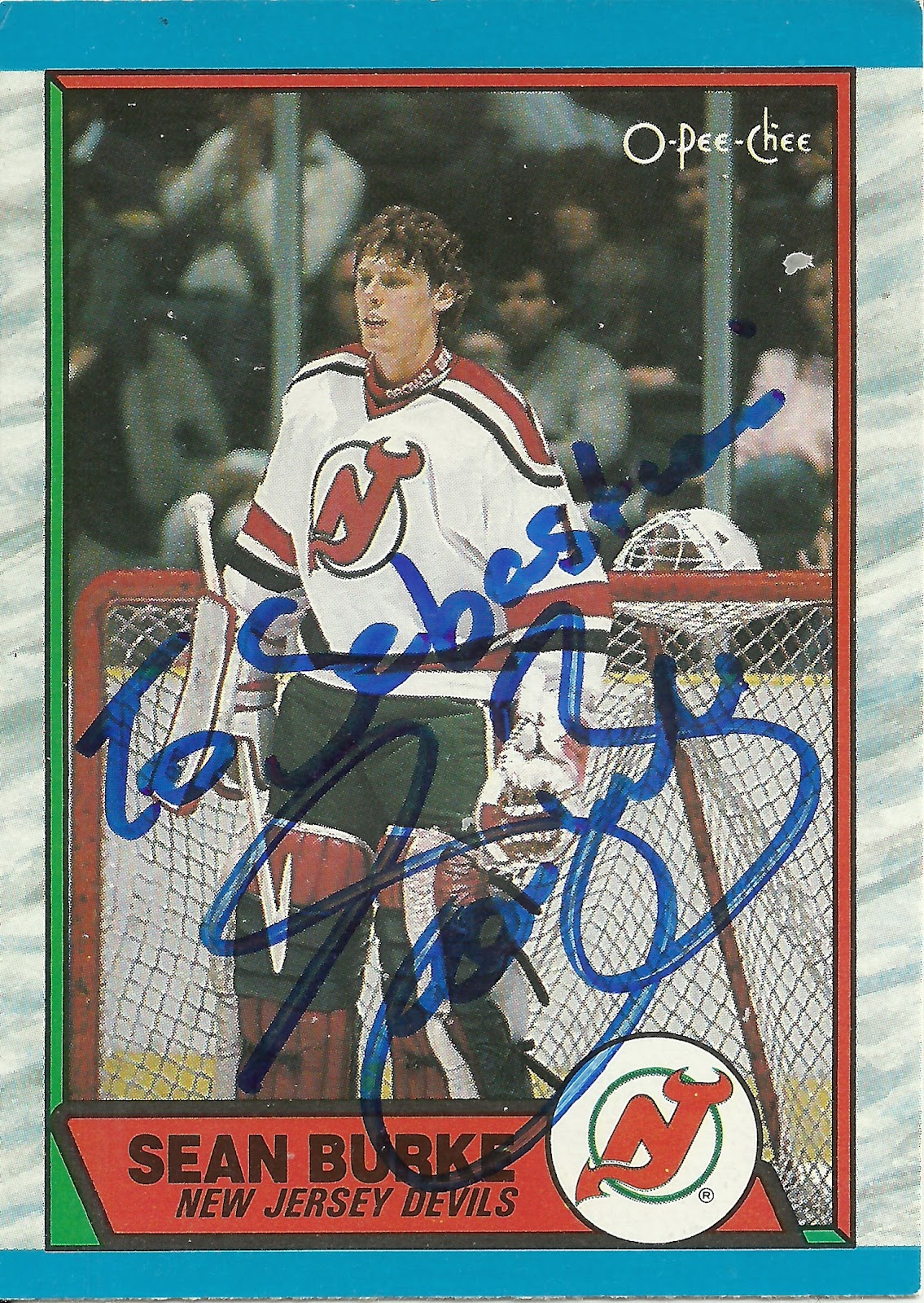
So I sent Burke a long, heart-felt fan letter and the 6 following cards on March 5th, 2012, and got all of them back, signed in blue sharpie, on Friday the 13th (of April, 2012) - with half of them personalized ''To Sebastian''; he even signed one of the index cards I sent in for protection, personalizing it, and adding me ''Best Wishes'', which may have made my year:
Now onto the cards, starting with his second year card from his Devils' days, where he kind of looks like Jesse Eisenberg in The Social Network:
It's from Topps' 1989-90 O-Pee-Chee set (card #92). His rookie card also showed him without a helmet... someone at Topps must have found him cute!

(continued in the next post)

Monday, November 1, 2010

Stéphane Richer: 4 Autographed Cards

I sent Stéphane Richer these four cards and a fan letter on October 18th, care of the golf club where he's the resident professional, and got 4/4 back today (November 1st), signed in blue sharpie, with his jersey number (#44) added. Less than two weeks, outside of golf season, and with Richer making three public appearances in that span for charity causes. Talk about a quick turnaround!

Stéphane Richer played parts of two seasons of major junior hockey with the Granby Bisons before turning pro, where he would meet a goalie he would see a lot of in the next few years, Patrick Roy. They would make the jump to the AHL together in 1984-85, winning the Calder Cup with the Sherbrooke Canadiens and the Stanley Cup the following season with the Montréal Canadiens. For the next four seasons, the Habs would be contenders for the President' Trophy during the regular season and would make another Stanley Cup Finals appearance in 1989, where they lost to the Calgary Flames.

But my defining ''Richer moment'' came during training camp prior to the 1987-88 season, when he candidly replied to a reporter's question about his objective for the season with these words: ''I'm going to try to score 50 goals''. The nerve, coming off a sophomore season that saw him score 20 (in 57 games), after a 21-goal rookie campaign (in 65 games)! And yet, he was on pace for most of the season, despite missing 8 games to injury, when came the last game of the season - and he was three goals short. Of course, he scored a hat trick, becoming the first player since Guy Lafleur's heyday to score 50 goals in a single season for the Habs, a feat he would repeat - and surpass - two seasons later, when he scored 51.

No other Canadiens player has scored 50 in a single season since. As a matter of fact, only Vincent Damphousse has managed to reach 40, in 1993-94.

After a ''disappointing'' 31-goal season in 1990-91, he was traded to the New Jersey Devils with Tom Chorske for their captain, Kirk Muller, and backup goalie Roland Melanson, a trade that may have benefitted both teams but sent shockwaves in both teams. Richer would win the Cup with the Devils in 1995, while the Habs won it in 1993.

During his first three seasons with the Devils, Richer scored 29, 38 and 36 goals respectively and, considering their style of play, lets one believe he would have scored at least 10 more per season had he played on another team. And as the decade was ending and Réjean Houle took command of the Canadiens, Richer was brought back to bring the team back to to glory with the absence of Roy - a feat which proved impossible to achieve. Midway through the second season of his Second Coming, he was shipped the the Tampa Bay Lightning with Darcy Tucker and David Wilkie in exchange for ''enforcer'' Mick Vukota, Patrick Poulin and Igor Ulanov, ironically weakening the team even more.

It was all downhill from there - both for the Habs and Richer, who disappeared from my radar and went on to play stints with the St. Louis Blues, Pittsburgh Penguins and the Devils again; he even played 2 games with the IHL's Detroit Vipers in 1999-2000. He retired from pro hockey after the 2001-02 season, but briefly made an appearance in semi-pro play in 2004-05 for the Sorel-Tracy Mission, with whom he tallied 2 goals and 6 assists in 8 games while trying not to kill anyone with his world-renowned powerful slap shot.

Blessed with size and strength beyond that of an athlete from his generation, Richer could have been anything he wanted: sure, he had terrific hockey skills, as his exploits will attest to, and he's now a golf pro - but back in his playing days, he was also a heck of a baseball/softball player, which is what he was doing when he was famously quoted as saying, during the 1994-95 lock-out: ''I don't understand why we're not playing hockey. Let's get a deal done and get back on the ice where we belong. We should be playing hockey.'' And that's all he wanted, really: not the cash, not the attention, just to play.

The card on the top-left was the first card I fell on when I opened my first pack of Topps' 1987-88 O-Pee-Chee cards; it's card #233 in the set, and sees him sporting a thin mustache (for the times), while he had cut it off by the time the card on the top-right came out, from the 1989-90 Topps set (card #153). Notice how both cards sport the trademark Topps/OPC ''uneven borders'' where the card isn't centered properly.

The card on the bottom-left is from the 1992-93 Pro Set collection (card #93) and is the only card I own of that year's Pro Set output that isn't a Parkhurst, so I probably traded for it. It has Richer wearing the Devils' old jersey with the green lines and patches on the shoulder, while the card bottom-right has the more modern one where the green has been replaced by black. That one is a thick card with a foil contour from Pinnacle Brands' 1996-97 Pinnacle Summit (card #99); I'd never seen those cards before last year, when I purchased a whole box of them. Notice the Habs' logo on the bottom: he'd been traded back to the Habs that summer for Lyle Odelein.

Tuesday, October 12, 2010

Rick Wamsley: Two Autographed Cards

I was a bit young to remember Rick Wamsley as a member of the Montréal Canadiens, where he spent the first 4 years of his illustrious career and shared the Jennings trophy in 1982 with Denis Herron, but I was getting seriously NHL-curious after the Habs' 1986 Stanley Cup (I was 7 years old) and could already tell Ron ''Le Prof'' Caron was building a great St. Louis Blues team when he traded for Wamsley, before dealing him to the Calgary Flames.

Caron had been the Habs' assistant GM for many years (and many Cups) when he took on the main job for the Blues, and one of the first things he did was bring Wamsley along with him. In his tenure, he brought such star players as Brett Hull, Adam Oates, Doug Gilmour and Al MacInnis to St. Louis; but by 1988, Wamsley had been deemed expendable, due to the Blues' drafting of Curtis Joseph.

But that was never a problem: Wamsley moved on with the Flames and in his first full season with the team, in 1988-89, he was ranked 5th in the league with a 2.96 GAA (yes, the high-scoring '80s were a different time!) and, more importantly, finished the year not only with his name engraved on Lord Stanley's Cup forever, but also as a member of the only visiting team to have ever won the Cup on the Canadiens' home ice - the only team in 101 years to do that.

He then spent two more full seasons with the Flames, seeing less and less ice time (36 games in 1989-90, 29 in 1990-91) as time progressed, in favor of Mike Vernon. He was traded to the Toronto Maple Leafs in January of 1992 but would only play 11 games for them in the course of two seasons, so he's not really tainted by their aura of perpetual defeat.

You want to know his worth to GMs of his time? When he was traded from the Habs to the Blues, Caron felt he was worth two draft picks who became tough-guy and Team Canada member Shayne Corson and two-time 50-goal man Stéphane Richer; when the Blues let him go, it was to acquire Brett Hull; and when the Flames themselves shipped him to Toronto, it was with Doug Gilmour for 50-goal man Gary Leeman and 4 others in a 10-player deal. Those are impressive names, forever linked to Wamsley.

Since retiring, he has spent time as both a scout and goaltending coach for the Leafs, Blues, Columbus Blue Jackets and now the Ottawa Senators since this summer, where he was reunited with Pascal Leclaire, who had his best seasons with the Jackets under Wamsley's tutelage.

Which brings me to these two cards. I sent them to him along with a fan letter on September 22nd and received both back, signed in black sharpie, today, October 12th, a very quick turnaround considering it encompassed rookie camp, training camp and the start of the regular season. The card on the left is from Topps' beautiful 1989-90 O-Pee-Chee set (card #204), while the one on the right is from the 1990-91 Upper Deck set (card #10), back when Upper Deck's trademark design was a white contour for all its series in all sports.