Showing posts with label 1982-83. Show all posts

Thursday, August 29, 2019

Marian Stastny: Three Autographed Cards

Marian Stastny has had an eventful life, let alone hockey career.

Born in Bratislava in the 1950s, Stastny, like the vast majority of Slovaks, existed in a time where he and his family had no space: Czechs and Slovaks had seceded from the Austro-Hungarian empire in the beginning of the century (1918) but did not have time (or did not feel the need) to fully divide the land and form independent governments before the Nazis took them over in the late 1930s; when the Soviets eventually "freed" them from German rule, they simply took over as the "new boss", sending their army in whenever people complained (the biggest show of force being the Prague 1968 invasion, but there were other power plays as well, notably in 1948, 1955, 1960 and 1988).

It took the fall of the Iron Curtain in 1989 to give them enough breathing room to first remove "communism" as the State's official way of running things (and from the country's name), to becoming a federacy in 1990 and finally holding democratic elections in 1991. By 1993, peaceful secession was adopted and two countries that should have always existed were finally born: the Czech Republic and Slovakia.

In the late 1970s and early 1980s, however, when Marian and his brothers Peter Stastny and Anton Stastny were playing professional hockey, being in favour of Slovak independence was passible of jail time with two levels of governance being strongly opposed to it: the majority Czech government, and that of the U.S.S.R. Essentially, Slovaks were "owned" by the Czechs who were "owned" by the Russians. They were sub-people, tax payers with little rights.

Hockey is an international sport, however, and the Stastnys were so good that they often faced Team Canada deep in tournament play, and they got to learn how things worked in North America.

During a tournament in Austria in 1980, Peter made a phone call that would change all three brothers' lives, to Québec Nordiques President Marcel Aubut, telling him he and Anton wanted to defect; they didn't invite Marian to come long because he was married with three children, and it was deemed too risky:
The next day, Nordiques President and CEO Aubut and director of personnel development Gilles Leger arrived in Innsbruck, Austria. They began planning immediately to get Anton, Peter and Peter’s wife, Darina, who was eight months pregnant (with their first child, a daughter), to the Canadian embassy in Vienna to apply for political asylum.
Faced with determined Czechoslovakian agents, who quickly realized what was happening, the group needed the help of not only the embassy, but also the Viennese police, Canadian Minister of Defence Gilles Lamontagne, Canadian Immigration Minister Lloyd Axworthy and Hockey Canada’s Douglas Fisher. After a tense dash to the airport, they boarded a flight to Amsterdam and freedom. A connecting flight brought them to Montréal. Peter’s daughter, Katarina, would be born in Canada. 
That version of the story omits a few actual yet unbelievable facts, however, such as an escape through a field to meet up with a car driven by Léger with Aubut in the passenger's seat, all Stastny family members riding in the trunk with covers to avoid detection at checkpoints, and Canadian officials waiting at the airport with the trio's belongings...

The Czech and Soviet governments didn't take too well to the daring escape, so they had Marian followed constantly, his phone lines were tapped and he was barred from both practising law (his would-be day job) and playing hockey, despite being a better-than-point-per-game player in league play and having two World Championship gold medals and a bronze to his name.

Had Peter, Anton and the Nordiques not smuggled money to him, he and his family would have been homeless and bankrupt.

Seeing no other issue, they applied for Canadian citizenship via the legal channels only to see the Czechoslovakian government deny them, so he too called Aubut. To evade the patience of their followers, the family's trip included stops in Hungary, Yougoslavia, and Austria before boarding a flight to Canada.

As the 1981-82 season got under way, the Stastnys became the third trio of brothers to play on the same team at the same time, but with Marian's 35 goals and 89 points, Peter's 46 goals and 139 points and Anton's 26 goals and 72 points in just 68 games, they are clearly the best and most effective band of brothers of all time.

When he was named to the 1983 All-Star Game with Peter, they became just the sixth brother combination to do so. He also assisted on Anton's 100th goal.

Following his five-year NHL career, Marian took a coaching job in Switzerland for two years before moving back to Québec, where he still lives to this day. He sold the golf course and hotel he operated last summer (his Parkinson's has gotten too intense to run a business day-to-day), though he has yet to get paid for it. He's received awards for his business acumen in recent years, too.

And earlier this month, the City of Québec unveiled a, uh... "statue" honoring the legacy of the Stastnys:
It's reminiscent of 1980s table hockey figures, yes, but I feel they deserved something less tacky, less cartoony. We're talking about five adults, three kids and one child-in-womb risking their actual lives and freedom to become the most impactful name of a city and franchise, and here they are with exaggerated traits and inaccurate equipment colouring.

We're a ways away from this:
Still, what a beautiful uniform! That's the Nordiques' classic blue (away) garbs, of course. The card on the left is #295 from O-Pee-Chee's 1982-83 O-Pee-Chee set, while the card on the right is #121 from Upper Deck's 2006-07 Parkhurst collection. The OPC is his rookie card.

You may have noticed up-top that there was a third card featured... that'd be #292 from OPC's 1984-85 O-Pee-Chee set:
You might also notice that's Anton, wearing his usual #20 uniform. It's one of those classic O-Pee-Chee errors!

Marian was a good sport and signed all of them at the unveiling in thin blue sharpie, tagging HIS number (18) at the end.

Wednesday, March 13, 2019

Garry Unger: Two Autographed Cards

Before Gary Unger, the NHL Ironman record was 264 straight games. From the time he suited up as a rookie for the Toronto Maple Leafs during the 1967-68 season through trades to the Detroit Red Wings (same year) to the St. Louis Blues during the 1970-71 season and to the Atlanta Flames in 1979-80, he suited up in 914 consecutive games, until head coach Al MacNeil made him a healthy scratch on December 21st, 1979. It was the only game he'd miss that year, and it was just a message to the team's other players that each and every one of them had to be accountable and deserve their ice time, regardless of the fact that they were a record holder, or what language they spoke.

It wasn't the only time Unger was treated unfairly; he was actually traded by Detroit because he defied head coach Ned Harkness. Harkness didn't like Unger's attitude; he'd scored 44 goals the previous season and was now dating the current Miss America, Pamela Eldred, who had been Miss Michigan prior to that. Unger had everything going for him, and had long, blonde shoulder-length locks. Harkness - an authoritarian disciplinarian - was of the old guard that hated individuality and may have been better at running a boarding school. His career .368 NHL record (12-22-4) as a coach now speaking of itself, Harkness insisted all of his players sport crew cuts, specifically aiming at one player to fall in line. Unger refused and was shipped to St. Louis with another good and dependable player (Wayne Connelly) for fading star "Red" Berenson and fourth-liner Tim Ecclestone.

Unger scored 30 goals or more in each of his eight seasons with the Blues, with a high of 41 in 1972-73; he had three seasons over the 80-point mark, with a high of 83 in 1975-76. After the Flames incident, he spent the 1980-81 season with the Los Angeles Kings, collecting 10 goals and 10 assists (20 points) in 58 games, as can be shown on card #123 from O-Pee-Chee's 1980-81 O-Pee-Chee set:
And, yes, he then spent the next three seasons mentoring Wayne Gretzky, Mark Messier, Paul Coffey, Kevin Lowe, Glenn Anderson, Jari Kurri, Ken Linseman, Charlie Huddy, Grant Fuhr, Andy Moog, Laurie Boschman, Lee Fogolin and the other young members of the Edmonton Oilers into being true professionals, as evidenced on card #120 from OPC's 1982-83 O-Pee-Chee collection:
And, yes, this card has him joining Tom Gilbert as wearers of #77 in my Oilers Numbers Project.

After retiring, Unger set his sights to coaching, winning a championship with the 1992-93 Tulsa Oilers and teaching kids in the Tulsa area for many years after that. However, when he started having grandchildren, he moved back to Alberta (Banff, more specifically) and heads the Banff Hockey Association to this day, into his 70s.

I've had these cards, signed in ballpoint pen since pretty much forever.  I met him a few times in the mid-to-late 1990s while attending and eventually teaching at the Jacques St-Jean Hockey School, and there were times when we organized meet-and-greet/tournaments with other hockey schools in the country. He was a class act each time we made our way there, spending time with every kid who went to see him.

Oh, and yes, Doug Jarvis now holds the NHL Ironman record with 964 consecutive games, from October 1975 until October 1987, and Unger is sitting comfortably in second place; the longest current active streak is Keith Yandle's, at 784, following Andrew Cogliano's suspension, which blocked his streak at 830.

Tuesday, May 10, 2016

Réal Cloutier Autographed Card

A lot of people forget just how amazing Réal Cloutier was. And looking at his numbers, it's plain dumbfounding...

As a 17-year-old Junior with the Québec Remparts in 1973-74, he scored an astonishing 75 goals (along with 123 assists and 216 points) in just 69 games, plus another 26 goals and 50 points in 26 postseason games (!!!), leading his team to the Memorial Cup final for the second straight year, losing to Clark Gillies' Regina Pats 7-4 in the decisive game.

From then on, he was drafted by the Québec Nordiques, who were part of the WHA at the time. In five seasons in the "other league", Cloutier put up 283 goals, 283 assists, and 566 points in 369 games. He had four consecutive 100-point seasons, winning two scoring titles - in 1976-77 with 141 points and in 1978-79 with his second consecutive 129-point season - and his 75 goals (in 77 games) in 1978-79 were the third-most in pro hockey history at the time, and remains the second-highest total in WHA history to Bobby Hull's 77).

He also led the Nordiques to the Avco Cup (the WHA championship) Final in both 1975-76 and 1976-77, losing to Gordie Howe's Houston Aeros the first time and winning against Hull's Winnipeg Jets the second.

He also had an impact when the team was absorbed by the NHL in 1979-80, scoring a hat trick in his very first game on his way to a 42-goal, 88-point season (in 67 games). He also had a 97-point season in 1981-82 (in 67 games as well), but he grew depressed from the endless comparisons to Guy Lafleur, the constant losing on a team that the league had depleted of many of its star players as a "penalty" for entering through the back door of the WHA folding, and a slew of debilitating injuries.

With depression came a drop in his interest in the game, heightened alcohol consumption and a bit of a statistical regression, not just of his own fault, but also as punishment by his coaches, who were less lenient and took away some of his ice time when he'd show up to practice hung over.

He was traded to the Buffalo Sabres prior to the 1983-84 campaign, and while he did okay with them with 24 goals and 60 points in 77 games, the team elected to send him to the minors the following season, which prompted him to retire at the age of 28.

He was inducted in the LHJMQ Hall Of Fame in December (along with Mario Marois, José Theodore and Daniel Brière), signing this beautiful card in blue sharpie in the process:
It's card #279 from O-Pee-Chee's 1982-83 O-Pee-Chee set, showing him wearing the Nordiques' beautiful blue (away) uniform; he is now immortalized as #9 in my Nordiques Numbers Project.

Cloutier ranks fourth of all time in WHA scoring, though he only suited up for five of the league's seven seasons.

Friday, April 11, 2014

Réjean Lemelin: 4 Autographed Cards

Réjean ''Reggie'' Lemelin was a consistent #1 goalie for all of the 1980s and the first couple of seasons of the 1990s, until he was almost 40 years old and the Boston Bruins decided to hand the reigns to Andy Moog alone.

But from the days where he dominated in Juniors in the LHJMQ (for the Sherbrooke Castors, i.e. ''Beavers''), his subsequent draft by the Philadelphia Flyers (125th overall in 1974) and his start with the Atlanta Flames, it was clear he would play hundreds of NHL games (he ended up appearing in 507), winning a ton (246, with a career high of 30 in 56 games with the lowly 1984-85 Calgary Flames, while his backup Don Edwards went 11-15-2).

His goals-against average (in the high 3s) may look bizarre nowadays, but he shared the Jennings Trophy with Moog in 1989-90 with a 2.80 - they were just different times. He also played for Team Canada at the 1984 Canada Cup (now referred to as the World Cup).

He reached the Stanley Cup Finals twice, in 1988 and 1990 - both times with the Bruins, both losses to the powerhouse Edmonton Oilers. For Lemelin, Moog, Raymond Bourque and Cam Neely, and because the Oilers had traded Wayne Gretzky and were now led by Mark Messier, I wouldn't have minded so much if Boston had won it in 1990.

Lemelin was more of a stand-up goalie, like many of his contemporaries pre-Patrick Roy. He had a decent glove hand and covered a fair amount of net. While he was with the Bruins (1987-93), I was in the minor hockey circuit, doing my best Roy imitation (all butterfly and glove), and my main competitor in my region was a kid named Yan Lemelin, whose idol was his namesake and had the same playing style. We would always meet in the neighbourhood finals at the atom, pee-wee and bantam levels... and I would always end up victorious, of course. But since the Bruins would also face the Montréal Canadiens often in the postseason even back then, it was like a double rivalry going on, with Lemelin (or Moog) versus Roy at the pro level, and Lemelin versus Hell (myself) in our age range.

And because I knew a guy who really liked the ''real'' Lemelin (Yan and I were acquaintances off the ice), I kind of didn't hate him either. I even followed his coaching career when he was the Flyers' goaltending coach upon retiring (on and off from 1997 until the end of the '00s), but it was a bit weird to see him around so much orange. Black suits him so much better, and so he looks right at home playing for the Bruins' alumni team these days.

I had sent a fan letter and these four cards to his home address on March 31st, 2014, and got them all back today - April 11th, 2014, a mere 11 days later - signed in black sharpie with his jersey number tagged at the end - 31 for the Flames, 1 with the Bruins - wrapped in... my fan letter (I guess it didn't resonate with him that much).

Let's look at the Flames cards first, both showing him with their red (away) uniform:
The card on the left is from O-Pee-Chee's 1982-83 O-Pee-Chee set (card #50), unmasked during a pre-game warm-up; the card on the right is from Topps' 1984-85 Topps set (card #25).

As for the ones showing him with the Bruins' beautiful, classic black (away) 1980s uniform:
The card on the left is from Topps' 1989-90 Topps set (card #40), making snow in front of his net to start a period, while the card on the right is from the company's 1990-91 Bowman collection (card #32), sitting on the bench as the evening's back-up, watching the game.

A great return by an important goalie of an Original Six team, one I got to see a lot of as an Oilers, Habs and Québec Nordiques watcher as a kid.

Wednesday, March 26, 2014

Dale Hawerchuk: 2 Autographed Cards

(team and product links go to sponsored Amazon products, player links go to related pages on my blog, news links go to source pages)

Here is another great return I got today, 51 days in the making! I had sent Dale Hawerchuk a fan letter and six cards depicting him wearing the different uniforms of the Winnipeg Jets, Buffalo Sabres and Philadelphia Flyers on February 3rd, 2014, and got 2 of them back signed in blue sharpie on March 26th, 2014, the two teams that best defined his career:
Having played his junior career in the LHJMQ with the Cornwall Royals, winning the Memorial Cup in both of his seasons there, adding the Rookie Of The Year and Playoff MVP awards the first year and Canadian Major Junior Player Of The Year and Memorial Cup MVP honors in his second, which prompted the Jets to select him first overall in 1981, ahead of fellow Hall Of Famers Ron Francis and Grant Fuhr.

The Jets immediately improved from being bottom-feeders to playoff-bound (though at the time 16 of 21 teams made the cut...) and he became an All-Star Game fixture, as well as a frequent Team Canada key contributor, particularly in the 1987 and 1991 Canada Cups. Unfortunately, they often found themselves facing Wayne Gretzky's Edmonton Oilers in the playoffs, which usually meant an early exit.

On Draft Day 1990, the Jets and Sabres made a blockbuster trade, when he and (the pick that would become) Brad May were traded for Phil Housley, Scott Arniel, Jeff Parker and (the pick that would become) Keith Tkachuk. Booth teams won, because Hawerchuk would join Alexander Mogilny and Pat Lafontaine and provide Buffalo with one of the most potent offenses in the league.

He played half a season with the St. Louis Blues and an injury-plagued one with the Flyers before calling it quits, at the relatively young age of 34, with 518 goals, 891 assists and 1409 points in 1188 games, plus an impressive 30 goals and 99 points in 97 playoff games despite only once advancing past the second round (statistics and situations that kind of resemble those of Alex Ovechkin).

He was inducted in the Hall Of Fame in 2001.

As I mentioned before, I had sent him cards which better displayed his uniforms (and had home-and-away variants), but am still more than happy with what I did get back. First, at one point my most valuable of his (it is his rookie card, after all), from O-Pee-Chee's 1982-83 O-Pee-Chee (card #380), a close-up of his face shot during pre-game warm-ups with the Jets:
The corners have gotten dented over time and through shipping, but it's still his first card.

And from his days with the Sabres, from Upper Deck's 1992-93 Series 1 (card #302), wearing their white (home) uniform:
Again, a warm-up shot (though the picture on the back is an action shot), but we can clearly see his alternate captain's 'A'.

I had sent the cards care of the OHL's Barrie Colts, the team he coaches and operates. I thought of sending the CD cover to Québec band Les Dale Hawerchuk for him to sign (they took on his name as a tribute), but am kind of glad I didn't.

Saturday, July 28, 2012

Rogatien Vachon: 5 Autographed Cards (Part 2)

(continued from the previous post)

As I mentioned before, he went from the Kings to the Detroit Red Wings, as can be attested by this card:
By then, he'd already won the 1976 Canada Cup and was voted Team Canada's MVP, as he played in every single game on a team that also included Gerry Cheevers and Glenn 'Chico' Resch, and a Vezina trophy (from his Habs days).

The card is from Topps' 1978-79 O-Pee-Chee set (card #20).

And he finished his storied career with two average seasons manning the nets for the Boston Bruins, as can be attested by this 1982-83 O-Pee-Chee card (card #23):
By then he's wearing a regular goalie helmet, has shorter hair, and looks a bit disgruntled.

After retiring, he went back to the Kings' organization in various functions, including serving as what is, to this day, the longest General Manager tenure in team history; he was even the one holding the position during the famous Wayne Gretzky trade with the Edmonton Oilers...

I sent Vachon these 5 cards on April 15th, 2012 in the midst of the Kings' Stanley Cup run, care of the team since he's one of their Royal Ambassadors. I got them all back, signed in blue sharpie, on July 24th, 2012.

Saturday, May 5, 2012

Mario Tremblay: 4 Autographed Items

Like it or not, Mario Tremblay is a Montréal Canadiens legend, having put up one 25- and four 30-goal seasons, playing on the team's checking (third) line for the historic 1970s, Scotty Bowman-coached team that won 4 straight Stanley Cups. He currently ranks 10th all-time on the team's plus/minus list with an astonishing +184.

He won another Cup in 1986, although he missed the playoffs due to a shoulder injury that would end his career the following September. He then became a sportscaster, with his own segment between the first and second periods of the Habs' Saturday night games on Radio-Canada (the French language CBC) and was quite entertaining, funny, and honest. He would often talk about behind-the-scenes secrets of events he'd witnessed in his playing days, as well as analyze current-game plays.

Unfortunately, those two tremendous successes are often overshadowed by the two seasons he spent as the team's head coach, from 1995 to 1997. Sure, he made the playoffs both years, losing in the first round, but he is solely responsible for the abrupt and controversial departures of star goalie Patrick Roy and beloved tough guy Donald Brashear, the first after letting him endure nine Detroit Red Wings goals in an 11-1 massacre, the latter during a morning skate where he called Brashear the ''n'' word in front of a TV news crew who happened to be filming...

In his defense, Tremblay wanted to be as tough a coach as he was a player, and had to step over Roy's ego and influence to ''take over'' the dressing room. The 1043 penalty minutes he gathered in 852 NHL games molded Tremblay into a man who would be no pushover. As a matter of fact, he is one of only two head coaches in the past 30 years who chose to leave the Habs on his on terms rather than get fired, the other being Jacques Lemaire, under whom Tremblay has served both with the Minnesota Wild (8 seasons) and New Jersey Devils (1 year).

These days, he is back as a TV analyst with RDS (the station that caught the Brashear incident on tape, ironically) where he often displays a tactical knowledge of the game beyond what transpired in his days behind the Montréal bench; he seems to have learned an awful lot behind Lemaire, while remaining the affable, honest talker he was when he first stopped playing.

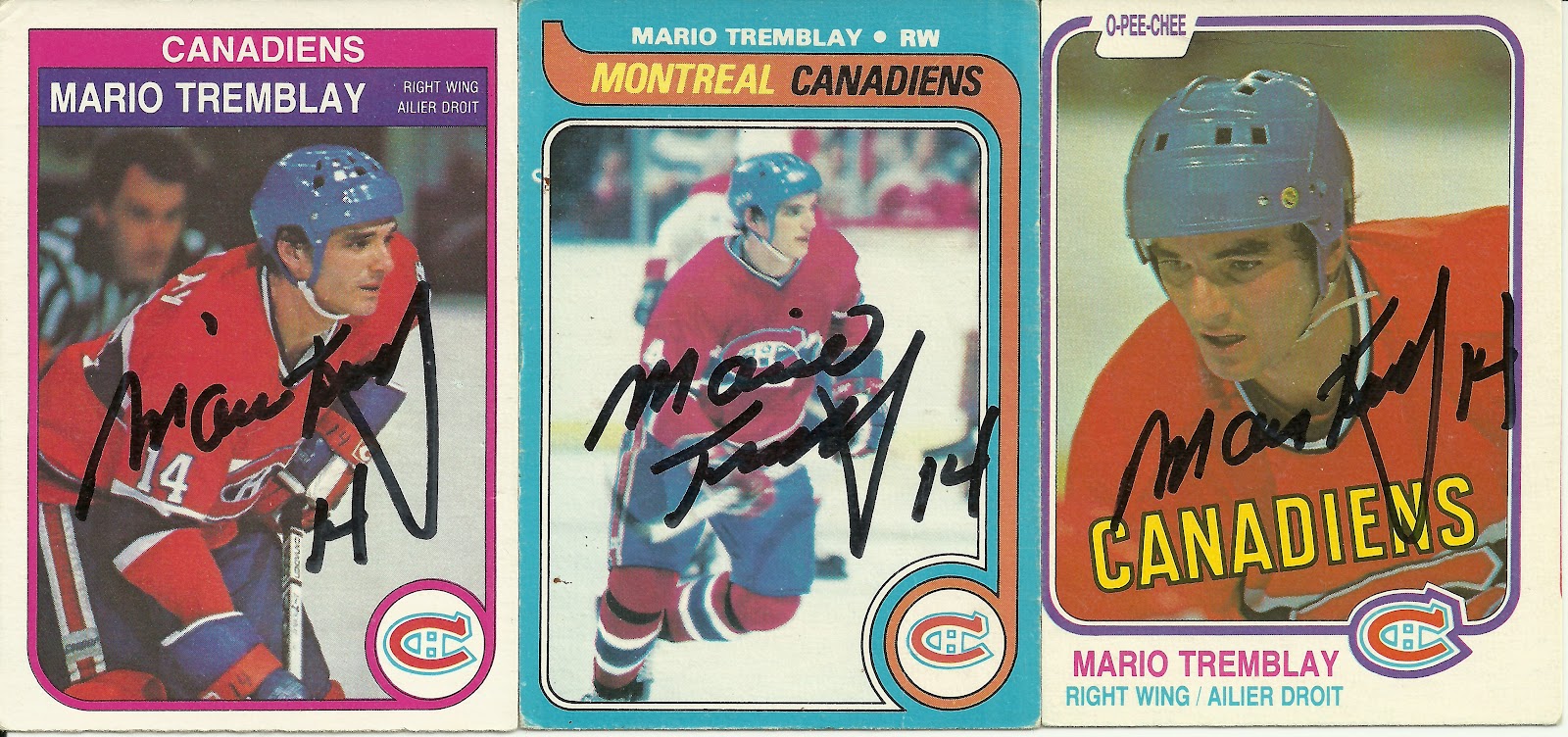
I sent Tremblay the above 3 cards and a fan letter on March 13th, 2012, and got them all back, signed in black sharpie - with his number 14 tagged at the end of each one - on May 1st, 2012. He was also kind enough to sign one of the two index cards I always enclose to protect my cards:

As for the cards, all of them show him wearing the Habs' red (away) uniform and his classic Jofa helmet, usually worn by European players (and Wayne Gretzky):


The card on the left is from Topps' 1982-83 O-Pee-Chee set (card #193), waiting for the puck to drop during a face-off; the card on the right is from Topps' 1979-80 O-Pee-Chee set (card #123), the back of which mentions his 100-point season (in 46 games!) in Juniors. It may appear blurry, but that's the actual card, not the scan.

While OPC was good at out-of-focus pictures, they also had a nasty habit of airbrushing players' new team jerseys onto old pictures and, like in the next card, not cutting them properly:


Believe it or not, that card was designed to be centered! It's card #192 in the 1981-82 O-Pee-Chee set by Topps.

Monday, April 23, 2012

Rick Wamsley: 3 Autographed Cards

I've liked the Ottawa Senators for a long time. First, their jerseys caught my eye, and when the Daniel Alfredsson era began (and the Alexei Yashin era ended), I kept an interested eye on them. And, since then, the Sens have pretty much always consistently gone further in the playoffs than my hometown Habs, and I've found myself rooting for them more often than not.

Jason Spezza remains, in my mind, one of the premier passers in the league, Alfie is a great captain (second to maybe only Jarome Iginla), and they always seem to turn out having great talent on defense.

More often than not, goaltending has been blamed for their lack of playoff success (i.e. that elusive Stanley Cup), but from Peter Sidorkiewicz getting All Star nods to Ron Tugnutt to Patrick Lalime, goalies have always done what was expected of them for this team. And while Pascal Leclaire's streak of bad luck only got worse in Ottawa, he didn't fare badly at all and, this season, Craig Anderson has done an admirable job - and so has Ben Bishop in a relief role.

And one person to thank for the Sens' recent rise in goaltending prowess is undoubtedly goalie coach Rick Wamsley, a former Cup and Jennings winner himself, who had previously signed these two cards for me, almost 2 years ago.

Now, I was hoping the Sens would send the New York Rangers packing tonight, but it looks like there'll be a Game 7 in that series...

But back to Wamsley. I wrote him a new fan letter to go along with these 3 cards I sent him on February 24, 2012 and got them all back today, April 23rd, 2012. They show him wearing the colours of his first two NHL teams, firstly with the Montréal Canadiens:


The card on the left is from Topps' 1982-83 O-Pee-Chee set (card #195), coming off his Jennings-worth season; the card on the right, featuring a helmet-less low-resolution picture of Wamsley sporting the back-up's ''towel around the neck'' classic attire (in the 80s), is from In The Game's 2010-11 Between The Pipes set (card #145, the Greats Of The Game sub-set).

And this card, showing him with the beautiful 80s-era St. Louis Blues uniform:


This is card #240 of Topps' 1986-87 O-Pee-Chee set, a beautiful and classic one, showing Wamsley skating around during a pre-game warmup against the New Jersey Devils.

Tuesday, February 21, 2012

Stan Smyl: 3 Autographed Cards

Welcome to my childhood! Stan Smyl was already the Vancouver Canucks' captain when I started paying attention to the NHL in the mid-80s. He was viewed as the Canucks' best player for most of his time, and held many team records, most of which have since been surpassed.

Among them: most points in a single season (88), most points in a single month (31), and the career leader in goals, assists and points. The goals and points marks were beaten by both Trevor Linden and Markus Naslund - his successors as captain - while the assists mark has been bested by Henrik Sedin.

Still, as the original Captain Canuck, he wore the classic Canucks uniforms I thought defined the team - I always hated the blue and green ones they brought back from purgatory a couple of years ago:
I barely knew the 'V' jerseys and, quite honestly, I always found them rather repulsive - and the yellow 'home' jersey was the worst of all. I like the black 'V' more than the retro/current/first ones, though. This one is from the 1982-83 O-Pee-Chee set (card #356) by Topps.
These two, however, to me, are the quintessential Canucks uniforms, as well as those I identify with the most from my childhood. The card on the left is from the first set I ever collected seriously, Topps' 1986-87 O-Pee-Chee (card #50), where my parents would let me buy a 35-cents pack of 7 cards for every errand I ran for them at the convenience store. Notice the patch on the jersey - it commemorates the city of Vancouver hosting the World's Fair in 1986. The card on the right is from the 1987-88 Topps set (card #4).

I sent Smyl these three cards and a fan letter care of the Canucks, where he is currently the assistant general manager, on January 27th, 2012, and got them all back signed in a fading black sharpie on February 16th - the same day I got these Guy Lafleur cards.

Sunday, February 19, 2012

Guy Lafleur: 5 Autographed Cards (Part 1)

Few players can claim to have been the best in a season, let alone in a decade or a generation. Guy Lafleur, however, sure can. His tenure with the Montréal Canadiens alone got him elected into the Hall Of Fame in his first year of eligibility (1988), and you'd figure he was a shoe-in, what with 1346 points (the team's all-time leading scorer), on the strength of 518 goals and 728 assists in 14 seasons.

He is tied for the team record of goals in a season (60) with his former linemate Steve Shutt, while the center of that line, Jacques Lemaire, is now widely regarded as one of the three best coaches in NHL history (with Scotty Bowman and Toe Blake) - and the reason why Lafleur retired in the first place, putting an unusual amount of pressure on the superstar to play a defensively-minded game rather than being the offensive catalyst.

He holds the team's points in a season record (136) and was the first player in NHL history to have six consecutive 50-goal and 100-point seasons. He has 3 Art Ross trophies (1976, 1977, 1978), 2 Hart trophies (league MVP in 1977 and 1978), 3 Lester B. Pearson Awards (now the Ted Lindsay trophy for the best player as voted by the players, 1976, 1977, 1978) and a Conn Smythe Trophy (1977) to go with his 5 Stanley Cups and 1976 Canada Cup.

One of the most beloved players in Habs history, the Forum crowd would enter chants of ''Guy! Guy! Guy!'' every time he touched the puck, scored, or was named one of the game's three stars.

Feeling he had been forced into retirement unjustly, and with the lingering feeling that he had a few more goals left in him, Lafleur trained like a boxer to get back in shape and attempted a comeback in time for the 1988-89 season, with the New York Rangers, becoming the second (after Gordie Howe, before Mario Lemieux) of three players to come back to the NHL after being named to the Hall Of Fame. In his first game back to the Forum, Lafleur netted a hat trick (3 goals!) against the best goalie of all time - Patrick Roy - in a 7-5 Rangers loss; he was named the first star, to the usual chants of ''Guy! Guy! Guy!'' that rang through the Forum for the whole game.

He was sent to the Québec Nordiques with head coach Michel Bergeron in the off-season and, despite diminished ice time, was among the best players on the team, even earning an invitation to the 1991 All-Star Game, an invitation he declined, stating ''Joe Sakic has been by far our best and most deserving player, I withdraw myself so he can attend as our team's representative''. Sakic was named, and Lafleur was subsequently invited as ''the commisionner's choice'', an honor for a soon-to-be-retiring player of high caliber he shared with Bobby Smith that year.

Now onto the cards!

First, the oldest Guy Lafleur card in my collection, from Topps' 1982-83 O-Pee-Chee set (card #187, the In Action sub-set):
Hair in the wind, about to take off at full speed, a complete view of his whole body position and uniform, and even the stick's curved blade. I like this card so much I even have two more of them (unsigned).

And now for some 2008-09 cards by Upper Deck:
The card above is from the special-edition 2008-09 Montreal Canadiens Centennial set, the Trophy Winners sub-set (card #256). I thought it'd be cool to have an off-ice card signed. He is pictured with all the trophies he won in the 1977-78 season.

But UD went all out for these cards:
Believe it or not, these two are variants of the same card, from the 2008-09 O-Pee-Chee set (card #579, the Legends sub-set). The card on the left is the regular version, while the one on the right is the ''retro'' variant. Even the backs were different:

(continued on the next post)