(team and product links go to sponsored Amazon products, player links go to related pages on my blog, news links go to source pages)
The last time I featured two autographed Tony Hrkac cards, I purposely skimmed through his time with the Mighty Ducks of Anaheim because I knew I had this post as a back-up.
His 140 games with Anaheim was the third-most he spent with any one organization, after the 201 with the St. Louis Blues and 160 with the Atlanta Thrashers. His 38 points with the Mighty Ducks in 2000-01 at age 34 is his fifth-highest total in the NHL, coming in the heart of the Dead Puck Era and his even (+0) plus/minus rating was tied for second-best on the team, with only Antti Aalto falling into the positives at +1, in only 12 games, mind you. The team's stars were all in deep minuses: Paul Kariya (67 points, -9), Teemu Selanne (59 points, -8), Oleg Tverdovsky (53 points, -11), Marty McInnis (42 points, -21) and Matt Cullen (40 points, -23) all brought forth a negative differential, making life difficult on goalies Guy Hebert (41 games, 12-23-4, 2 shutouts, 3.12 GAA and .897 save percentage) and Jean-Sébastien Giguère (34 games, 11-17-5, 4 shutouts, 2.57 GAA and .911 save percentage).
Card #5 from Pacific's 2001-02 Pacific series encapsulates his time in California very well:
The purple (technically "eggplant") and jade uniform was their main away gear from the team's inception in 1993 until 2006, when Disney sold the team and it changed its look and took the "Mighty" out of its name to not interfere with Disney's copyrights from the kids' film franchise, with the team opting to modify its brand and look at the same time.
However, I mostly tend to remember Hrkac as a member of the Blues and Québec Nordiques, as the early 90s were when I followed the sport and the NHL the most religiously, and I also have him sporting the Nords' beautiful blue (away) uniform from the late 80s/early 90s, before they started incorporating red on the contours of the numbers:
That's card #172 from Topps' 1990-91 Bowman set, which enables me to enter Hrkac as #28 in my Nordiques Numbers Project. You might recall he's also there as #40, and he is a rare player who went from wearing a "regular" (read: below #35) number in 1989-90 to a "high number" (40 and up) in 1990-91; back in the day, it was customary for goalies to wear #1, #20, #29, or a number between 30 and 35, while tough guys and goons were given available numbers between 30 and 39 and other skaters typically had lower numbers - except for stars, who could get "the doubles" (11, 22, 44, 55, 66, 77, 88 and 99). The numbers above 40 were typically reserved for rookies who had yet to "earn" their lower number.
Hrkac signed these in blue sharpie when he came out of retirement at age 42, from 2008 to 2010, with the Houston Aeros of the AHL. His 2008-09 playoff run was particularly impressive, as he posted 14 points in 19 games in a deep postseason run.
He's been a pro scout with the Tampa Bay Lightning since 2015, who have acquired the likes of Anton Stralman, Michaël Bournival, Gabriel Dumont, Peter Budaj, Louis Domingue, Dan Girardi, Ryan McDonagh, Mikhail Sergachev, Eddie Pasquale, Cameron Gaunce, Danick Martel, J.T. Miller, Curtis McElhinney, Jan Rutta, Luke Schenn, Kevin Shattenkirk and Pat Maroon via other means than drafting during his tenure, so either he is passionate about my blog or he travels from Montréal to New York a lot.
Showing posts with label Bowman. Show all posts
Tuesday, February 4, 2020
Friday, September 20, 2019
Steve Bozek: Three Autographed Cards
(As per years past, this is a twin-post with my "regular" blog, where I predicted the Vancouver Canucks would finish fifth in the Pacific Division in 2019-20).
Those were my favourite Vancouver Canucks jerseys by far. The predominant black, the golden-orange that stands out, and just a bit of red to accent both. I miss them dearly.
Steve Bozek had 89 points in 41 games in his draft year playing for the NCAA's Northern Michigan University Wildcats, so it was a bit of a surprise to see him fall to 53rd overall, which is when the Los Angeles Kings called his name out. To prove he was no fluke, he led all College players the following year with 90 points in 44 games, a team record that still stands.
He had an immediate impact with the Kings, as an injury to Charlie Simmer gave him the opportunity to line up with Marcel Dionne and Dave Taylor on the first line; his 33 goals were a team record for a rookie at the time, but have since been surpassed by Luc Robitaille (45 in 1986-87).
It would be short-sighted to not at least put a caveat to the fact that his rookie season was his best, statistically, what with his 33 goals, 23 assists and 56 points all being career highs; the fact of the matter is he's missed 10 to 25 games to injury in most following seasons, sometimes over 40, and he still put up point-per-game averages close to 0.5 seven times, including in his penultimate season, in 1990-91, which was his last one with the Canucks.
Between his time in L.A. and all the way up the coast to Vancouver, he spent the bulk of five seasons with the Calgary Flames earning praise for his two-way play and helping them reach the 1986 Stanley Cup Final, and 7 games with the St. Louis Blues. His final NHL season was in 1991-92, as he signed a one-year deal as a free agent with the San Jose Sharks before playing one year in Italy (11 points in 15 games in 1992-93) and one game in Slovenia in 1993-94.
But I remember him best from his days with the Canucks, where he proved to be a strong penalty killer. Here he is on a slightly blurry picture with card #293 from Pro Set's 1990-91 Series 1 set:
And here he is on two cards from Topps:
On the left is card #325 from the 1991-92 Bowman collection, while the one on the right is #28 from the 1991-92 Stadium Club set, with the mention that he's now with the Sharks.
He signed all three cards for me in black sharpie at a card show in Toronto a couple of years back; I think he lives there now and works as a financial advisor.
He won a silver medal with Team Canada at the 1991 World Championships.
Those were my favourite Vancouver Canucks jerseys by far. The predominant black, the golden-orange that stands out, and just a bit of red to accent both. I miss them dearly.
Steve Bozek had 89 points in 41 games in his draft year playing for the NCAA's Northern Michigan University Wildcats, so it was a bit of a surprise to see him fall to 53rd overall, which is when the Los Angeles Kings called his name out. To prove he was no fluke, he led all College players the following year with 90 points in 44 games, a team record that still stands.
He had an immediate impact with the Kings, as an injury to Charlie Simmer gave him the opportunity to line up with Marcel Dionne and Dave Taylor on the first line; his 33 goals were a team record for a rookie at the time, but have since been surpassed by Luc Robitaille (45 in 1986-87).
It would be short-sighted to not at least put a caveat to the fact that his rookie season was his best, statistically, what with his 33 goals, 23 assists and 56 points all being career highs; the fact of the matter is he's missed 10 to 25 games to injury in most following seasons, sometimes over 40, and he still put up point-per-game averages close to 0.5 seven times, including in his penultimate season, in 1990-91, which was his last one with the Canucks.
Between his time in L.A. and all the way up the coast to Vancouver, he spent the bulk of five seasons with the Calgary Flames earning praise for his two-way play and helping them reach the 1986 Stanley Cup Final, and 7 games with the St. Louis Blues. His final NHL season was in 1991-92, as he signed a one-year deal as a free agent with the San Jose Sharks before playing one year in Italy (11 points in 15 games in 1992-93) and one game in Slovenia in 1993-94.
But I remember him best from his days with the Canucks, where he proved to be a strong penalty killer. Here he is on a slightly blurry picture with card #293 from Pro Set's 1990-91 Series 1 set:
And here he is on two cards from Topps:
On the left is card #325 from the 1991-92 Bowman collection, while the one on the right is #28 from the 1991-92 Stadium Club set, with the mention that he's now with the Sharks.
He signed all three cards for me in black sharpie at a card show in Toronto a couple of years back; I think he lives there now and works as a financial advisor.
He won a silver medal with Team Canada at the 1991 World Championships.
Thursday, March 14, 2019
Brent Ashton: Two Autographed Cards
Three weeks ago, the NHL trade deadline saw nearly 50 trades happen with a total of 83 actual players switching teams (one of them, Derick Brassard, moving twice) with just about the same number of draft picks switching owners.
No stranger to moving, Brent Ashton was the NHL's record-holder in that category for more than a decade, having been traded eight times in his 14-season career, a feat that was tied by Mike Sillinger in 2004 and surpassed two years later.
Fun fact: both Ashton and Sillinger hail from Saskatchewan, and both returned to their respective hometowns of Saskatoon and Regina upon retiring from the NHL. Fittingly, Ashton owns a sportswear business and is a licensed... real estate agent. He does know a thing or two about purchasing and moving into and out of homes, after all.
His wife Susan, however, may have had the most experience in that matter according to a 2009 interview with the NHL's website:
Brent's prime took place between the 1984-85 and 1989-90 seasons, where he had six consecutive 50-plus-point seasons (all of them with more than 20 goals), with a high of 40 goals and 75 points in 1986-87, which was split almost evenly between the Québec Nordiques and Detroit Red Wings.
He finished his career two games shy of the 1000 mark, with 284 goals and 345 assists for 629 points. He also had three solid postseason runs (one in Québec and two in Detroit) in which he amassed 35 of his career 49 playoff points (in 85 games).
His time in Québec occurring just before I started really paying attention to the sport, I mostly remember him with the Winnipeg Jets, which is why that's the team I had him sign cards from.
First, here he is wearing the team's initial purple (away) uniform on card #130 from Topps' 1990-91 Bowman collection:
Those long white sleeves are a look then-GM John Ferguson had previously tried to impose when with the New York Rangers (to vitriolic reviews) and brought over to the Jets when they made the switch from the WHA to the NHL.
They then modernized their look for the 1990s, as can be attested from card #78 from Score's 1991-92 Score (Canadian Edition) set:
He signed both in black sharpie. These cards allow me to induct him beside Keith Tkachuk as wearers of #7 in my Jets Numbers Project.
No stranger to moving, Brent Ashton was the NHL's record-holder in that category for more than a decade, having been traded eight times in his 14-season career, a feat that was tied by Mike Sillinger in 2004 and surpassed two years later.
Fun fact: both Ashton and Sillinger hail from Saskatchewan, and both returned to their respective hometowns of Saskatoon and Regina upon retiring from the NHL. Fittingly, Ashton owns a sportswear business and is a licensed... real estate agent. He does know a thing or two about purchasing and moving into and out of homes, after all.
His wife Susan, however, may have had the most experience in that matter according to a 2009 interview with the NHL's website:
"There was no help," she says.Their son, Carter Ashton, was a Tampa Bay Lightning draft pick (29th overall, first round, 2009) who now plays in the KHL after a few years in the Toronto Maple Leafs organization.
Susan was the one who said goodbye to her friends, sold the home, found a moving company, had the mail redirected, found a new place to live, got the phone hooked up and set up shop in a new city, where she started all over again. She didn't have a dressing room to offer shelter from the storm.
"It wasn't easy," says Brent about what his wife had to juggle. "As players, we have the dressing room. What do the wives have? They were left on their own."
Of all the moves she's been through, Susan says the one time she was close to the edge emotionally was in 1991. She recalls being at the Winnipeg airport on her way to Boston with a lot on her plate.
"I had a 6-month-old, a 2 1/2-year-old and I had a dog, which was running around the airport, and I had our luggage," she says. "It was left up to me to move. But what could I do? What was the alternative? But I didn't cry. We were fortunate because our kids were not in school."
Brent's prime took place between the 1984-85 and 1989-90 seasons, where he had six consecutive 50-plus-point seasons (all of them with more than 20 goals), with a high of 40 goals and 75 points in 1986-87, which was split almost evenly between the Québec Nordiques and Detroit Red Wings.
He finished his career two games shy of the 1000 mark, with 284 goals and 345 assists for 629 points. He also had three solid postseason runs (one in Québec and two in Detroit) in which he amassed 35 of his career 49 playoff points (in 85 games).
His time in Québec occurring just before I started really paying attention to the sport, I mostly remember him with the Winnipeg Jets, which is why that's the team I had him sign cards from.
First, here he is wearing the team's initial purple (away) uniform on card #130 from Topps' 1990-91 Bowman collection:
Those long white sleeves are a look then-GM John Ferguson had previously tried to impose when with the New York Rangers (to vitriolic reviews) and brought over to the Jets when they made the switch from the WHA to the NHL.
They then modernized their look for the 1990s, as can be attested from card #78 from Score's 1991-92 Score (Canadian Edition) set:
He signed both in black sharpie. These cards allow me to induct him beside Keith Tkachuk as wearers of #7 in my Jets Numbers Project.
Friday, November 24, 2017
Brandon Watson Autographed Card
When Brandon Watson was drafted by the fledgling Montréal Expos in the ninth round in 1999, there was some level of excitement, because he's the godson of former Cincinnati Reds star Eric Davis.
It didn't turn out that way, and he eventually toiled around in the minor league systems of the Florida Marlins, Reds, Detroit Tigers, Cleveland Indians, Washington Nationals, Philadelphia Phillies, Arizona Diamondbacks, and Los Angeles Dodgers.
He did play in the Majors - with the Expos' descendants, the Nationals, no less - appearing in 40 total games over three seasons between 2005 and 2007. His career batting average stands at .198.
He does have a minor-league record, however, having hit in 43 consecutive games in the International League with the Columbus Clippers in 2007.
Here he is sporting the Expos' #20 - which he never wore in an actual game - on card #321 from Topps' 2003 Bowman collection and First Year Card sub-set, identifying it as his rookie card:
He signed it in blue sharpie, on top of the silver facsimile autograph on the card.
He wore #00 with the Nationals.
It didn't turn out that way, and he eventually toiled around in the minor league systems of the Florida Marlins, Reds, Detroit Tigers, Cleveland Indians, Washington Nationals, Philadelphia Phillies, Arizona Diamondbacks, and Los Angeles Dodgers.
He did play in the Majors - with the Expos' descendants, the Nationals, no less - appearing in 40 total games over three seasons between 2005 and 2007. His career batting average stands at .198.
He does have a minor-league record, however, having hit in 43 consecutive games in the International League with the Columbus Clippers in 2007.
Here he is sporting the Expos' #20 - which he never wore in an actual game - on card #321 from Topps' 2003 Bowman collection and First Year Card sub-set, identifying it as his rookie card:
He signed it in blue sharpie, on top of the silver facsimile autograph on the card.
He wore #00 with the Nationals.
Tuesday, November 14, 2017
Josh Labandeira Autographed Card
Josh Labandeira played professional baseball until 2008, mostly in AAA ball, appearing in 7 MLB games with the Montréal Expos in 2004, with 14 plate appearances and 4 strikeouts. I met him at that time, in September 2004, as the team was ready to fold, playing its final games at the Stade Olympique. That's probably when he signed this rookie card, #216 from Topps' 2004 Bowman set and First Year sub-set, in blue sharpie, although I do not specifically recall it:
While it doesn't show him wearing the #1 uniform from his regular season games, it does show him wearing #73, from Spring training, which slots him perfectly in my Expos Numbers Project.
Following his retirement, he moved to California and became an assistant coach for the Reedley College baseball team, until the Boston Red Sox came calling and signed him as their Western California scout.
While it doesn't show him wearing the #1 uniform from his regular season games, it does show him wearing #73, from Spring training, which slots him perfectly in my Expos Numbers Project.
Following his retirement, he moved to California and became an assistant coach for the Reedley College baseball team, until the Boston Red Sox came calling and signed him as their Western California scout.
Saturday, October 28, 2017
Rollie Melanson Autographed Card
Many thought Roland Melanson would take the 2016-17 season off completely when he announced he wanted to spend more time with his mother and fiancée, but he eventually reached an agreement with the Vancouver Canucks where Dan Cloutier would take over as goalie coach in the NHL and Melanson would be more of a consultant dealing with the prospects and AHLers, traveling from Utica to Montréal to Moncton by car when required.
Then he left the Canucks' organization altogether and joined the New Jersey Devils this summer, reuniting him with former Vancouver prospect Cory Schneider.
Today, I'd like to focus on the short time he spent with the Montréal Canadiens - as a player, that is. It started off with a lop-sided trade by GM Serge Savard, who receive "Rollie The Goalie" and the Devils' captain, Kirk Muller, in exchange for two-time 50-goal scorer Stéphane Richer and Tom Chorske. While both teams would win a Stanley Cup in the next five years, the Habs won it first (1993 vs 1995), and Richer never again reached even the 40-goal mark, while Muller was almost a point-per-game player in Montréal, culminating in a 94-point season in 1992-93.
For his part, Melanson stole the backup job away from prospects André Racicot, Frédéric Chabot, Jean-Claude Bergeron and Les Kuntar on the strength of an incredible training camp performance (two shutouts and two one-goal games in four appearances). He continued his strong play with two regular-season shutouts in 9 games in 1991-92 (against the Philadelphia Flyers and division rivals Buffalo Sabres), but did do poorly against the Chicago Blackhawks and Washington Capitals, letting in 4 goals against each team. Racicot would also suit in for 9 games, but at that point, the Habs were solely Patrick Roy's show, as #33 hit the ice in 67 contests.
And yet, here's Melanson, wearing the Habs' classic red (then-away) uniform, sporting the now-retired #1 (for Jacques Plante), on card #187 from Topps' 1992-93 Bowman set:
He signed it in black sharpie in 2002-03, when he was the Canadiens' goaltending coach.
I personally relate to his season in Montréal because, like him, I earned a roster spot on my most competitive team yet that year, as coaches dubbed me "Rollie" or "Hellie", seeing as I too came in not expected to make the Pee-Wee "A" team as a guy who'd only been a "C"-level player before then; I was just supposed to be a body who would get cut, someone present to make others look good and boost their confidence. Instead, I became the starting goalie and led the team to three tournament finals and the City Championship, earning MVP honors at every turn.
Meeting him while he was coaching the likes of José Theodore and Jeff Hackett inspired me to offer my services to coach kids myself, which I eventually got to do.
Then he left the Canucks' organization altogether and joined the New Jersey Devils this summer, reuniting him with former Vancouver prospect Cory Schneider.
Today, I'd like to focus on the short time he spent with the Montréal Canadiens - as a player, that is. It started off with a lop-sided trade by GM Serge Savard, who receive "Rollie The Goalie" and the Devils' captain, Kirk Muller, in exchange for two-time 50-goal scorer Stéphane Richer and Tom Chorske. While both teams would win a Stanley Cup in the next five years, the Habs won it first (1993 vs 1995), and Richer never again reached even the 40-goal mark, while Muller was almost a point-per-game player in Montréal, culminating in a 94-point season in 1992-93.
For his part, Melanson stole the backup job away from prospects André Racicot, Frédéric Chabot, Jean-Claude Bergeron and Les Kuntar on the strength of an incredible training camp performance (two shutouts and two one-goal games in four appearances). He continued his strong play with two regular-season shutouts in 9 games in 1991-92 (against the Philadelphia Flyers and division rivals Buffalo Sabres), but did do poorly against the Chicago Blackhawks and Washington Capitals, letting in 4 goals against each team. Racicot would also suit in for 9 games, but at that point, the Habs were solely Patrick Roy's show, as #33 hit the ice in 67 contests.
And yet, here's Melanson, wearing the Habs' classic red (then-away) uniform, sporting the now-retired #1 (for Jacques Plante), on card #187 from Topps' 1992-93 Bowman set:
He signed it in black sharpie in 2002-03, when he was the Canadiens' goaltending coach.
I personally relate to his season in Montréal because, like him, I earned a roster spot on my most competitive team yet that year, as coaches dubbed me "Rollie" or "Hellie", seeing as I too came in not expected to make the Pee-Wee "A" team as a guy who'd only been a "C"-level player before then; I was just supposed to be a body who would get cut, someone present to make others look good and boost their confidence. Instead, I became the starting goalie and led the team to three tournament finals and the City Championship, earning MVP honors at every turn.
Meeting him while he was coaching the likes of José Theodore and Jeff Hackett inspired me to offer my services to coach kids myself, which I eventually got to do.
Friday, October 27, 2017
Anthony Thomas Jersey Card
Yes, I am one of those: I'm boycotting the NFL this year.
Not because players are kneeling, mind you, but for the opposite reason: because NFL owners colluded to blacklist the player who started the movement, Colin Kaepernick, while signing much lesser quarterbacks to expensive long-term contracts, leaving him unemployed.
Case in point:
Brian Hoyer, San Francisco 49ers (2 years, $12M). Currently sitting on the bench.
Nick Foles, Philadelphia Eagles (2 years, $11M). Backup with injury issues.
Josh McCown, New York Jets (one-year, $6M). Too good for a bad team, and tends to make costly mistakes.
Landry Jones, Pittsburgh Steelers (2 years, $4.4M). One of the better backups in the league.
Matt Barkley, 49ers (2 years, $4M). Didn't even make the team after training camp.
Mark Sanchez, Chicago Bears (one year, $2M). Third-string QB.
Geno Smith, New York Giants (one year, $1.2M). I can't believe this guy can still find work, he still believes he can start games.
Josh Johnson, Giants (two years, $1.02M). Failed to make the team.
E.J. Manuel, Oakland Raiders (one year, $800K). Interim starter after Derek Carr's injury.
Kellen Moore, Dallas Cowboys (one year, $775K). Now on practice squad.
Aaron Murray, Los Angeles Rams (one year, $615K). Released in the summer.
Chase Daniels, New Orleans Saints (one year, $900K paid by Saints, $4.1M paid by Eagles). Backup.
Case Keenum, Minnesota Vikings (one year, $2M, plus incentives). Getting the job done.
David Fales, Miami Dolphins. Apparently, a 27-year-old guy with two career complete passes is better than Kaepernick when your two starters (Ryan Tannehill and Jay Cutler) go down.
T.J. Yates, Buffalo Bills (one year). With too many QBs at the Bills' training camp, he became one of four when he was placed on injured reserve following a concussion. He reached a settlement with the team and has been released.
Matt McGloin, Eagles (one year). Failed to make the team.
Blaine Gabbert, Arizona Cardinals. Doing well.
Ryan Fitzpatrick, Tampa Bay Buccaneers (one year, $3M). Consistently inconsistent.
Austin Davis, Seattle Seahawks (one year, league minimum). A terrible quarterback.
And, of course, Mike Glendon, of Da Bears (3 years, $45M). Jesus.
That's not the worst decision the Bears ever took, though, but that's a story for another day. Today, I'll focus on a player who was fine with the team, terrible elsewhere, and could/should have been exceptional, Anthony Thomas.
Thomas was given the nickname "A-Train" when playing for the University of Michigan Wolverines, by sportscaster Brent Musburger, making his name as one of 1997's Big Ten Top Freshmen on an undefeated Wolverines team.
He followed that by leading the team in rushing for three consecutive years with 893 yards in 1998, 1297 yards in 1999, and 1733 yards in 2000, the latter of which remains the second-highest single-season total in Michigan history. That year, he had nine games in which he rushed for over 100 yards. His 4772 career rushing years set a school record (which has since been surpassed by Mike Hart).
He was therefore perhaps a steal when the Bears selected him in the second round (38th overall) in 2001, an impression he added to when he won the Offensive Rookie Of The Year award helping Chicago to an NFC Central championship.
He had two more decent seasons (721 rushing yards in 2002 and 1,024 rushing yards in 2003) before being surpassed by Thomas Jones, then made his way to the Cowboys, Saints and Bills, never truly finding a home or a role worthy of his past. Not everyone was a fan, though, even of his days in Chicago.
It's therefore fitting that I feature him wearing the Bears' classic black (home) uniform, with the jersey insert version of card #110 from Topps' 2001 Bowman's Best set:
It's a nice foil card that includes a matching jersey swatch from the NFL Rookie Premier event. It,s numbered 789/999.
Not because players are kneeling, mind you, but for the opposite reason: because NFL owners colluded to blacklist the player who started the movement, Colin Kaepernick, while signing much lesser quarterbacks to expensive long-term contracts, leaving him unemployed.
Case in point:
Brian Hoyer, San Francisco 49ers (2 years, $12M). Currently sitting on the bench.
Nick Foles, Philadelphia Eagles (2 years, $11M). Backup with injury issues.
Josh McCown, New York Jets (one-year, $6M). Too good for a bad team, and tends to make costly mistakes.
Landry Jones, Pittsburgh Steelers (2 years, $4.4M). One of the better backups in the league.
Matt Barkley, 49ers (2 years, $4M). Didn't even make the team after training camp.
Mark Sanchez, Chicago Bears (one year, $2M). Third-string QB.
Geno Smith, New York Giants (one year, $1.2M). I can't believe this guy can still find work, he still believes he can start games.
Josh Johnson, Giants (two years, $1.02M). Failed to make the team.
E.J. Manuel, Oakland Raiders (one year, $800K). Interim starter after Derek Carr's injury.
Kellen Moore, Dallas Cowboys (one year, $775K). Now on practice squad.
Aaron Murray, Los Angeles Rams (one year, $615K). Released in the summer.
Chase Daniels, New Orleans Saints (one year, $900K paid by Saints, $4.1M paid by Eagles). Backup.
Case Keenum, Minnesota Vikings (one year, $2M, plus incentives). Getting the job done.
David Fales, Miami Dolphins. Apparently, a 27-year-old guy with two career complete passes is better than Kaepernick when your two starters (Ryan Tannehill and Jay Cutler) go down.
T.J. Yates, Buffalo Bills (one year). With too many QBs at the Bills' training camp, he became one of four when he was placed on injured reserve following a concussion. He reached a settlement with the team and has been released.
Matt McGloin, Eagles (one year). Failed to make the team.
Blaine Gabbert, Arizona Cardinals. Doing well.
Ryan Fitzpatrick, Tampa Bay Buccaneers (one year, $3M). Consistently inconsistent.
Austin Davis, Seattle Seahawks (one year, league minimum). A terrible quarterback.
And, of course, Mike Glendon, of Da Bears (3 years, $45M). Jesus.
That's not the worst decision the Bears ever took, though, but that's a story for another day. Today, I'll focus on a player who was fine with the team, terrible elsewhere, and could/should have been exceptional, Anthony Thomas.
Thomas was given the nickname "A-Train" when playing for the University of Michigan Wolverines, by sportscaster Brent Musburger, making his name as one of 1997's Big Ten Top Freshmen on an undefeated Wolverines team.
He followed that by leading the team in rushing for three consecutive years with 893 yards in 1998, 1297 yards in 1999, and 1733 yards in 2000, the latter of which remains the second-highest single-season total in Michigan history. That year, he had nine games in which he rushed for over 100 yards. His 4772 career rushing years set a school record (which has since been surpassed by Mike Hart).
He was therefore perhaps a steal when the Bears selected him in the second round (38th overall) in 2001, an impression he added to when he won the Offensive Rookie Of The Year award helping Chicago to an NFC Central championship.
He had two more decent seasons (721 rushing yards in 2002 and 1,024 rushing yards in 2003) before being surpassed by Thomas Jones, then made his way to the Cowboys, Saints and Bills, never truly finding a home or a role worthy of his past. Not everyone was a fan, though, even of his days in Chicago.
It's therefore fitting that I feature him wearing the Bears' classic black (home) uniform, with the jersey insert version of card #110 from Topps' 2001 Bowman's Best set:
It's a nice foil card that includes a matching jersey swatch from the NFL Rookie Premier event. It,s numbered 789/999.
Wednesday, September 13, 2017
Brian Hayward: Three Signed Sharks Cards
Remember the good old days when you could count on the San Jose Sharks to not make the playoffs? Well, according to me earlier today, things are looking bad for the boys in teal this coming season, as I see them finishing 6th in the Pacific Division.
It's not that they don't have top-level talent, they do: GM Doug Wilson has built a strong roster with good upper-end players like Logan Couture, Joe Pavelski, Brent Burns and Marc-Édouard Vlasic, who can provide an almost-elite-level 20 minutes per game, plus the 60 games of top-notch goaltending from Martin Jones. Instead, the problem lies within the team's depth and a lack of youth among their prospects, considering none of Danny O'Regan (23 years old, C, point-per-game AHLer), Julius Bergman (21, D), Antoine Bibeau (23, G), Marcus Sorensen (25, LW), or Radim Simek (25, D) are under the age of 20, and some are already in their mid-20s.
It's not as bad as the Sharks' inaugural season, mind you, when a rookie by the name of Pat Falloon, whom many (not me) see as a failed draft pick or, worse, a "bust", led the team in every offensive category with 25 goals, 34 assists and 59 points in 79 games. Those would be half-decent numbers in 2017, but they were extremely low in 1991-92. So low that he was also a -32, which was in a three-way tie (with Jayson Moore and Pat MacLeod) for fourth-worse on the team; indeed, Paul Fenton was -39, current GM and then-captain and All-Star Wilson was -38, and Bob McGill was -34.
In net, the highest save percentage was a tie between Jeff Hackett and Wade Flaherty, at .892; followed future All-Star Arturs Irbe (.868), Team Finland goalie Jarmo Myllys (.867) and three-time Jennings Trophy winner Brian Hayward, whose back gave out from all the flailing around required to stop pucks with that porous a defense (.867, in 7 games). In terms of goals-against average, it ranged from 3.84 (Hackett) to 5.02 (Myllys), with three at 4-or-more in between (Flaherty at 4.38, Irbe at 4.47 and Hayward at 4.92).
It was while injured that Hayward caught the broadcasting bug, as he would serve as colour commentator for Sharks games when he was sidelined, until he retired and the expansion Anaheim Mighty Ducks came calling and offered him to do the job for them... fives times. He declined for a while, wanting to finish his MBA at Cornell University instead.
He did eventually agree and, 23 years later, he's still there, occasionally taking on double-duties with Hockey Night In Canada and on NBC. It was during one of those double-broadcasts in the playoffs that I crossed his path at the Bell Centre, where he took a black sharpie to sign cards featuring him wearing the Sharks' inaugural uniforms.
Let's start with the white (then-home) uniform, for which all players posed with the same, generic #91 jersey, on card #59 from Upper Deck's 1991-92 Series 1 set:
For the teal (then-away) uniform, I decided to go with two cards from the Topps brand:
On the left, possibly in the middle of one of his patented two-legged pad slides, is card #436 from the 1992-93 Topps set, while the picture on the right - also known as card #60 from the 1992-93 Bowman set, of which I have an unopened box for sale or trade, if anyone is interested - is probably from a pre-game warmup. What I like on the Bowman card is that he's two years removed from asking for a trade away from the Montréal Canadiens, but is still wearing Lefebvre pads, hand-made made by then-Habs trainer Gaétan Lefebvre for Patrick Roy and other butterfly goalies. Lefebvre produced these from 1987 until roughly 1995 for close friends and their families, but had already drastically reduced production when Roy started using all-Koho equipment prior to the 1992-93 season.
It's not that they don't have top-level talent, they do: GM Doug Wilson has built a strong roster with good upper-end players like Logan Couture, Joe Pavelski, Brent Burns and Marc-Édouard Vlasic, who can provide an almost-elite-level 20 minutes per game, plus the 60 games of top-notch goaltending from Martin Jones. Instead, the problem lies within the team's depth and a lack of youth among their prospects, considering none of Danny O'Regan (23 years old, C, point-per-game AHLer), Julius Bergman (21, D), Antoine Bibeau (23, G), Marcus Sorensen (25, LW), or Radim Simek (25, D) are under the age of 20, and some are already in their mid-20s.
It's not as bad as the Sharks' inaugural season, mind you, when a rookie by the name of Pat Falloon, whom many (not me) see as a failed draft pick or, worse, a "bust", led the team in every offensive category with 25 goals, 34 assists and 59 points in 79 games. Those would be half-decent numbers in 2017, but they were extremely low in 1991-92. So low that he was also a -32, which was in a three-way tie (with Jayson Moore and Pat MacLeod) for fourth-worse on the team; indeed, Paul Fenton was -39, current GM and then-captain and All-Star Wilson was -38, and Bob McGill was -34.
In net, the highest save percentage was a tie between Jeff Hackett and Wade Flaherty, at .892; followed future All-Star Arturs Irbe (.868), Team Finland goalie Jarmo Myllys (.867) and three-time Jennings Trophy winner Brian Hayward, whose back gave out from all the flailing around required to stop pucks with that porous a defense (.867, in 7 games). In terms of goals-against average, it ranged from 3.84 (Hackett) to 5.02 (Myllys), with three at 4-or-more in between (Flaherty at 4.38, Irbe at 4.47 and Hayward at 4.92).
It was while injured that Hayward caught the broadcasting bug, as he would serve as colour commentator for Sharks games when he was sidelined, until he retired and the expansion Anaheim Mighty Ducks came calling and offered him to do the job for them... fives times. He declined for a while, wanting to finish his MBA at Cornell University instead.
He did eventually agree and, 23 years later, he's still there, occasionally taking on double-duties with Hockey Night In Canada and on NBC. It was during one of those double-broadcasts in the playoffs that I crossed his path at the Bell Centre, where he took a black sharpie to sign cards featuring him wearing the Sharks' inaugural uniforms.
Let's start with the white (then-home) uniform, for which all players posed with the same, generic #91 jersey, on card #59 from Upper Deck's 1991-92 Series 1 set:
For the teal (then-away) uniform, I decided to go with two cards from the Topps brand:
On the left, possibly in the middle of one of his patented two-legged pad slides, is card #436 from the 1992-93 Topps set, while the picture on the right - also known as card #60 from the 1992-93 Bowman set, of which I have an unopened box for sale or trade, if anyone is interested - is probably from a pre-game warmup. What I like on the Bowman card is that he's two years removed from asking for a trade away from the Montréal Canadiens, but is still wearing Lefebvre pads, hand-made made by then-Habs trainer Gaétan Lefebvre for Patrick Roy and other butterfly goalies. Lefebvre produced these from 1987 until roughly 1995 for close friends and their families, but had already drastically reduced production when Roy started using all-Koho equipment prior to the 1992-93 season.
Thursday, May 25, 2017
Javier Vazquez Jersey Card
Javier Vazquez had many highlights with the Montréal Expos.
His first shutout came on my birthday - September 14th - in 1999, against the Los Angeles Dodgers. By his third season with the team, in 2000, he was already the opening day pitcher, and had accumulated 8 wins in his first 11 starts that year, though the team being as bad as it was ended up catching up with him, as he finished with an 11-9 record. The following summer, he led the National League with 3 shutouts.
Following his final season with the team, in 2003, he told reporters he didn't like playing for "a team without an owner who couldn't afford to trade for a player to help down the stretch". That was actually putting it lightly: Major League Baseball actually forbade the team to even recall players from their minor leagues, essentially tanking a playoff-caliber team that finished 83-79 (fourth in the NL East), enabling the Florida Marlins (91-71) and Philadelphia Phillies (86-76) to pass them, and securing the division title for the Atlanta Braves (101-61). It was one of the most unsportsmanlike and deliberate fixing situations I've ever seen - and I follow hockey and the Arizona Coyotes situation.
For the 2004 season, he signed on with the New York Yankees, and many sportswriters saw him as that year's eventual Cy Young winner; he wasn't in contention, but he did play in his only All-Star Game that summer.
He played for the Puerto Rican team in the 2006 World Baseball Classic (while with the Chicago White Sox) and finished fourth in NL Cy Young voting in 2009 while with the Braves. In 2010, in his second stint with the Yankees, he became the third active pitcher to beat all 30 MLB teams.
Still, seeing as I stopped following baseball after he left town, this is how I remember him best, wearing the Expos' pinstriped white (home) uniform:
That's card #DC-JV from Topps' 2003 Bowman Heritage set, featuring a grey game-worn jersey swatch.
His first shutout came on my birthday - September 14th - in 1999, against the Los Angeles Dodgers. By his third season with the team, in 2000, he was already the opening day pitcher, and had accumulated 8 wins in his first 11 starts that year, though the team being as bad as it was ended up catching up with him, as he finished with an 11-9 record. The following summer, he led the National League with 3 shutouts.
Following his final season with the team, in 2003, he told reporters he didn't like playing for "a team without an owner who couldn't afford to trade for a player to help down the stretch". That was actually putting it lightly: Major League Baseball actually forbade the team to even recall players from their minor leagues, essentially tanking a playoff-caliber team that finished 83-79 (fourth in the NL East), enabling the Florida Marlins (91-71) and Philadelphia Phillies (86-76) to pass them, and securing the division title for the Atlanta Braves (101-61). It was one of the most unsportsmanlike and deliberate fixing situations I've ever seen - and I follow hockey and the Arizona Coyotes situation.
For the 2004 season, he signed on with the New York Yankees, and many sportswriters saw him as that year's eventual Cy Young winner; he wasn't in contention, but he did play in his only All-Star Game that summer.
He played for the Puerto Rican team in the 2006 World Baseball Classic (while with the Chicago White Sox) and finished fourth in NL Cy Young voting in 2009 while with the Braves. In 2010, in his second stint with the Yankees, he became the third active pitcher to beat all 30 MLB teams.
Still, seeing as I stopped following baseball after he left town, this is how I remember him best, wearing the Expos' pinstriped white (home) uniform:
That's card #DC-JV from Topps' 2003 Bowman Heritage set, featuring a grey game-worn jersey swatch.
Sunday, September 4, 2016
Solomon Jones Autograph Card
Solomon Jones was the 33rd overall pick of the 2006 NBA draft, but barely remained with the Atlanta Hawks for three seasons. He also played for the Indiana Pacers (2010-11), Los Angeles Clippers and New Orleans Hornets (2012), New York Knicks (2013) and Orlando Magic (2014), and also signed deals with but never played for the Phoenix Suns (2012) and Chicago Bulls (2014), as both teams released or waived him before he could hit the floorboards.
He also played in China, for both the CBA (for the Liaoning Flying Leopards) and its development/minor league, the NBL (for the Dongguan Snowwolf).
Here is his rookie card, from Topps' 2006-07 Bowman Elevation set and Rookie Writings sub-set:
It's card #RWA-SJ in the signed insert series and features an on-sticker blue-sharpied autograph.
He also played in China, for both the CBA (for the Liaoning Flying Leopards) and its development/minor league, the NBL (for the Dongguan Snowwolf).
Here is his rookie card, from Topps' 2006-07 Bowman Elevation set and Rookie Writings sub-set:
It's card #RWA-SJ in the signed insert series and features an on-sticker blue-sharpied autograph.
Thursday, September 1, 2016
Jose Vidro Autographed Card
It's September, which means hockey and football training camps are starting and baseball is ending its season. Back when the Montréal Expos existed, it was often the time of year when the Atlanta Braves would give their final push to relegate my hometown team to its role of perennial playoff-absentee.
The 2000s weren't pretty for the Expos, but there were a few pleasant occurrences, such as Jose Vidro batting for over .300 - which he did for five straight seasons, representing the team at the All-Star Game in 2000, 2002 and 2003.
Not just that, but in 2000, he had a .375 batting average going into the Summer Classic, leading the Majors. It was a terrific season for him, as he ended up finishing seventh in the National League in BA (.330), second in hits (200), and third in doubles (51), setting career highs for home runs (24) and RBIs (97).
He also won the Sliver Slugger Award as the best-hitting second baseman in the NL in 2003. He also had a decent arm for an infielder, throwing outs at home plate and first base regularly.
He ended his career with one great (.314, 78 runs) and one extremely painful (.234) season with the Seattle Mariners, after suiting up for the first two seasons of the Washington Nationals, who traded him for two prospects in the most Expos-like deal they could muster up.
He is the best possible representative of uniform #3 in my Expos Numbers Project, with card #45 of the 2001 Bowman set, by Topps, which he signed in blue sharpie around 2002-2004, on top of a fac-simile autograph printed on the card:
It shows him wearing the team's final (grey) away uniform, batting right-handed (he was a switch hitter).
The 2000s weren't pretty for the Expos, but there were a few pleasant occurrences, such as Jose Vidro batting for over .300 - which he did for five straight seasons, representing the team at the All-Star Game in 2000, 2002 and 2003.
Not just that, but in 2000, he had a .375 batting average going into the Summer Classic, leading the Majors. It was a terrific season for him, as he ended up finishing seventh in the National League in BA (.330), second in hits (200), and third in doubles (51), setting career highs for home runs (24) and RBIs (97).
He also won the Sliver Slugger Award as the best-hitting second baseman in the NL in 2003. He also had a decent arm for an infielder, throwing outs at home plate and first base regularly.
He ended his career with one great (.314, 78 runs) and one extremely painful (.234) season with the Seattle Mariners, after suiting up for the first two seasons of the Washington Nationals, who traded him for two prospects in the most Expos-like deal they could muster up.
He is the best possible representative of uniform #3 in my Expos Numbers Project, with card #45 of the 2001 Bowman set, by Topps, which he signed in blue sharpie around 2002-2004, on top of a fac-simile autograph printed on the card:
It shows him wearing the team's final (grey) away uniform, batting right-handed (he was a switch hitter).
Sunday, April 10, 2016
Mark Grudzielanek: 2 Autographed Cards
As far as shortstops go, Mark Grudzielanek made his mark in three and a half years with the Montréal Expos, but he wasn't the finest they've ever had at the position; Spike Owen was the best defensive infielder in the National League for a few years, and Wilfredo Cordero was an All-Star, so the competition's impressive.
Then again, Grudzielanek was an All-Star himself in 1996 (grounding out in his only at-bat), and a Gold Glove winner in 2006 with the Kansas City Royals, so he's no slouch either. He also led the NL in at-bats (649) and doubles (54) in 1997, his last full summer with the Expos, as he was traded to the Los Angeles Dodgers near the 1998 trade deadline and played parts of five seasons in L.A., where he set an unusual MLB record, with 35 straight home games with at least a hit in 1999, the year he finished sixth in the NL with a .326 batting average.
His career batting average was a decent .289, but towards the end, he was often injured.
Post-retirement, he has moved into a managerial career, first as the Arizona Diamondbacks' Class-A manager, then as part of their Player Development staff.
He probably signed the two cards I'm featuring today in the late 1990s - so, likely as a Dodger, which is ironic considering the other notable #4 for the Expos in my youth was Delino DeShields, who was also a middle-infielder who was sent to L.A. Both cards were signed in blue sharpie and show him wearing the Expos' grey (away) uniform.
First, here's card #76 from Donruss' 1996 Leaf Signature Series set:
And here's card #267 from Topps' 1997 Bowman collection:
You get a good feel of his batting stance with those cards. As you might expect, he fits very well in my Expos Numbers Project.
Then again, Grudzielanek was an All-Star himself in 1996 (grounding out in his only at-bat), and a Gold Glove winner in 2006 with the Kansas City Royals, so he's no slouch either. He also led the NL in at-bats (649) and doubles (54) in 1997, his last full summer with the Expos, as he was traded to the Los Angeles Dodgers near the 1998 trade deadline and played parts of five seasons in L.A., where he set an unusual MLB record, with 35 straight home games with at least a hit in 1999, the year he finished sixth in the NL with a .326 batting average.
His career batting average was a decent .289, but towards the end, he was often injured.
Post-retirement, he has moved into a managerial career, first as the Arizona Diamondbacks' Class-A manager, then as part of their Player Development staff.
He probably signed the two cards I'm featuring today in the late 1990s - so, likely as a Dodger, which is ironic considering the other notable #4 for the Expos in my youth was Delino DeShields, who was also a middle-infielder who was sent to L.A. Both cards were signed in blue sharpie and show him wearing the Expos' grey (away) uniform.
First, here's card #76 from Donruss' 1996 Leaf Signature Series set:
And here's card #267 from Topps' 1997 Bowman collection:
You get a good feel of his batting stance with those cards. As you might expect, he fits very well in my Expos Numbers Project.
Friday, November 27, 2015
Jason Taylor Jersey Card
Jason Taylor played in the NFL for 15 seasons, which included three stints with the Miami Dolphins and a season each with the Washington Redskins and New York Giants.
He may eventually make into the Hall Of Fame, located in Akron, Ohio, where he played College Ball. He currently ranks sixth of all time in sacks and holds the NFL record for most fumbles returned for touchdowns (6).
He was a force on defense, participating in the Pro Bow six times, getting named All-Pro four times, and was the Defensive Player Of The Year for the AFC twice.
He entered the top-10 in sacks by bringing none other than New England Patriots QB Tom Brady down. He now appears poised to have a career in broadcasting, having appeared on numerous game analysis shows to provide feedback.
Here he is from Topps' 2007 Bowman Sterling set (card #BSVR-JT of the Authentic Game-Worn Jersey sub-set, featuring a game-worn light teal uniform swatch):
He's seen sporting the Dolphins' white uniform, #99 (an impressive number to hockey fans); later on in his career, he wore the captain's ''C'' with Miami.
He may eventually make into the Hall Of Fame, located in Akron, Ohio, where he played College Ball. He currently ranks sixth of all time in sacks and holds the NFL record for most fumbles returned for touchdowns (6).
He was a force on defense, participating in the Pro Bow six times, getting named All-Pro four times, and was the Defensive Player Of The Year for the AFC twice.
He entered the top-10 in sacks by bringing none other than New England Patriots QB Tom Brady down. He now appears poised to have a career in broadcasting, having appeared on numerous game analysis shows to provide feedback.
Here he is from Topps' 2007 Bowman Sterling set (card #BSVR-JT of the Authentic Game-Worn Jersey sub-set, featuring a game-worn light teal uniform swatch):
He's seen sporting the Dolphins' white uniform, #99 (an impressive number to hockey fans); later on in his career, he wore the captain's ''C'' with Miami.
Thursday, November 26, 2015
Keith Evans Autographed Card
I might be cheating or at the very least stretching it a bit by including Keith Evans as #64 in my Expos Numbers Project, considering he never actually played for the Montréal Expos - or any other MLB team, for that matter - in the majors; instead, the 220th pick of the 1996 draft spent most of his time in AAA ball with their affiliate Ottawa Lynx.
He had a couple of 70-strikeout seasons with the Lynx but mostly had a losing record in the NCAA (15-22 in three seasons), in AA (8-11 over two seasons) and AAA (13-27 over five seasons). He was a starting pitcher at every level except AAA, where his ball control was no longer enough and his lack of a powerful fastball definitely hindered him.
And yet here he is, in a major card set, from Topps' 2000 Bowman collection (card #433 in the set, his Rookie Card, showing him wearing the Expos' final striped white uniform in training camp (no name plate on the back):
He signed it in blue sharpie in either 2000 or 2001 when he was playing in Ottawa.
He had a couple of 70-strikeout seasons with the Lynx but mostly had a losing record in the NCAA (15-22 in three seasons), in AA (8-11 over two seasons) and AAA (13-27 over five seasons). He was a starting pitcher at every level except AAA, where his ball control was no longer enough and his lack of a powerful fastball definitely hindered him.
And yet here he is, in a major card set, from Topps' 2000 Bowman collection (card #433 in the set, his Rookie Card, showing him wearing the Expos' final striped white uniform in training camp (no name plate on the back):
He signed it in blue sharpie in either 2000 or 2001 when he was playing in Ottawa.
Tuesday, November 10, 2015
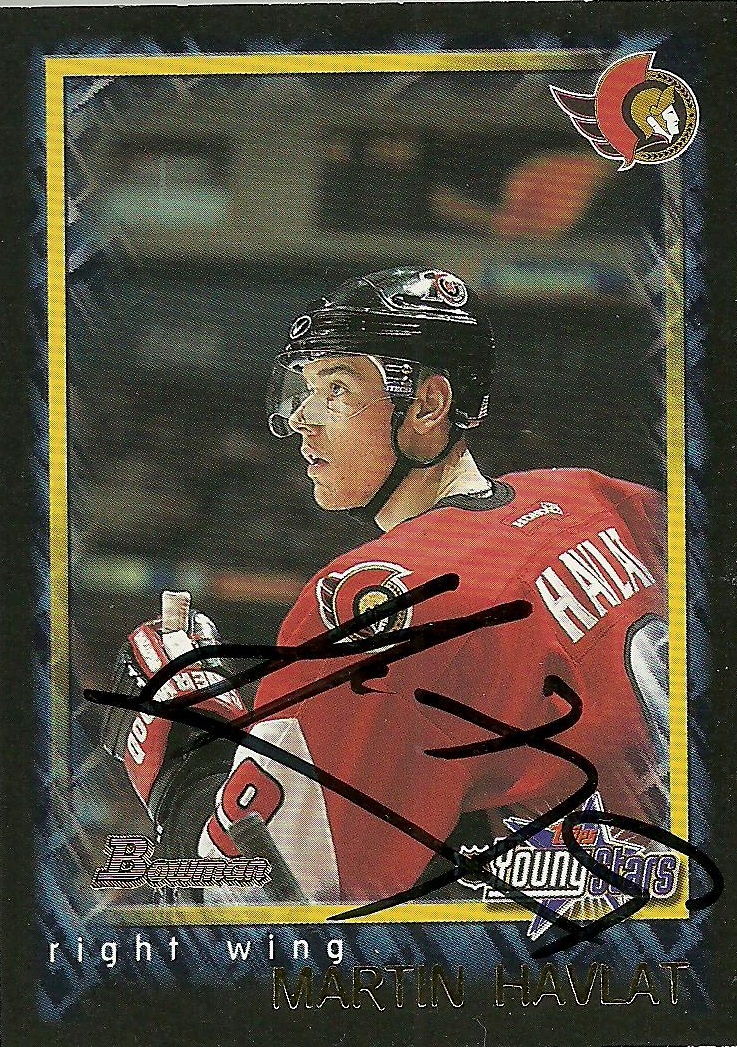
Martin Havlat: 3 Autographed Cards
As it happens relatively often, I've fallen behind on the hockey news when it comes to my blog; part of that is my professional life, part of it is having lost my desktop computer and all the scans I'd prepared on it, but mostly it's because so much is happening around the NHL and the sport at the moment.
So, I'll take it one step at a time, and start with the most recent news, which is that Martin Havlat scored a goal last night (assisted by Scott Gomez), in his first game of the season, after having been signed to a PTO by the St. Louis Blues (like Gomez).
Havlat was originally the 26th player chosen at the 1999 draft; the Ottawa Senators saw in him the same thing they saw in Marian Hossa two years prior, and it's true that perhaps he would have had that career path had he been luckier on the injury front. Alas, he was not, and he has lost a step or two since garnering Selke and Lady Byng votes with the Chicago Blackhawks in 2008-09. At that point, the 2000-01 Calder runner-up had already had 3 of his 7 NHL seasons significantly cut by injury, and had only played 73, 72, 67 and 68 games in the other four.
He was, however, nearly a point-per-game player who could play well at both ends and control a game's momentum. He then spent two seasons with the Minnesota Wild in which his point production remained steady (54 points in 73 games in 2009-10 and 62 points off 22 goals in 78 games the following season), but his -19 and -10 differentials were not becoming of what he had shown in the past.
A trade to the San Jose Sharks led to more bad luck (including a broken hamstring from getting his skate caught on the bench) and he wound up on the New Jersey Devils last year, merely registering 14 points in 40 games on one of the worst teams in the league.
I met him a few times between 2002 and 2005, when he was with the Sens. These three cards are probably from the same session, judging by the black sharpie used to sign them.
First, from Upper Deck's always-beautiful see-through plastic 2001-02 Ice set (card #31), wearing the team's superb black uniform:
Wearing the Sens' red uniform comes card #OTG13 from the Own The Game (and Rookie Points) sub-sets of the 2001-02 Topps collection:
And, finally, here's card #142 from the YoungStars sub-set of Topps' 2001-02 Bowman collection:
I wish him continued success. The Blues could use it, and he deserves it. I want him to end his career on a high note, and on his own terms. I honestly do not feel like the Blues are Cup-worthy (nor true contenders), but if he can finish his season playing with the Czech Team at the World Championships and add to his medal count (which already includes gold in 2000 and bronze in 2011, plus gold at the 2000 World Juniors), it would still be better than if he'd called it a day after not having had a contract after training camp.
And, hey, maybe he plays well enough this year that he scores himself a contract for next season. That would be great as well.
So, I'll take it one step at a time, and start with the most recent news, which is that Martin Havlat scored a goal last night (assisted by Scott Gomez), in his first game of the season, after having been signed to a PTO by the St. Louis Blues (like Gomez).
Havlat was originally the 26th player chosen at the 1999 draft; the Ottawa Senators saw in him the same thing they saw in Marian Hossa two years prior, and it's true that perhaps he would have had that career path had he been luckier on the injury front. Alas, he was not, and he has lost a step or two since garnering Selke and Lady Byng votes with the Chicago Blackhawks in 2008-09. At that point, the 2000-01 Calder runner-up had already had 3 of his 7 NHL seasons significantly cut by injury, and had only played 73, 72, 67 and 68 games in the other four.
He was, however, nearly a point-per-game player who could play well at both ends and control a game's momentum. He then spent two seasons with the Minnesota Wild in which his point production remained steady (54 points in 73 games in 2009-10 and 62 points off 22 goals in 78 games the following season), but his -19 and -10 differentials were not becoming of what he had shown in the past.
A trade to the San Jose Sharks led to more bad luck (including a broken hamstring from getting his skate caught on the bench) and he wound up on the New Jersey Devils last year, merely registering 14 points in 40 games on one of the worst teams in the league.
I met him a few times between 2002 and 2005, when he was with the Sens. These three cards are probably from the same session, judging by the black sharpie used to sign them.
First, from Upper Deck's always-beautiful see-through plastic 2001-02 Ice set (card #31), wearing the team's superb black uniform:
Wearing the Sens' red uniform comes card #OTG13 from the Own The Game (and Rookie Points) sub-sets of the 2001-02 Topps collection:
And, finally, here's card #142 from the YoungStars sub-set of Topps' 2001-02 Bowman collection:
I wish him continued success. The Blues could use it, and he deserves it. I want him to end his career on a high note, and on his own terms. I honestly do not feel like the Blues are Cup-worthy (nor true contenders), but if he can finish his season playing with the Czech Team at the World Championships and add to his medal count (which already includes gold in 2000 and bronze in 2011, plus gold at the 2000 World Juniors), it would still be better than if he'd called it a day after not having had a contract after training camp.
And, hey, maybe he plays well enough this year that he scores himself a contract for next season. That would be great as well.
Wednesday, September 2, 2015
Robert Meachem Rookie Jersey Card
Oh, look, a player-worn (but unclear whether in-game or during an event) jersey card:
(spoiler alert: he hadn't yet played in an NFL game, so it's ''event-worn''...)
That's from this card of Robert Meachem's, from Topps' 2007 Bowman Sterling set (card #BSRR-RM of the Authentic Player-Worn Jersey sub-set, which also acts as his rookie card in the collection):
He's pictured wearing the New Orleans Saints' black and gold uniform, the same worn he's worn in six of his seven NFL seasons, having spent the 2012 season with the San Diego Chargers.
He would usually dress for all the games (usually 16 in the regular season and 1 to 3 in the playoffs), but it's been harder on him since his one season in San Diego. In 2014, he was actually cut from the Saints' training camp and only offered a role after rookie Khairi Fortt got injured; he did manage to play in 11 games, though, and average his usual 16 yards per catch.
He's still a free agent as of today, but I'm fairly confident he'll get an offer soon. Every team needs a reliable wide receiver who happens to also be a veteran leader, a Super Bowl champion and former first-round pick to help teach the kids what it takes to win.
(spoiler alert: he hadn't yet played in an NFL game, so it's ''event-worn''...)
That's from this card of Robert Meachem's, from Topps' 2007 Bowman Sterling set (card #BSRR-RM of the Authentic Player-Worn Jersey sub-set, which also acts as his rookie card in the collection):
He's pictured wearing the New Orleans Saints' black and gold uniform, the same worn he's worn in six of his seven NFL seasons, having spent the 2012 season with the San Diego Chargers.
He would usually dress for all the games (usually 16 in the regular season and 1 to 3 in the playoffs), but it's been harder on him since his one season in San Diego. In 2014, he was actually cut from the Saints' training camp and only offered a role after rookie Khairi Fortt got injured; he did manage to play in 11 games, though, and average his usual 16 yards per catch.
He's still a free agent as of today, but I'm fairly confident he'll get an offer soon. Every team needs a reliable wide receiver who happens to also be a veteran leader, a Super Bowl champion and former first-round pick to help teach the kids what it takes to win.
Labels:
(American) Football,
2007,
Authentic Player-Worn Jerseys,
Bowman,
Bowman Sterling,
Card,
Insert,
Jersey Card,
New Orleans Saints,
NFL,
Robert Meachem,
Rookie Card,
Swatch Card,
Topps
Saturday, July 12, 2014
Marcel Hossa Jersey Card
I miss Marcel Hossa.
After failing to secure an NHL contract on favorable terms, he has now spent seven seasons in the KHL, four of them in three separate stints with Dinamo Riga. He actually was the league's leading goal scorer in 2009-10, with 35 goals in 56 games. Apart from a sub-par season in 2012-13 with the lowly Lev Praha, he has been a point-per-game player (or close) in the KHL - a rare feat - including posting 41 points (off 22 goals) in 50 games this past year.
At 32 years old and coming off his third straight Olympics with Team Slovakia, and a silver medal at the 2012 World Championships - so after both individual and team success, and having matured
- I think he could be a terrific middle-six forward in the NHL, a second-line winger on a playoff-bubble team, or a third-liner with some powerplay time (up to a minute per game) on a deep team that doesn't use its third line exclusively as a checking and grinding line.
Just because he won't turn out to be another Marian Hossa doesn't mean he can't be his own man, and that that wouldn't be enough. Even on this side of the pond, he participated in the YoungStars game, and when the New York Rangers put him on their top line for a month, he responded with 8 goals and 18 points in 11 games. It was after an injury and when he was relegated to a lower echelon (from the first line to the third) that things went sour, eventually leading to his being traded to the Phoenix Coyotes - a lose-lose situation if I've ever seen one - and subsequent fall from grace in North America.
Speaking of his good things he's done while in the NHL, here's a card from Topps' 2002-03 Bowman set (card #FFJ-MH from the Fabric Of The Future sub-sub-set of the YoungStars sub-set, featuring a big white jersey swatch that fits with his Montréal Canadiens' home uniform from the picture):
Notice he's wearing jersey #81, which would be what he'd use for pretty much the rest of his career, except when his brother Marian's also on the team, in which case Marcel would switch to #88 to 18; the first time I met Marcel, he signed two cards where he was sporting #36 with the Habs.
After failing to secure an NHL contract on favorable terms, he has now spent seven seasons in the KHL, four of them in three separate stints with Dinamo Riga. He actually was the league's leading goal scorer in 2009-10, with 35 goals in 56 games. Apart from a sub-par season in 2012-13 with the lowly Lev Praha, he has been a point-per-game player (or close) in the KHL - a rare feat - including posting 41 points (off 22 goals) in 50 games this past year.
At 32 years old and coming off his third straight Olympics with Team Slovakia, and a silver medal at the 2012 World Championships - so after both individual and team success, and having matured
- I think he could be a terrific middle-six forward in the NHL, a second-line winger on a playoff-bubble team, or a third-liner with some powerplay time (up to a minute per game) on a deep team that doesn't use its third line exclusively as a checking and grinding line.
Just because he won't turn out to be another Marian Hossa doesn't mean he can't be his own man, and that that wouldn't be enough. Even on this side of the pond, he participated in the YoungStars game, and when the New York Rangers put him on their top line for a month, he responded with 8 goals and 18 points in 11 games. It was after an injury and when he was relegated to a lower echelon (from the first line to the third) that things went sour, eventually leading to his being traded to the Phoenix Coyotes - a lose-lose situation if I've ever seen one - and subsequent fall from grace in North America.
Speaking of his good things he's done while in the NHL, here's a card from Topps' 2002-03 Bowman set (card #FFJ-MH from the Fabric Of The Future sub-sub-set of the YoungStars sub-set, featuring a big white jersey swatch that fits with his Montréal Canadiens' home uniform from the picture):
Notice he's wearing jersey #81, which would be what he'd use for pretty much the rest of his career, except when his brother Marian's also on the team, in which case Marcel would switch to #88 to 18; the first time I met Marcel, he signed two cards where he was sporting #36 with the Habs.
Thursday, May 15, 2014
Kevin Dineen: 4 Autographed Cards
Today marks one of the longest returns I've ever had - 784 days, more than two years, and ten days longer than this trio of David Booth cards!
I had sent Kevin Dineen a fan letter and 5 cards on March 22nd, 2012, care of the Florida Panthers, and got these four back today (May 15th, 2014), signed in black sharpie, with his jersey number (11) tagged at the end.
Dineen was a heart-and-soul star player for half of the 1980s and most of the 1990s. For a long time, he and Ron Francis were the only decent players on the Hartford Whalers, and Dineen was the associate captain while Francis wore the 'C'. Dineen was a point-per-game player who also usually reached the 160 penalty-minute plateau (with a high of 217 in 1987-88).
Soon after the 1991-92 season began, he was traded to the Philadelphia Flyers for Murray Craven; ironically, the Flyers owned the pick that got Dineen drafted in the first place (56th overall in 1982), which they'd traded to the Whalers. And it was more than just one instance of going full circle, as the Flyers' coach at the time of his arrival was Bill Dineen - his father. Both of them were born in Québec, though Kevin's brothers - former NHLers Gord and Peter Dineen - were born in Ontario; only Gord considers himself an American.
Kevin's statistics faltered a bit in Philadelphia, possibly because of the toll he'd put his body through since the beginning of his career, but also perhaps due to the Dead Puck Era; still, the Flyers elected to make him their captain for the 1993-94 season. They stripped him of his captaincy to hand it to Eric Lindros the following season.
He was sent back to the Whalers' organization, and eventually made their captain as well. He scored the last goal of the Whalers part of the franchise and followed the team as they became the Carolina Hurricanes in 1997-98. They too stripped him of the captaincy, handing it to (future Flyer) Keith Primeau for the 1998-99 season.
He closed out his career with one season as a member of the Ottawa Senators, and two seasons plus 4 games with the Columbus Blue Jackets; all told, he played in 1188 regular-season NHL games, scored 355 goals, had 760 points and 2229 penalty minutes (plus 23 goals, 41 points, and 127 penalty minutes in 59 playoff games), played for Team Canada at numerous World Championships and for the NHL at Rendez-Vous '87 in his home town.
After his playing career, he coached the AHL's Portland Pirates for 6 seasons, and the NHL's Florida Panthers for two and a quarter seasons; when he was fired from the Panthers, he was named the Canadian womens' hockey team's head coach, and promptly won the gold medal.
I thought I had sent a card of him wearing the Whalers' white (home) uniform, but that may be the one he kept. Instead, I have these two of him in the green (away) uniform, with the alternate captain's 'A':
On the left, skating into a play, is card #261 of Topps' 1990-91 Bowman set; on the right, from Topps' 1991-92 Stadium Club (card #162), he appears to have just gotten on the ice from the players' bench, and it seems he's holding his stick backwards.
And here's two of him with the Flyers, with the 1991-92 All-Star Game patch on the left shoulder and the NHL's 75th anniversary patch on the right:
On the left, wearing the white (home) uniform, card #284 of Pinnacle Brands' 1992-93 Score, in full puck possession; on the right, looking ready to enter the play or gearing up for a huge hit, we have sticker #186 of Panini's 1992-93 Panini collection to go in their sticker album.
I was done hoping this one would ever make its way back to me; I have been proven wrong.
I had sent Kevin Dineen a fan letter and 5 cards on March 22nd, 2012, care of the Florida Panthers, and got these four back today (May 15th, 2014), signed in black sharpie, with his jersey number (11) tagged at the end.
Dineen was a heart-and-soul star player for half of the 1980s and most of the 1990s. For a long time, he and Ron Francis were the only decent players on the Hartford Whalers, and Dineen was the associate captain while Francis wore the 'C'. Dineen was a point-per-game player who also usually reached the 160 penalty-minute plateau (with a high of 217 in 1987-88).
Soon after the 1991-92 season began, he was traded to the Philadelphia Flyers for Murray Craven; ironically, the Flyers owned the pick that got Dineen drafted in the first place (56th overall in 1982), which they'd traded to the Whalers. And it was more than just one instance of going full circle, as the Flyers' coach at the time of his arrival was Bill Dineen - his father. Both of them were born in Québec, though Kevin's brothers - former NHLers Gord and Peter Dineen - were born in Ontario; only Gord considers himself an American.
Kevin's statistics faltered a bit in Philadelphia, possibly because of the toll he'd put his body through since the beginning of his career, but also perhaps due to the Dead Puck Era; still, the Flyers elected to make him their captain for the 1993-94 season. They stripped him of his captaincy to hand it to Eric Lindros the following season.
He was sent back to the Whalers' organization, and eventually made their captain as well. He scored the last goal of the Whalers part of the franchise and followed the team as they became the Carolina Hurricanes in 1997-98. They too stripped him of the captaincy, handing it to (future Flyer) Keith Primeau for the 1998-99 season.
He closed out his career with one season as a member of the Ottawa Senators, and two seasons plus 4 games with the Columbus Blue Jackets; all told, he played in 1188 regular-season NHL games, scored 355 goals, had 760 points and 2229 penalty minutes (plus 23 goals, 41 points, and 127 penalty minutes in 59 playoff games), played for Team Canada at numerous World Championships and for the NHL at Rendez-Vous '87 in his home town.
After his playing career, he coached the AHL's Portland Pirates for 6 seasons, and the NHL's Florida Panthers for two and a quarter seasons; when he was fired from the Panthers, he was named the Canadian womens' hockey team's head coach, and promptly won the gold medal.
I thought I had sent a card of him wearing the Whalers' white (home) uniform, but that may be the one he kept. Instead, I have these two of him in the green (away) uniform, with the alternate captain's 'A':
On the left, skating into a play, is card #261 of Topps' 1990-91 Bowman set; on the right, from Topps' 1991-92 Stadium Club (card #162), he appears to have just gotten on the ice from the players' bench, and it seems he's holding his stick backwards.
And here's two of him with the Flyers, with the 1991-92 All-Star Game patch on the left shoulder and the NHL's 75th anniversary patch on the right:
On the left, wearing the white (home) uniform, card #284 of Pinnacle Brands' 1992-93 Score, in full puck possession; on the right, looking ready to enter the play or gearing up for a huge hit, we have sticker #186 of Panini's 1992-93 Panini collection to go in their sticker album.
I was done hoping this one would ever make its way back to me; I have been proven wrong.
Labels:
1990-91,
1991-92,
1992-93,
Autograph,
Bowman,
By Mail,
Card,
Hartford Whalers,
Hockey,
Kevin Dineen,
NHL,
Panini,
Philadelphia Flyers,
Pinnacle Brands,
Score,
Stadium Club,
Sticker,
Topps
Friday, April 11, 2014
Réjean Lemelin: 4 Autographed Cards
Réjean ''Reggie'' Lemelin was a consistent #1 goalie for all of the 1980s and the first couple of seasons of the 1990s, until he was almost 40 years old and the Boston Bruins decided to hand the reigns to Andy Moog alone.
But from the days where he dominated in Juniors in the LHJMQ (for the Sherbrooke Castors, i.e. ''Beavers''), his subsequent draft by the Philadelphia Flyers (125th overall in 1974) and his start with the Atlanta Flames, it was clear he would play hundreds of NHL games (he ended up appearing in 507), winning a ton (246, with a career high of 30 in 56 games with the lowly 1984-85 Calgary Flames, while his backup Don Edwards went 11-15-2).
His goals-against average (in the high 3s) may look bizarre nowadays, but he shared the Jennings Trophy with Moog in 1989-90 with a 2.80 - they were just different times. He also played for Team Canada at the 1984 Canada Cup (now referred to as the World Cup).
He reached the Stanley Cup Finals twice, in 1988 and 1990 - both times with the Bruins, both losses to the powerhouse Edmonton Oilers. For Lemelin, Moog, Raymond Bourque and Cam Neely, and because the Oilers had traded Wayne Gretzky and were now led by Mark Messier, I wouldn't have minded so much if Boston had won it in 1990.
Lemelin was more of a stand-up goalie, like many of his contemporaries pre-Patrick Roy. He had a decent glove hand and covered a fair amount of net. While he was with the Bruins (1987-93), I was in the minor hockey circuit, doing my best Roy imitation (all butterfly and glove), and my main competitor in my region was a kid named Yan Lemelin, whose idol was his namesake and had the same playing style. We would always meet in the neighbourhood finals at the atom, pee-wee and bantam levels... and I would always end up victorious, of course. But since the Bruins would also face the Montréal Canadiens often in the postseason even back then, it was like a double rivalry going on, with Lemelin (or Moog) versus Roy at the pro level, and Lemelin versus Hell (myself) in our age range.
And because I knew a guy who really liked the ''real'' Lemelin (Yan and I were acquaintances off the ice), I kind of didn't hate him either. I even followed his coaching career when he was the Flyers' goaltending coach upon retiring (on and off from 1997 until the end of the '00s), but it was a bit weird to see him around so much orange. Black suits him so much better, and so he looks right at home playing for the Bruins' alumni team these days.
I had sent a fan letter and these four cards to his home address on March 31st, 2014, and got them all back today - April 11th, 2014, a mere 11 days later - signed in black sharpie with his jersey number tagged at the end - 31 for the Flames, 1 with the Bruins - wrapped in... my fan letter (I guess it didn't resonate with him that much).
Let's look at the Flames cards first, both showing him with their red (away) uniform:
The card on the left is from O-Pee-Chee's 1982-83 O-Pee-Chee set (card #50), unmasked during a pre-game warm-up; the card on the right is from Topps' 1984-85 Topps set (card #25).
As for the ones showing him with the Bruins' beautiful, classic black (away) 1980s uniform:
The card on the left is from Topps' 1989-90 Topps set (card #40), making snow in front of his net to start a period, while the card on the right is from the company's 1990-91 Bowman collection (card #32), sitting on the bench as the evening's back-up, watching the game.
A great return by an important goalie of an Original Six team, one I got to see a lot of as an Oilers, Habs and Québec Nordiques watcher as a kid.
But from the days where he dominated in Juniors in the LHJMQ (for the Sherbrooke Castors, i.e. ''Beavers''), his subsequent draft by the Philadelphia Flyers (125th overall in 1974) and his start with the Atlanta Flames, it was clear he would play hundreds of NHL games (he ended up appearing in 507), winning a ton (246, with a career high of 30 in 56 games with the lowly 1984-85 Calgary Flames, while his backup Don Edwards went 11-15-2).
His goals-against average (in the high 3s) may look bizarre nowadays, but he shared the Jennings Trophy with Moog in 1989-90 with a 2.80 - they were just different times. He also played for Team Canada at the 1984 Canada Cup (now referred to as the World Cup).
He reached the Stanley Cup Finals twice, in 1988 and 1990 - both times with the Bruins, both losses to the powerhouse Edmonton Oilers. For Lemelin, Moog, Raymond Bourque and Cam Neely, and because the Oilers had traded Wayne Gretzky and were now led by Mark Messier, I wouldn't have minded so much if Boston had won it in 1990.
Lemelin was more of a stand-up goalie, like many of his contemporaries pre-Patrick Roy. He had a decent glove hand and covered a fair amount of net. While he was with the Bruins (1987-93), I was in the minor hockey circuit, doing my best Roy imitation (all butterfly and glove), and my main competitor in my region was a kid named Yan Lemelin, whose idol was his namesake and had the same playing style. We would always meet in the neighbourhood finals at the atom, pee-wee and bantam levels... and I would always end up victorious, of course. But since the Bruins would also face the Montréal Canadiens often in the postseason even back then, it was like a double rivalry going on, with Lemelin (or Moog) versus Roy at the pro level, and Lemelin versus Hell (myself) in our age range.
And because I knew a guy who really liked the ''real'' Lemelin (Yan and I were acquaintances off the ice), I kind of didn't hate him either. I even followed his coaching career when he was the Flyers' goaltending coach upon retiring (on and off from 1997 until the end of the '00s), but it was a bit weird to see him around so much orange. Black suits him so much better, and so he looks right at home playing for the Bruins' alumni team these days.
I had sent a fan letter and these four cards to his home address on March 31st, 2014, and got them all back today - April 11th, 2014, a mere 11 days later - signed in black sharpie with his jersey number tagged at the end - 31 for the Flames, 1 with the Bruins - wrapped in... my fan letter (I guess it didn't resonate with him that much).
Let's look at the Flames cards first, both showing him with their red (away) uniform:
The card on the left is from O-Pee-Chee's 1982-83 O-Pee-Chee set (card #50), unmasked during a pre-game warm-up; the card on the right is from Topps' 1984-85 Topps set (card #25).
As for the ones showing him with the Bruins' beautiful, classic black (away) 1980s uniform:
The card on the left is from Topps' 1989-90 Topps set (card #40), making snow in front of his net to start a period, while the card on the right is from the company's 1990-91 Bowman collection (card #32), sitting on the bench as the evening's back-up, watching the game.
A great return by an important goalie of an Original Six team, one I got to see a lot of as an Oilers, Habs and Québec Nordiques watcher as a kid.
Saturday, April 5, 2014
Steve Smith: 4 Autographed Cards
I came across these four cards I'd forgotten to write about when I originally got them...
I had sent them to Steve Smith with a fan letter on November 30th, 2010 - care of the Edmonton Oilers, where he is an assistant coach - and got them all back, signed in blue sharpie, on October 20th, 2011 - a 325-day return.
The 111th overall pick of the 1981 draft, Smith was a 6'3'', 210-pound rugged defenseman who often flirted with or surpassed the 200-penalty-minute mark, even once going as far as 304, in 1991-92. He won three Stanley Cups with the Oilers, though many remember him for an own-goal in a 1985-86 Game 7 that gave the Calgary Flames a 3-2 lead they would never relinquish; the Flames would end up losing in the Cup Finals against the Montréal Canadiens. The next season, when the Oilers won their third Cup, captain Wayne Gretzky made it a point to hand him the Cup before anyone else, showing the world there were no hard, lingering feelings.
The Oilers traded him to the Chicago Blackhawks for a similar type of defenseman, Dave Manson, to start off the 1991-92 season, and he would have his best offensive season the following year, with 47 assists and 57 points. He surpassed the 50-point mark three times in total, and scored 10 or more goals in each of those seasons.
Many thought a serious injury would bring an end to his career in 1996-97, but after sitting out the 1997-98 season, he made a comeback with the Flames - of all teams, though he had been an assistant coach with them during his year off - and played parts of three seasons with them to cap off a 72-goal, 375-point and 804-game career (plus 11-41-52 in 134 playoff games).
As an Oilers fan growing up, I was more than happy to add these cards of him wearing their blue (away) uniform:
The card on the left, an action shot, is from Pinnacle Brands' 1991-92 Score (American), card #11 in the set, while the card on the right, a pre-game warm-up shot displaying an awesome mullet-in-the-making, is from Topps' 1990-91 Bowman (card #200).
I was also happy to get him to sign two cards of him with the Hawks, an Original Six team:
The card on the left that sees him wearing the team's white (then-home) uniform - one fans have been familiar with since 1955 - is from Pro Set's 1991-92 Platinum set (card #27), and the card on the right is from Pinnacle Brands' 1992-93 Score (French Canadian Version), which is card #48 in the set, and sees him wearing the Blackhawks' third jersey of the NHL's 75th anniversary, which is the one they wore from 1941 until 1955. Such a beautiful design - like all the Hawks' jerseys.
I had sent them to Steve Smith with a fan letter on November 30th, 2010 - care of the Edmonton Oilers, where he is an assistant coach - and got them all back, signed in blue sharpie, on October 20th, 2011 - a 325-day return.
The 111th overall pick of the 1981 draft, Smith was a 6'3'', 210-pound rugged defenseman who often flirted with or surpassed the 200-penalty-minute mark, even once going as far as 304, in 1991-92. He won three Stanley Cups with the Oilers, though many remember him for an own-goal in a 1985-86 Game 7 that gave the Calgary Flames a 3-2 lead they would never relinquish; the Flames would end up losing in the Cup Finals against the Montréal Canadiens. The next season, when the Oilers won their third Cup, captain Wayne Gretzky made it a point to hand him the Cup before anyone else, showing the world there were no hard, lingering feelings.
The Oilers traded him to the Chicago Blackhawks for a similar type of defenseman, Dave Manson, to start off the 1991-92 season, and he would have his best offensive season the following year, with 47 assists and 57 points. He surpassed the 50-point mark three times in total, and scored 10 or more goals in each of those seasons.
Many thought a serious injury would bring an end to his career in 1996-97, but after sitting out the 1997-98 season, he made a comeback with the Flames - of all teams, though he had been an assistant coach with them during his year off - and played parts of three seasons with them to cap off a 72-goal, 375-point and 804-game career (plus 11-41-52 in 134 playoff games).
As an Oilers fan growing up, I was more than happy to add these cards of him wearing their blue (away) uniform:
The card on the left, an action shot, is from Pinnacle Brands' 1991-92 Score (American), card #11 in the set, while the card on the right, a pre-game warm-up shot displaying an awesome mullet-in-the-making, is from Topps' 1990-91 Bowman (card #200).
I was also happy to get him to sign two cards of him with the Hawks, an Original Six team:
The card on the left that sees him wearing the team's white (then-home) uniform - one fans have been familiar with since 1955 - is from Pro Set's 1991-92 Platinum set (card #27), and the card on the right is from Pinnacle Brands' 1992-93 Score (French Canadian Version), which is card #48 in the set, and sees him wearing the Blackhawks' third jersey of the NHL's 75th anniversary, which is the one they wore from 1941 until 1955. Such a beautiful design - like all the Hawks' jerseys.
Labels:
1990-91,
1991-92,
1992-93,
American,
Autograph,
Bowman,
By Mail,
Card,
Chicago Blackhawks,
Edmonton Oilers,
French Canadian Version,
Hockey,
NHL,
Pinnacle Brands,
Platinum,
Pro Set,
Score,
Steve Smith,
Topps
Subscribe to:
Posts (Atom)