Showing posts with label 1994-95. Show all posts

Friday, February 5, 2021

Brad Shaw Autographed Card

(team links go to sponsored Amazon products, player links go to related pages on my blog, news links go to source pages)

The Gatineau/French Ottawa region's main newspaper Le Droit made an interesting parallel today betweeen the current edition of the Ottawa Senators and the first-year expansion team their uniforms reverted back to this season, noting that original captain Laurie Boschman makes it a point to watch every Sens game this season, and comparing the teams' respective records after 11 games (1-9-1 in 1992-93, 2-8-1 in 2020-21, both teams winning their first game by a 5-3 score).

One of my favourite players from that first edition of the Sens was Brad Shaw, one of seven (!!!) former Hartford Whalers on the inaugural team (with Peter Sidorkiewicz, Norm Maciver, Sylvain Turgeon, Jim Thomson, Jody Hull, and Steve Weeks), to go along with a handful of former Buffalo Sabres and nearly the same amount of former New Jersey Devils. Add that up, and it's no wonder the team finished with 70 losses in 84 games, including a span of 20 in 21 games, with a tie against the Sabres thrown in for good measure.

Shaw looked like a hockey player, quick on his skates, a wonderful passer, decent if not flawless defensively (seasons of -47 and -41 in Ottawa were more a testament to the team's lack of depth and how often he had to be thrown on the ice than any additional danger when he set foot out there). He was a top point producer in the OHL, AHL and IHL, and his point-per-game average was better in the playoffs than in the regular season in each of those leagues, which is a testament to how he could elevate his game in important moments. Unfortunately, despite making the All-Rookie Team with the Whalers in 1989-90, his time in Ottawa burned his NHL bridges in the mid-1990s, which is why he suited up with the Atlanta Knights (1994-95) and Detroit Vipers (1995-99, where he was officially a player and assistant-coach) until he had a late-season surge with the Washington Capitals (4 games) and St. Louis Blues (12 regular-season games, 4 in the playoffs) to close out the millennium.

Still, for me, with the All-Rookie credentials in Hartford and a co-captaincy with the Sens in 1994-95 after the team bought out Boschman, he'll always remain a member of those two teams first and foremost in my mind.

He retired as a player following his short stint with the Blues and immediately (re)turned to coaching, as an assistant with the Tampa Bay Lightning (NHL), as head coach of the Vipers (IHL),then assistant with the Springfield Falcons (AHL), Cincinnati Mighty Ducks (AHL), assistant (first half) and head coach (second) with the New York Islanders (NHL, 06), nine seasons as either assistant- or associate-coach with the Blues under four different head coaches (NHL), and his most impactful tenure, assistant to John Tortorella with the Columbus Blue Jackets.

It is in Columbus that he helped forge the team spirit that has produced results year in and year out despite improbable odds, a high roster turnover (mostly of star players) and strong divisional rivalries. After all, the Metro Division is home to the Caps and Pittsburgh Penguins, winners of three of the last five Stanley Cups.

Today's Sens are closer to the 2007 Pens than the 1994 Senators, however, full of promising young guys who just need to adjust to the speed of the NHL game and learn to win as a team. And those uniforms are just amazing, as seen on card #151 from Fleer's 1994-95 Fleer Ultra set:
It's one of my favourite NHL uniforms. Shaw signed the card during his short time with the Isles. Of those hard times in Ottawa, he says:
They say you learn more in defeat than victory; I can say we learned more than anybody in the league that year. It was hard, but each day you have to remind yourself that you're priviledged to play in the NHL. (...) And some veterans tried to lighten the mood up; Doug Smail once got up and said: "guys, it's not that we're a terrible team, it's just that we're playing in a very good league" - the entire room had a good chuckle.
Nearly half the players on that team never suited up for another NHL club afterwards, but the vast majority kept playing, either in minor leagues or in Europe. I admire their dedication and resilience.

Friday, December 18, 2020

Jets Preview: Igor Ulanov Autograph Card

This will likely be the preface to all of this year's Season Preview posts: 2020 is a different beast and requires adaptability; in my case, it means the joint posts with my "main/personal" blog will not be in the "player here/analysis there" format but rather the entire scope of the analysis will take place here and the player will have some sort of direct connection to what's written. Two more caveats: at this point, the NHL has not even confirmed the division make-ups yet despite the season being set to start a month from now, and several impact players such as 25-to-30-goal scorer Mike Hoffman and 20-goal journeyman forward Anthony Duclair, among others, haven't found a team yet. And quite a few teams are currently above the salary cap, which means there is much maneuvering left to do.

That being said, let's start with the one division we're pretty sure is going to happen if only because of the border situation, the Canadian/North Division, and the Winnipeg Jets.

As recently as two years ago, the Jets were a Stanley Cup contender, with a young, up-and-coming goalie, an extremely underrated offense made up of two very potent lines of point-per-game players - including a possible eventual 50-goal scorer - and tremendous depth, and an impenetrable defense. Connor Hellebuyck has become one of the best goalies in the game, the offense is still capable though some of the veterans have started slowing down, but the defense has had to be completely overhauled due to contracts ending and superstar Dustin Byfuglien arguing with team doctors about the status of his injured body.

They would be the team that would suffer the most from being in a Canadian division, as it would essentially mean adding the Toronto Maple Leafs and Montréal Canadiens to their usual division foes Calgary Flames and Edmonton Oilers, instead of playing the lowly California teams more regularly.

What makes their odds look good:
Mark Scheifele, Blake Wheeler, Kyle Connor, Patrik Laine - four All-Stars up front, backed up by 23-year-old Nikolaj Ehlers, 22-year-old Jack Roslovic, long-time dependable middle-six wall Mathieu Perreault, and a nice mix of veterans and young guns ready to step up when needed - and the fact that not much gets in between the pipes.

Neal Pionk and Josh Morrissey might not be household names and Norris nominees, but I would take either of them on any team of mine as a top-pair guy; Luca Sbisa (29) has surprised in a comeback season, while Dmitri Kulikov (28 yeras old) and Nathan Beaulieu (26) look comfortable in shutdown roles, but there is room to get younger with more upside on them and Anthony Bitetto (29) and Tucker Poolman (26), and it probably starts with Ville Heinola (18) and Sami Niku (22). The team is one strong 25-or-younger D-man from making the playoffs in this strong division.

Question marks:
I jumped the gun, there, didn't I? The Leafs have one of the strongest top-six forward corps in the league, the Habs and Canucks are deep and balanced (with Vancouver boasting elite talent both up-front and on D), the Oilers have two of the three best forwards in the world and until the Flames post consecutive seasons where they underperform, last year cannot yet be deemed a trend downward, which makes for tough competition for Winnipeg. In a year where a condensed schedule might mean lots of back-to-back games and three-game series in a four-day span, goaltending depth is where the Jets might suffer.

Outlook:
This is going to be an exciting team to watch play and watch grow. In place since January 12th, 2014 - or for 516 regular-season games - Paul Marice is the NHL's second-longest tenured coach; eventualy, the Toronto media will start talking about message fatigue, which will spread like wildfire in the national sports landscape.

Prediction:
Sixth in the Canadian/North Division.

I almost featured Morrissey here, but I opted to go with a figure from the past instead, Igor Ulanov, who was a bruising presence for his entire career but also a well-rounded player who could be counted on for a handful of goals and a 20-point pace in his prime on the second pair with the Habs and Oilers.

He ended up appearing in 739 regular-season NHL games - with 27 goals, 135 assists, 162 points and 1151 penalty minutes - and 39 more in the playoffs (1-4-5, 84), which isn't bad for a tenth-round pick (203rd overall) of the Jets in 1991. As a matter of fact, that's more than anyone else chosen past the sixth round that year, with only Andreas Johansson (136th, 377 games), Janne Laukkanen (156th, 407), Dmitri Mironov (160th, 556), and Brian Savage (171st, 674) appearing in over 250. This is what he looked like in Jets blue/mauve, on card #70 from Upper Deck's 1994-95 Be A Player set:
This card allows he to enter him as #5 in my Jets Numbers Project.

Thursday, November 21, 2019

Stéphane Quintal Autographed Card

The Winnipeg Jets are experimenting with their forward depth these days and possibly eyeing the future as they are turning first-line winger and captain Blake Wheeler into the second-line centre they've been looking for for the past three years and slotting Patrik Laine in his spot alongside Mark Scheifele and Kyle Connor.

The thinking is if Wheeler can remain effective as a centre playing behind Scheifele, both will see advantageous match-ups - perhaps even more so Wheeler - as opponents will now have two lines with the potential to take over a game and pay attention to.

With goalie Connor Hellebuyck back to his Vezina-level ways, that just leaves the defence as a point of concern, particularly the right side, which reminds me that Stéphane Quintal has once held that position as a 25/26-year-old, as can be attested by card #245 from Fleer's 1994-95 Fleer Ultra set, which he signed in black sharpie at his induction into the LHJMQ Hall Of Fame last year:
You tend to forget how simple and beautiful their white (home garbs were at the time, because you mostly see the dark jersey nowadays, but "WOW". The veteran of 1037 NHL games is still the Assistant-Director and Senior VP of Player Safety for the NHL but would listen if an NHL team came calling with an offer for a front-office job.

Saturday, February 23, 2019

Jason Botterill Autographed Card

To 1990s card collectors, Jason Botterill, 20th overall pick of the 1994 draft (Dallas Stars), was a prospect whose ceiling would have been as a checking specialist and eventual leader, possibly even a captain - somewhere along the lines of a Dave Scatchard (42nd overall).

So many players from that draft class ended up with better career stats than Botterill's 5 goals, 9 assists and 14 points in 88 games spread over eight seasons that, in retrospect, it seems more than risky of the Stars to have gambled so much on the 6'4" two-way forward, even in the Dead Puck Era: Dan Cloutier (26th overall, #1 goalie), Rhett Warrener (27th, 714 games on defense), Scatchard (42nd, 269 points in 659 games), Curtis Brown (43rd, 300 points in 736 games), José Theodore (44th, Hart and Vezina trophies as a #1 goalie, Team Canada Olympian), Mathieu Dandenault (49th, 203 points in 868 games on the blue line), Patrik Elias (51st, 1025 points in 1240 games and two Stanley Cups in four Cup Finals), Fredrik Modin (64th, 462 points in 898 games), Sheldon Souray (71st, 300 points in 758 games, three-time All-Star and NHL record-holder for powerplay goals in a single season by a defenseman), Chris Drury (72nd, 615 points in 892 games, captain of two teams), Milan Hejduk (87th, 805 points in 1020 games, Stanley Cup champion and Olympic gold and bronze medalist), Marty Turco (124th, #1 goalie), Daniel Alfredsson (133rd, 1157 points in 12546 games, Olympic gold and silver medalist, NHL captain), Bryce Salvador (138th, 110 points in 786 games as a defenseman and NHL captain), Tim Thomas (217th, #1 goalie, Conn Smythe and Vezina winner), Johan Hedberg (218th, quality backup and at times starting goalie), Evgeni Nabokov (219th, All-Star goalie), Tomas Vokoun (226th, All-Star goalie), Steve Sullivan (233rd, 747 points in 1011 games), Richard Zednik (379 points in 745 games and Olympian), Tomas Holmstrom (530 points in 1026 games, Stanley Cup champion), and Kim Johnsson (286th, 284 points in 739 games from the blue line).

But Botterill proved to be a good learner and teammate, so he made good enough contacts to climb through the ranks on teams' staffs after retiring:
from EliteProspects
Being a long-time assistant on a team that wins three Stanley Cups with two separate GMs rightfully gives a guy like Botterill a shot at running a show himself, which is what he got when he was named GM of the Buffalo Sabres in May of 2017, inheriting a roster that already included "generational" player Jack Eichel and a stacked prospect cupboard.

He was also savvy enough to trade away bad leaders like Evander Kane and Ryan O'Reilly, bringing in Marco Scandella and bringing back former captain Jason Pominville.

Here he is in his first of three appearances at the World Juniors, wearing Canada's red (away) uniform, on card #202 from Pinnacle Brands' 1994-95 Score set and World Juniors sub-set:
On it, he's sporting #23, making him a welcome addition to my Team Canada Numbers Project. When he signed it in black sharpie, however, he tagged it with #19, which is the number he wore with the St. John's Flames (1999-2002, it was most likely the latter, the year I got back into watching hockey regaularly).

Tuesday, January 2, 2018

1994-95 Action Packed Pins

 
Regular readers know my fondness for one of the nicest collectors out there, sometimes The Hockey News/Beckett Hockey contributor and creator of PuckJunk, Sal Barry.

I can easily credit Sal for getting me back in the collectibles game, because I abandoned card collecting in the mid-1990s when cards I could see worth worthless were being sold at $50-100 a pop, roughly a year before I took a decade-long hiatus from following my hometown team, the Montréal Canadiens, although I did continue following the Edmonton Oilers and Colorado Avalanche in the postseason.

In 2000 and 2001, I started seeing packs of cards at dollar stores and would buy one or two once in a while, and in 2002 I bought a decent bunch and fell upon this Nikolai Antropov autograph card, which piqued my interest and brought it back to a 6/10; when my interest in though-the-mail (TTM) autographs peaked in 2009, Sal's website, personal blog, and tips on how to obtain autographs made it go up to 11, so much so that I also went digging through my old stuff that was in my Mom's attic. (Coincidentally, she was about to throw them out).

A couple of weeks ago, Sal wrote an article for Beckett on ill-fated 1994-95 hockey sets by a company named Action Packed and went more specifically into their set of lapel pins in another article on PuckJunk, then proceeded to hold a contest on his Twitter feed to draw three "packs" at random.

And I won!

This is what they look like as photographed by my smartphone:
Clockwise from left, that's Patrick Roy in his iconic Habs mask, Mike Modano, Doug Gilmour and Sergei Fedorov, four of the best players of their era. There's a case to be made for Roy as the best goalie of all time (and I often do), and there's also one to be made for Hart Trophy winner Fedorov as the most important piece of the Detroit Red Wings' 1997, 1998 and 2002 Stanley Cup-winning teams; where Modano stands as one of the best American-born players of all time may be up for debate, but he certainly makes my current Top-5, and Gilmour was tremendous in 1988-89 and 1992-93, perhaps the best player skater not named Wayne Gretzky of those two seasons.

This was supposed to be a 50-player set of the best players in the world.. and Terry Yake:
from PuckJunk
Well, Alexandre Daigle did play a long time but ended up being a marginal player instead of the Pierre Turgeon-like superstar he was sold as being by the scouts of the era. The same can be said of Pat Falloon, and there were a couple of, uh, fighters in the lot (Dave Manson, Marty McSorley, Bob Probert) as well as serviceable players who were not necessarily stars, such as Dmitry Khristich (wrongly spelled on the checklist), Stéphane Richer, Geoff Courtnall, Rick Tocchet, All-Star by default Geoff Sanderson, Tomas Sandstrom, Steve Thomas and Kevin Stevens.

Like I told Sal, I probably would have purchased the Roy at the time if it'd been below $25, but I wouldn't have bought a pack out of fear of landing a few too many Yakes...

It's a great product, though.

Thanks again, Sal!

Tuesday, August 29, 2017

Dan Cloutier Autograph Card

About a year ago, Dan Cloutier was named the Vancouver Canucks' full-time goaltending coach, replacing Roland Melanson, who moves to a development role. He had previously served as a consultant, working mainly with the team's prospects.

Cloutier's best seasons in the NHL came in Vancouver, after stints with the New York Rangers and Tampa Bay Lightning, and before following head coach Marc Crawford to the Los Angeles Kings.

Like many Québec-born goalies of the 1990s, he modeled his style on Patrick Roy's butterfly technique, albeit in a more compact manner that made him seem shorter when both, in fact, stand at 6'1". His father being a logger had him move to Sault-Ste-Marie at a young age, and it was with the Soo Greyhounds that he started out his OHL career, as can be attested by this signed insert card from Signature Rookies' 1994-95 Tet Rad series:
It's numbered 1995/7000 and signed on-card in blue sharpie.

He also played for the Guelph Storm, a team his older brother Sylvain had previously captained. Fun fact: Sylvain retired in 2014, four years after Dan.

Also of note, the Canucks hired Travis Green to coach the team this summer; he and Cloutier have a bit of a history:

Saturday, June 24, 2017

René Corbet Autographed Card

Bonne Saint-Jean!

Indeed, what better way to celebrate Québec's National Holiday than by featuring one of its national capital's former second-round draft picks for the second time in just over six months?

Sure, René Corbet didn't put up the same point-per-game numbers with the Québec Nordiques as he did with the Cornwall Aces, nor did he put up spectacular numbers like he did with the Drummundville Voltigeurs (like the 79 goals, 69 assists, 148 points and 143 penalty minutes he posted in 1992-93), but as the kids would probably say these days, "he could hockey" very well.

The former AHL Rookie Of The Year (1993-94) and Stanley Cup winner (1995-96, Colorado Avalanche) spent his final seven seasons in Germany with Mannheim Adler (Eagles), whom he helped to a league championship in 2006-07 alongside other former NHLers Jean-Marc Pelletier, Blake Sloan, Sven Butenschön, Pascal Trépanier, Nathan Robinson, Jason Jaspers, Colin Forbes, Rico Fata, Jeff Shantz, François Méthot, and Rick Girard.

He will no enter as #55 in my Nordiques Numbers Project with card #193 from Upper Deck's 1994-95 Parkhurst set:
It shows him wearing the Nordiques' white (home) uniform. He signed it in thin black sharpie at a card show around 2012.

Friday, November 4, 2016

Dave Poulin Autograph Card

One thing that's cool about players from the 1980s and early 1990s is that they were entirely relatable to me; most of them were my parents' age, and most started playing seriously when I was born, or when I was a child.

Such was the case for former Philadelphia Flyers captain Dave Poulin, who was born the same year as my Mom and started playing College Hockey for the University of Notre Dame Fighting Irish the year I was born, then went on to star in the NHL during all of my formative years.

Undrafted after his four seasons at Notre Dame, Poulin had a busy 1982-83, playing in Sweden for Division 1 team Rögle Bandyklubb (a.k.a. Rögle BK) for head coach Ted Sator, who moonlighted as the Flyers' power skating instructor and Swedish league scout, and upon the season's end promptly recommended him to his "other" employer, who opted to have him start with the AHL's Maine Mariners, where he was a point-per-game player (7 goals, 9 assists for 16 points in 16 games), earning him a call-up with the parent team to end the season, playing the final two regular-season games (scoring two goals) and three playoff games (posting 4 points), skating alongside future Hall of Famer Darryl Sittler and future star player Ilka Sinisalo.

The next season, he would line up with Tim Kerr and Brian Propp on perhaps the best two-way line in the entire league. Another Flyers playoff defeat signaled the end of an era with the team, and their captain and leader Bobby Clarke retired and was named GM, and fiery Mike Keenan was made head coach, meaning Poulin was thrust into a leadership role wearing the "C" on his chest at just 25 years old, in his second full season.

On a team that featured award-winning goaltending (Pelle Lindbergh first, and upon his death, Ron Hextall), Poulin was chosen to represent the team at the All-Star Game in three straight seasons, with a Selke Trophy win to end the 1986-87 season, after posting a +47 rating. The Flyers went to their second Stanley Cup Final in three years that season, but lost to the Edmonton Oilers.

After a disappointing 1988-89 and early 1989-90, the Flyers tore down their nucleus and traded Poulin to the Boston Bruins (for super-pest Ken Linseman), where he was reunited with Propp, leading the Bs to the Cup Final... which they lost to the Oilers.

In his final season with Boston, in 1992-93, he won the King Clancy Memorial Trophy for his charitable work. He then spent two seasons with his former rivals, the Washington Capitals, retiring after the lockout-shortened 1994-95 season to become head coach at his alma mater, Notre Dame, for a full decade, with 19 of his players getting drafted by NHL teams.

My favourite quote of his is this one:
It's important as an athlete to know your limits and play within yourself. However, it's best to play at the upper limits. Everyone has limitations – it's how far you push the top end of them that makes you distinctly different and successful.
Here's a card of his from his final season, so with the Caps:
It's the signed insert version of card #124 from Upper Deck's 1994-95 Be A Player set, an NHLPA-only licensed product, which is why they do not name the team he plays for nor shows their logo, though it's clear he's wearing their classic red (then-away) uniform. He signed it in black sharpie and tagged his Caps jersey number (9) at the end.

Wednesday, October 26, 2016

Rod Brind'Amour: Two Autographed Cards

I must admit, I initially thought there'd be more Broad Street Bullies and Big Bad Bruins featured when I first came up with my "scary" Halloween theme for October. Heck, the Philadelphia Flyers even have the colour scheme in their regular palette...

So I'll make up for it by featuring Rod Brind'Amour, a true leader whose statistics at times resembled those of a power forward even though he played center, who twice passed the 100-penalty minute mark and had nine seasons near or over the point-per-game mark in his 20-year career.

His career-high for goals was 37 (1992-93), while his tops for assists (62) and points (97) were hit the following year, both times with the Flyers, after two seasons with the St. Louis Blues.

He mainly served as alternate captain in Philly, but he did fill in as actual captain when Eric Lindros would be injured. He was eventually traded to the Carolina Hurricanes (for Keith Primeau, essentially a future captains trade), whom he led to two Stanley Cup Finals, including a Cup victory in 2005-06 against the Edmonton Oilers.

In his other two Finals, with Philadelphia in 1996-97 and with Carolina in 2001-02, his teams fell to the Detroit Red Wings in short series.

So here's to his days of wearing the "A" in orange and black, first featuring their away uniform, on card #86 from Upper Deck's 1994-95 SP set, one I never actively collected but traded for when it came to specific players (this one may have been an add-on):
And here he is wearing their white (home) uniform, on card #78 from Fleer/Skybox's 1996-97 Fleer set:
He signed both at the same time but with different blue sharpies, as it was dying out on the first card (the Fleer). He added his jersey number (17) with the newer pen.

The two-time Selke Trophy winner (2005-06 and 2006-07) has suited up for Team Canada a number of times, winning gold at the 1994 World Championships, but was also on the second-place 1996 World Cup team as well as the disappointing 1998 Olympics showing - that time when Lindros was made captain ahead of Wayne Gretzky, that head coach Marc Crawford selected Ray Bourque for the shootout ahead of Gretzky or Steve Yzerman, on a roster that included Rob Zamuner but neither Scott Niedermayer nor Mark Messier.

Sunday, July 10, 2016

Martin Lapointe Autograph Card

The Montréal Canadiens' prospects are currently practicing in a pre-rookie camp held by the team's Director of Player Personnel, Martin Lapointe.

You might remember Lapointe from his famous 2001 free agency summer, when he spurned the Habs' $25M offer to instead sign with their rival Boston Bruins, becoming the league's most overpaid player in the process.

You might not remember he got that offer because although he was not "the scoring type" (with 181 goals, 200 assists and 381 points in 991 regular-season NHL games), his leadership and consistent, physical play was considered a huge part of the Detroit Red Wings' Stanley Cup-winning teams of 1997 and 1998; his post-season play was also quite productive in those playoffs, with 12 points in 20 games in 1996-97 and 15 points (9 of them goals) in 21 games in 1997-98 on what is still the last team to date to win back-to-back championships.

He had averaged 15-17 minutes per game with the Wings and in his first season with the Bruins, but by the time 2005-06 came along and he started playing with the Chicago Blackhawks in his third Original Six team in a row, his ice time dipped below the 15-minute mark and, eventually, below the 10-minute mark, before he was sent to the Ottawa Senators (technically an actual original NHL team, as the league originally consisted of the Habs, the Montréal Wanderers, the Sens, the Québec Bulldogs - on paper only at first - and the Toronto Arenas) for his final 18 games in 2007-08.

It would have been nice for the man with 1,143 career penalty minutes to reach the 1000-game plateau, but he really was a bit out of place in the faster post-lockout NHL, and no team was willing to give up a roster spot for him to reach that milestone for the nine games that he would have required them to, especially since the "mutual breakup waivers" didn't exist back then.

Here he is in the Wings' white (then-home) jersey, on the signed insert (in thin black sharpie) of card #133 from Upper Deck's 1994-95 Be A Player set:
The 1994-95 set, because of the lockout mostly, but also because it was approved by the NHLPA but didn't have the licensing rights to NHL teams, featured either bust shots like this one, NHLPA "All-Star" union tours uniforms, or the players in casual, early-90s fluorescent "every day" clothes or playing other sports. It was ridiculous at the time, it's hilarious now!

Sunday, July 3, 2016

Brent Sutter: Two Autographed Cards

Do you know who Conner Bleackley is? He is a talented hockey brat who was drafted by the Colorado Avalanche in the first round in 2014, reported to camp out of shape and was never signed by the team, whose rights were traded to the Arizona Coyotes - who also declined to sign him - and was finally re-drafted by the St. Louis Blues in the fifth round this year and signed to his entry-level deal yesterday.

His own coach in Juniors - who happens to be the Red Deer Rebels' owner, too - even famously said, after he was initially drafted:
No, he’s not ready for NHL hockey. Conner still needs to grow, especially with skating and defensive responsibilities. His vision needs to improve. I’m not Colorado, I’m not Patrick Roy, but I feel like he’s not NHL-ready. There is growth in his game. There is a reason he went 23rd and not in the top-10, but I do think he’s a great prospect for that organization.
That coach/owner? None other than Brent Sutter. And, judging by my favourite comments from  Los Angeles Kings head coach Darryl Sutter, honesty and being a straight shooter is definitely a family trait.

There will never be enough Sutters in hockey. They are the example of why and how its players are down-to-earth, much more so than their counterparts in football, basketball and perhaps even baseball. Hockey does have a few flamboyant personalities (Alex Ovechkin, Alexander Radulov, P.K. Subban) - and we love them; but it's those quiet, hard-working "common men" grinders that push the sport itself through the decades.

Sutter's Rebels were the hosts of the 2016 Memorial Cup, which eventually went to Dale Hunter's London Knights; througout the season, he's had to field calls about his team's future - more specifically, if he was looking to sell it.

Here are two cards I got in the mail this winter, signed in black sharpie, presumably from having sent them in 2014 or 2015 (my former computer died and I lost much of my sent-receipt data from 2013-15), first with card #529 from Upper Deck's 2012-13 O-Pee-Chee set and Marquee Legends sub-set, showing him wearing the New York Islanders' white (then-home) uniform, battling for position with a 1980s mustache carrying a hockey player:
And here he is in the same stance, this time in front of Philadelphia Flyers goalie Tommy Soderstrom, looking to deflect a shot, as a member of the Chicago Blackhawks:
That's card #30 from Donruss' 1994-95 Leaf set, showing him in the Hawks' classic red (then-away) uniform.

Tuesday, June 7, 2016

David Oliver Autographed Card

I guess now's as good a time as any to show off the fifth of a five-card package I received in a trade close to two weeks ago, with a card that slots David Oliver as the entry for #42 in my Oilers Numbers Project, #269 in Upper Deck's 1994-95 Series 1 set (and Star Rookie sub-set):
It shows him wearing the Edmonton Oilers' classic white (then-home) uniform, and he signed it in silver sharpie, with the number 20 tagged at the end, which means he could have signed it when playing in Edmonton (1995-97) or when he was with the Phoenix Coyotes (1999-2000). He only wore #42 in pre-season games.

Oliver started his career extremely well with the Oilers, finishing fifth in Calder Trophy voting in the lockout-shortened 1994-95 season with 16 goals, 14 assists and 30 points in 44 games, which he followed with a 20-goal outing the following season.

But things went downhill from there, as his 3 points in 17 games to start off the 1996-97 season led the team to put him on waivers, and the only time he reached double digits in points after that was when he posted a surprising 12 points in 36 games with the Dallas Stars while only averaging 9:51 of ice time per game in 2003-04.

He also played in the British League, in Germany and in Sweden, retiring after playing the 2006-07 season with the Ängelholm Rögle Bandyklubb. (Rögle BK for short).

He finished his NHL career just short of a few milestone marks, with 49 goals, 49 assists and 98 points in 233 regular-season games.

Friday, April 22, 2016

Ed Jovanovski Autograph Card

Somewhere, I have a signed card of Ed Jovanovski's with the Vancouver Canucks, which to me is as representative of his time in the NHL as the Florida Panthers, whom he captained in his last NHL season (and is the team that drafted him first overall in 1994).

I also have this card that lists him with the Panthers but shows him wearing his Junior team Windsor Spitfires (OHL) uniform, strongly inspired by that of the late-1970s New York Rangers and 1980s Winnipeg Jets:
It's an autographed insert card from Classic's 1994-95 5 Sport set, which he signed on-card in blue sharpie.

While he was very good with the Spitfires, he was never actually ranked first of his draft class, an honor that #3 pick Radek Bonk actually got, but Panthers president Bill Torrey was adamant the team pick a defenseman, and Jovo and Oleg Tverdovsky were ranked top of their class. Little did Florida know the towering Jovanovski would get into legal troubles later that year, as he and two teammates were charged with sexually assaulting a 24-year-old woman, who withdrew her charges after the Panthers' lawyers threatened to sue her.

By all accounts, though, he seemed to get over that mess, and the 6'3", 220-pounder went on to have a successful NHL career, playing seven seasons apiece with the Canucks and Panthers, and five with the Phoenix Coyotes. He cracked the Norris top-10 twice and finished fifteenth two other times when things went his way (read: 40-some points and over 100 PIMs), but he was mostly known as a high-risk defenseman at both ends of the ice: he was eager to join the rush on offense and in his own zone was more focused on delivering huge highlight-reel checks than intercepting the puck of perfect positioning.

As age caught up to him and he got slower, the risks became that much higher, injuries took their toll, and his point production was no longer high enough to excuse his shortcomings. He was bought out of his final season by the Panthers, sitting out the 2014-15 season altogether before announcing his retirement in December 2015.

Still, although he never won a Stanley Cup, he did suit up for Team Canada on a number of occasions, winning the 2004 World Cup, gold at the 2002 Olympics and 1995 World Juniors, and silver at the 2005 and 2008 World Championships.

Wednesday, April 13, 2016

Enrico Ciccone Autograph Card

Thank you Ebay for netting me this card of Enrico Ciccone's showing him wearing the Minnesota North Stars' colours (though he's listed on the back as a member of the Tampa Bay Lightning):
It's the autographed insert version of card #132 from Upper Deck's 1994-95 Be A Player set, which he signed on-card in gold sharpie.

It's fitting, because the North Stars moved south just a few seasons later to become the Dallas Stars, and a decade later were replaced by the Minnesota Wild, who are currently facing off in the first round of these 2016 playoffs. (I'm predicting the Stars will win it in 5 games).

Ciccone's one of Québec's best hockey analysts and an NHL-recognized player agent (one job obviously helps with the other). The former heavyweight defenseman (6'5", 200 pounds in the 1990s) racked up 1469 penalty minutes in just 374 regular-season games while suiting up for seven teams (Minnesota and Tampa Bay, obviously, as well as the Washington Capitals, Chicago Blackhawks, Carolina Hurricanes, Vancouver Canucks and Montréal Canadiens).

Friday, April 8, 2016

Adam Deadmarsh Autographed Card

Carolina Hurricanes owner Peter Karmanos is pretty adamant that his team will NOT move to Québec City in the next few months, going as far as to "guarantee it", although there are never any guarantees in Life, least of which what one's succession chooses to do upon an owner's death, who it sells assets to, and what those people choose to do with said assets. Keep in mind, the main group trying to get a team to Québec, Vidéotron/Quebecor, is actually a media empire from Montréal, meaning they could run the team in Carolina for a few years without it affecting their bottom line all that much.

Still, what better time to check off #36 from my Nordiques Numbers Project with this card of Adam Deadmarsh's, wearing the team's superb blue 1990s uniform:
It's card #251 from Upper Deck's 1994-95 Series 1 set and Star Rookie sub-set; it is his main rookie card. He signed it in blue sharpie.

Deadmarsh was a Juniors sensation, posting 30 goals and 60 points in 68 games as a 16-year-old rookie with the Portland Winter Hawks in 1991-92. He followed that up with 33-goal (69 points) and 43-goal seasons (99 points) before graduating to the Québec Nordiques post-lockout in 1994-95, who had drafted him 14th overall in 1993, posting 9 goals and 17 points in the 48-game shortened season.

He had a lot of team success, winning gold for Team Canada at the U-18 Pacific Cup in 1992, the Stanley Cup in 1996 when the Nordiques moved to Denver to become the Colorado Avalanche, the 1996 World Cup with Team USA (he has dual citizenship) and silver with the Americans at the 2002 Olympics.

He posted 17 points in 22 playoff games when Colorado won the Cup. He also led the Avs with 33 goals in 1996-97 as they won the Presidents' Trophy as the best team in the league, which ended up being is career high.

Prior to winning their second Cup in 2001, the Avs traded Deadmarsh to the Los Angeles Kings for defenseman Rob Blake, with both teams facing off in the Conference Finals and the Avs winning in seven games.

Although concussions would take their toll during his time in L.A., limiting him to 20 games in 2002-03, he still posted 17 points that year on the strength of 13 goals, no less. The previous season, he had a career-high 62 points (29 of those being goals) in 78 games as he finished second in team scoring to Jason Allison's 74. This was in the heart of the Dead Puck Era, as the Kings' goalies, who were middle-of-the-pack, showed impressive goals-against averages, with Félix Potvin showing a 2.31 GAA (in 71 games) and Jamie Storr's 1.90 (in 19 games) being equally striking.

Deadmarsh retired in January of 2005, having not played a game in three years.

His post-concussion troubles came back in 2011-12 when he was in his third season on the Avs' staff, his first as an assistant coach, forcing him to retire from hockey for good.

Friday, February 19, 2016

Josef Beranek: 2 Autographed Cards

As I mentioned when I initially made my list for my Oilers Numbers Project, I was fairly certain I had a signed card of Josef Beranek's with the Edmonton Oilers, but I cannot seem to be able to get my hands on it, no matter which box I look into.

Still, I managed to find two where he's with the Philadelphia Flyers, tonight's guests in town, as they were facing the Montréal Canadiens at the Bell Centre:
Beranek was the Oilers' fourth-round pick (78th overall) in 1989, the year Mats Sundin was chosen first overall by the Québec Nordiques. There were a few very good players left from the third round onwards, such as Olympians Rob Zamuner (45th), Nicklas Lidstrom (53rd, yeah, I know), Kris Draper (62nd), Robert Reichel (70th), Pavel Bure (110th), Anatoli Semenov (120th), Vladimir Malakhov (191st), Arturs Irbe (196th), and Evgeny Davydov (235th), as well as All-Star Donald Audette (183rd).

Beranek had a knack for beginnings; upon being traded from the Oilers to the Flyers midway through the 1992-93 season, he scored 10 goals in his first 29 games in Philadelphia, ending with 13 in 40 with the team and 15 goals (and 33 points) in 66 games in total. At the beginning of the 1993-94 season, he went on an even hotter streak, with no less than 18 goals in his first 23 games (including an 8-game goal streak), but finishing with 28 goals and 48 points in 80 games that year.

He signed both cards in ball-point pen in the mid-1990s; here's the first one, in his own zone in from of goalie Tommy Soderstrom (I had the same Jofa helmet as Soderstrom's at the time), from Score's 1993-94 Score (Canadian Bilingual Edition) set, with card #439 in the collection:
And here he is moving in on the Washington Capitals' Don Beaupre, from Pinnacle Brands' 1994-95 Score set (card #77 in the collection):
On both cards, he's wearing the Flyers' orange uniform from my youth, with the black sleeves and white arms with black lines, a truly classic look.

The Czech winger retired in 2010 after nine seasons with Slavia Praha (Prague) of the Czech League.

Saturday, April 4, 2015

Chris Marinucci Autograph Card

With the slew of undrafted U.S. College hockey players signed to NHL deals in the past couple of weeks, I was wondering how many of them would eventually become full-time players, and how many were little more than lottery picks.

I was also telling myself it'd be nice to have a game of, say, the 30 best of these undrafted players in their early 20s facing off against kids aged 18 and 19 from Canadian Juniors teams who were drafted outside the top 10 picks and devoid of any professional experience, just to see if these educated promising young men actually did have what it takes to further their development. I mean, if they were all NHL-bound, surely they'd have been drafted by now, and it's a recipe more teams than just the Boston Bruins and Minnesota Wild would be trying out on a consistent basis.

It's looking more like an ''impending salary cap crunch'' kind of situation than a ''stocking up on great talent'' run. Not that these guys are awful, in any way, it's just that the NHL is supposed to be the best league in the world, where the elite play - not a development program for late bloomers. There are but 660 jobs for skaters, 65 for goalies, and each team is only allowed to have 50 NHL contracts at any given time; somewhere, somehow, something,s going to crack.

And my reflection was started by the fact that not even all Hobey Baker winners (i.e. the trophy for ''Best College Player'') ''make it''; case in point: Chris Marinucci, winner of the 1993-94 award, preceded by Paul Kariya (''The Next One''), ahead of Brian Holzinger (a dependable defensive forward who put up 20-35 points per season, mostly with the Buffalo Sabres, Pittsburgh Penguins and Tampa Bay Lightning).

Marinucci was drated by the New York Islanders out of high school (90th overall in 1990), then proceeded to play for four seasons for the University of Minnesota-Duluth Bulldogs, his local team considering he hails from Grand Rapids. His NCAA stats read like this:
 1990-91: 6 goals, 10 assists, 16 points and 20 PIMs in 36 games
 1991-92: 6 goals, 13 assists, 19 points and 41 PIMs in 37 games
 1992-93: 35 goals, 42 assists, 77 points and 52 PIMs in 40 games
 1993-94: 30 goals, 31 assists, 61 points and 65 PIMs in 38 games
He got better as he got older, except that last season where he was probably subjected to better opposition, which might explain why his penalty minutes got higher, although that increase is consistent throughout the years.

He ended up playing 12 games with the Islanders in 1994-95 before getting traded to the Los Angeles Kings and playing one game with them, but spent the bulk of his career in the IHL, with notable stints with the Denver/Utah Grizzlies and Chicago Wolves, before moving to European leagues at the turn of the millennium, winning a Norwegian championship with the Storhamar Dragons in 2003-04 - his last season of record.

He won the Ken McKenzie Trophy as the IHL's best American-born rookie in 1994-95 as well as their Man Of The Year award in 1998-99 for his community work and charitable efforts. He did put up 365 points (on 157 goals) in 405 IHL games, so it's not like he wasn't any good. However, knowing as a kid that he and Kip Miller were Hobey Baker winners did teach me a thing about minor-league stars not always turning into elite professionals.

Here he is showing off his trophy while wearing the Bulldogs' white (home) uniform, from Classic's 1994-95 Classic set - the signed insert version of card #100:


Thursday, November 13, 2014

Alexei Zhamnov Autographed Card

I waxed poetic about Alexei Zhamnov last month, and I found another card I had him sign at those Winnipeg Jets pretend camps in the mid-1990s:
Clearly I didn't know about pre-erasing the first (few) layers of gloss off cards back then, and I used someone else's sharpie (mine were thicker back in the day) for this one. It's from Pinnacle Brands' 1994-95 Score set (card #154 in the series) and is signed in black sharpie. He is shown sporting the team's purplish-blue (away) uniform, with the Goals For Kids patch I mentioned in this old post on Thomas Steen.

He had just come off his second straight season where he was a better-than-a-point-per-game player, with 51 goals and 143 points (and 120 penalty minutes) in 129 games for both years.

It was by chance that I fell on this card when coming home from the Montréal Canadiens hosting the Jets two nights ago - a Habs shutout win - looking through a box of cards for something else.

Thursday, May 29, 2014

Kelly Buchberger: 6 Autographed Items

I wrote about Ryan Smyth last month and how his heart and dedication made him a very special player, and how it may have contributed to his stats being better than what may have been anticipated from him when he was drafted.

The same cannot exactly be said about Kelly Buchberger, who ended his 17-year NHL career with 105 goals, 204 assists and 309 points in 1182 games, unless you count his penalty minutes: a whopping 2297, with seven seasons over the 150-minute mark.

A two-time Stanley Cup winner (1987 and 1990) with the Edmonton Oilers, he also played 19 regular-season games with the team who won it in 1988, but spent some time (and playoff time) with their AHL affiliate Nova Scotia Oilers; his name may not be engraved on the 1988 trophy, but the Oilers always treated him like it was. He was so liked and respected within the club that he was captain from 1995 until 1999, at which point he was drafted by the expansion Atlanta Thrashers. He served between Shayne Corson and Doug Weight.

Not exactly a heavyweight, Buchberger never back down from a fight, though. As a matter of fact, his very first NHL game came when he was recalled from his Juniors team, the Moose Jaw Warriors, to face the Philadelphia Flyers in he 1987 Cup Final, and the first period wasn't even over yet when one of the toughest men in NHL history, Dave Brown, invited him to dance - and he just dropped the gloves and went. It would become a nightly occurrence for him, the fighting. And sticking up for his teammates. In many ways, he took Dave Semenko's mantle, without winning all of his fights.

And he wasn't just an agitator to be used sporadically: more often than not, he was on the third line, facing the opposition's best players, and trying to shut them down. He became quite adept at reading plays and was a fixture on the penalty kill. He was also decent at dumping and chasing, though he didn't usually play with a guy who could finish from the slot, so he'd play what are now known as ''quality minutes creating momentum in the offensive zone''.

He only reached the 10-goal mark three times, but scored 20 in 1991-92. He surpassed the 20-point mark seven times, with a high of 44 that same year, the only one in which he finished in contention for the Selke trophy (though he was in 14th place). At some point, he'd only scored 5 goals in two seasons - 4 of them being game winners.

After his stint with the Oilers, he spent half a season with Atlanta, two and half with the Los Angeles Kings, and one each with the Phoenix Coyotes and Pittsburgh Penguins. But his heart will always be where it bled the most - in Edmonton - which is why I'm so happy with these three cards showing him in the team's classic blue uniform:
The card on the left is from Pro Set's 1990-91 Series 1 collection (card #385 in the set); the one in the middle is from Pro Set's 1992-93 Parkhurst set (card #275); and on the right, we have card #333 from Donruss' 1994-95 Donruss set. The first two cards feature the NHL's 75th Anniversary crest on the chest, while the one on the right has the better-appreciated alternate captain's 'A' on it.

I also have this card of him with the Coyotes (back in their psychedelic days, with their peyote-inspired jerseys and logo, in the team's home (white) uniform, from Topps' 2002-03 Total set (card #310):
Notice how he kept wearing the oversized Cooper despite almost all of his Edmonton teammates using Jofas...

I had sent him these four cards and a fan letter on January 28th, 2014 - care of the Oilers, where he has served as an assistant coach since 2008 - and got them all back signed in (fading) blue sharpie, with just the Coyotes one smudged, on May 29th, 2014, for a 119-day return. He also signed the two index cards I'd enclosed to protect the cards:
The pride of Langenburg, Saskatchewan (alongside his Team Canada, volleyball-playing sister) was among the last few of the first wave of players I watched assiduously before I took a long break from watching hockey on a regular basis (1995-2002, maybe even 2005).

Sunday, April 27, 2014

Stéphan Lebeau: 6 Autographed Items (Part 2)

        (continued from the previous post)

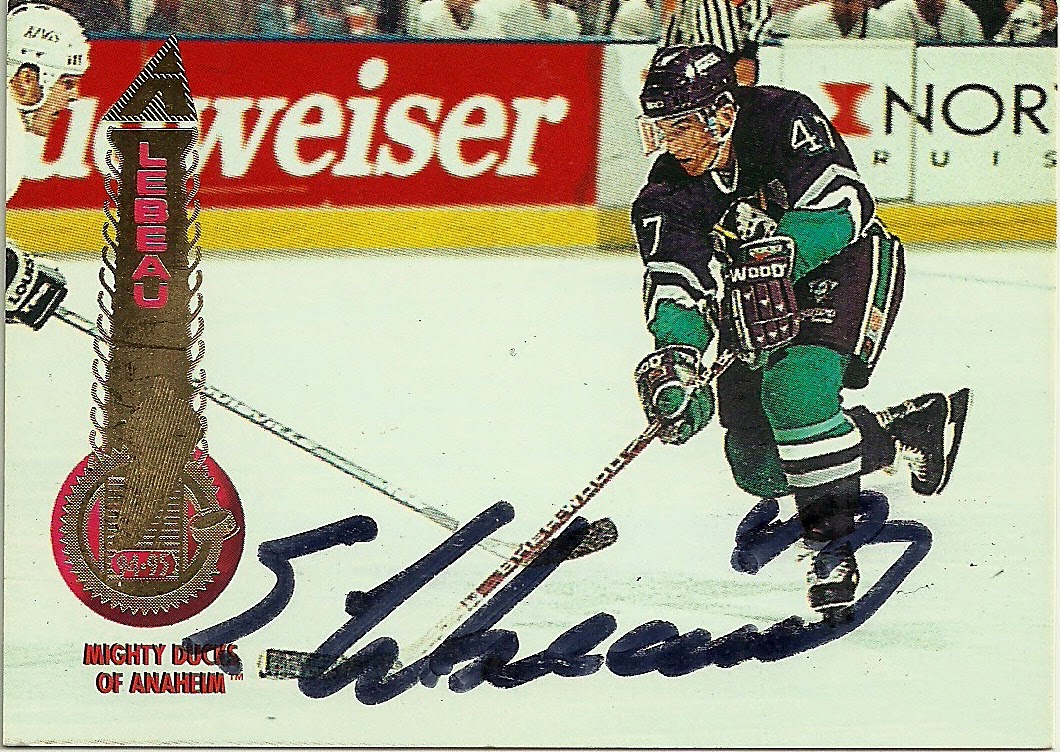
The next season started slower for most of the team, and Stéphan Lebeau was among those who paid for it, as he was traded mid-season to the Mighty Ducks Of Anaheim. Over two half-seasons in Anaheim - the second one due to the lock-out - Lebeau had 34 points in 60 games; to put it into context, his 16 assists in 1994-95 were second in team totals and his 24 points were good enough for third, despite having missed 10 games due to injury.

From that era, here is a beautiful 1994-95 Pinnacle card (#67 in the set) from Pinnacle Brands (notice how his skate bottoms are now black):
Teal and purple, so 1990s! I chose to feature Lebeau today because of this card: the Anaheim Ducks winning last night, and the Los Angeles Kings (notice the defender on the left of the card?) playing a team that is usually teal-coloured tonight (the San Jose Sharks).

Still, despite being one of the team leaders in Anaheim, the Mighty Ducks chose not to offer him a new contract, and he spent his final six years of pro hockey in the Swiss League, playing for three different teams for two seasons each, totaling 349 points (143 of them goals) in 222 games.

Upon retiring, he first moved back to Sherbrooke and became involved in minor hockey at Bishop's College (Midget AAA), until he was named an assistant coach with the AHL's Hamilton Bulldogs this year. My guess is he'll be the team's head coach before next Christmas.

I had sent him these 5 cards on April 3rd, 2014, care of the Bulldogs, and got them all back signed in black sharpie - with his jersey number (47) on the top-right of his autograph - 22 days later (April 25th, 2014), along with this note on one of the index cards I'd used to protect the cards:
It reads: ''Hello Sebastian, thanks for your comments, Stéphan''.